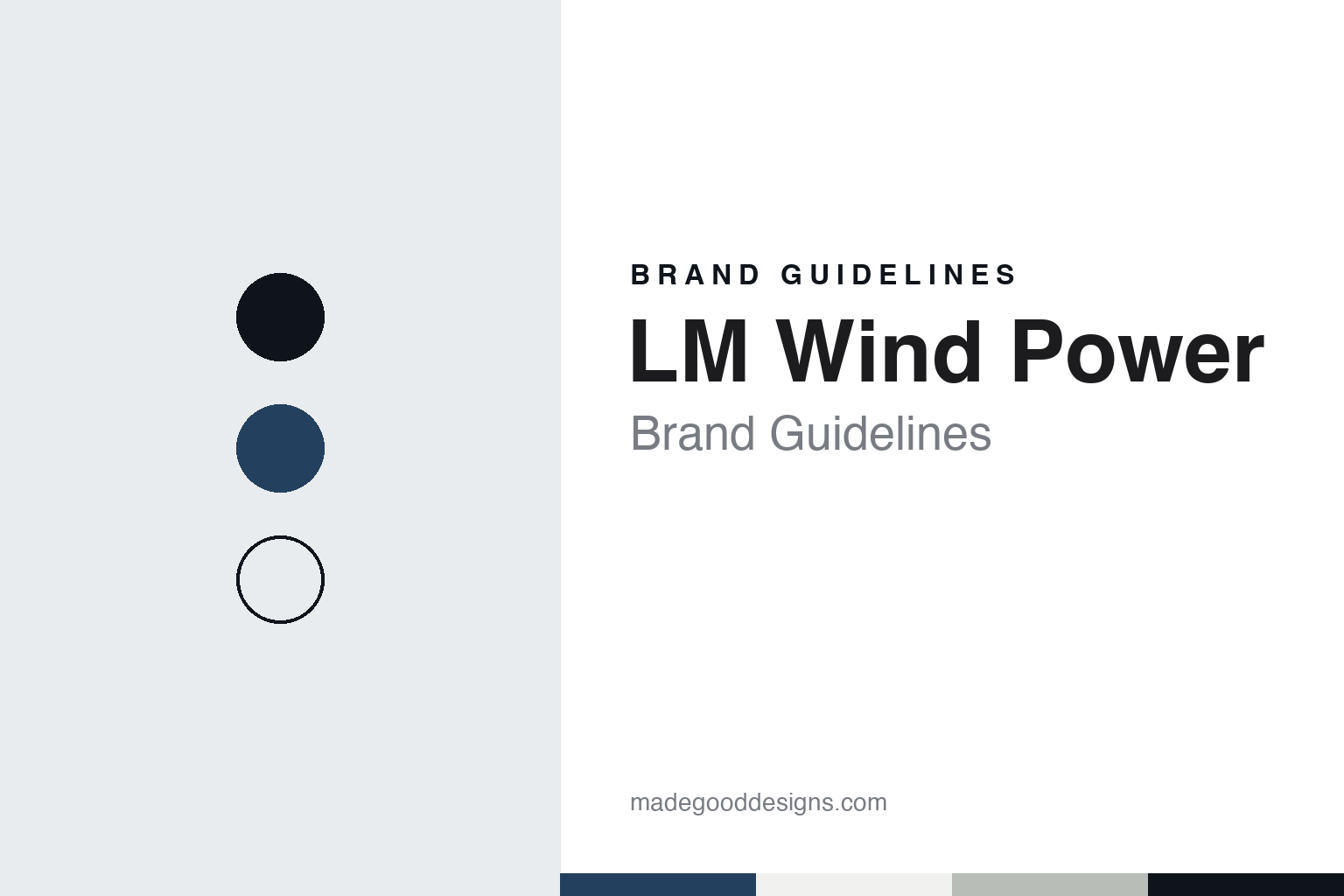
LM Wind Power Brand Guidelines
From a 1940 furniture factory to GE Vernova’s blades.
Aa
Two constants: a blue, grey and white palette and a Scandinavian sans register. Abstract homage — not an LM Wind Power product or mark; no blade, logo or nameplate is reproduced.
Lunderskov Møbelfabrik
A furniture workshop that found glass fibre.
LM Wind Power began as a furniture factory. Lunderskov Møbelfabrik was founded in 1940 by Ejner Lorentzen and Aage Skouboe in Lunderskov, a small town near Kolding in southern Jutland, Danish Wikipedia and the company’s heritage page agree. In 1952, English Wikipedia says, the firm began to study the commercial use of glass fibre, gave up its plan to make wooden furniture and took the name LM Glasfiber.
The company says it split in 1953 into LM Camping, run by Lorentzen, and LM Glasfiber, run by Skouboe, and that the two together built about 300 LM caravans with glass-fibre shells and wooden interiors. Danish Wikipedia dates the start of glass-fibre fish tanks and caravans to 1955. Glass-fibre fish boxes, the company says, let live fish travel by truck rather than in wooden barrels by train. Boats followed: the company dates its first speedboats to 1954 and its sailing boats to 1969, and says its LM 27 motor sailer was, in its day, the most-produced in Europe. English Wikipedia names the LM 24 among the yachts it built in the 1970s.
Wind came at the end of that decade. English and Danish Wikipedia date the start of blade production to 1978; the company says its first set of blades went to a Windmatic turbine in the Orkney Islands, off the north coast of Scotland. In 1985, Danish Wikipedia says, the business was restructured and the present limited company was formed.
Colour
Blades, and only blades.
LM Wind Power designs and makes rotor blades rather than whole turbines. It says it had made more than 275,000 blades since 1978 by the start of 2025, and that nearly one in five turbines worldwide carries its blades; those are company figures. Danish Wikipedia says the head office remains in Kolding, with production in Lunderskov and a development department in Copenhagen.
The company has long worked far beyond Denmark. At the end of 2014, English Wikipedia says, it ran production at 13 locations in eight countries, Denmark, Spain, the United States, Canada, India, China, Poland and Brazil, with research centres in Denmark, the Netherlands and India and an office in Amsterdam.
The blades are long, and moving them is part of the story. On 11 June 2010, English Wikipedia says, LM chartered the Antonov An-225 to fly two new 42-metre blades from its factory in Tianjin, China, to its test site in Lunderskov, setting a record for the longest single piece of air cargo. In April 2019 the company unveiled a 107-metre blade, the LM 107.0 P, for GE’s Haliade-X 12 MW offshore turbine; Energy Live News reported on 23 April 2019 that the firm called it the first wind turbine blade longer than 100 metres. The company says the blade won gold in the blades category of Windpower Monthly’s turbines of the year for 2019, and that its previous record blade, three years earlier, was 88.4 metres long.
Offshorewind.biz reported on 7 November 2019 that GE had formally opened the LM Wind Power blade factory in Cherbourg, France, where production had started early that year, with Haliade-X blades due for Ørsted’s Ocean Wind and Skipjack projects in the United States and the Dogger Bank project in the UK; the site was expected to grow from 260 employees to nearly 550, the report said. The company’s website also has sections on blade service, logistics, blade recycling and what it calls “zero waste blades.”
Typography
Towers, blades and nacelles.
Wind turbine makers sell machines that few people ever see up close, so the pictures they publish do much of the work of a brand. The most familiar image is the finished turbine: a white tower and three blades on a ridge, across farmland or in a line out at sea, often shot at dawn or against a clear sky. Onshore and offshore are presented as two different worlds, one of fields and hills, the other of open water and service vessels.
The second set of images is about scale and movement. Makers like to show a single blade strapped to a long trailer on a country road, or rows of blades, towers and nacelles waiting on the quay of a port before being loaded onto ships. Port hubs and installation vessels have become a picture in their own right as offshore wind has grown.
Inside the factory, the pictures turn to process: nacelles lined up in high, bright halls, generators and hubs on assembly stands, and blade moulds the length of the building, with workers in overalls and helmets for scale. Service teams make up the last familiar scene, technicians clipped on at the top of a nacelle with the landscape far below, or descending a blade on ropes.
Behind the images is a heavy industry with a small number of large makers. BloombergNEF reported that 169 gigawatts of wind capacity were added worldwide in 2025, about 95 per cent of it onshore, and that Chinese makers took the top six places in its supplier ranking for the first time. This guide sets out what can be checked about each brand — who founded it, who owns it and where it says its turbines, blades and towers are made — and marks clearly what rests only on the company’s own word.
Aa
A Scandinavian sans for a quiet engineering register. (Specimen set in Barlow, a sans STAND-IN; NOT the LM Wind Power logo.)
LM Wind Power
From private equity to GE Vernova.
From 2001 to 2017, English Wikipedia says, LM’s main owners were investment partnerships organised by the London private-equity firm Doughty Hanson. The company changed its name from LM Glasfiber to LM Wind Power in 2010, keeping its initials as a tribute to its past, it says; the company adds that a global expansion of its factories followed the arrival of Doughty Hanson soon after 2000.
In October 2016 GE agreed to buy the company from Doughty Hanson, and on 20 April 2017 it announced that the deal was complete after regulatory approval in the European Union, the United States, China and Brazil. GE’s release said LM Wind Power would be run as an individual operating unit within GE Renewable Energy, supplying blades for GE’s onshore and offshore turbines while continuing to supply the rest of the wind industry, with safeguards for customers’ confidential data. In the same release, LM’s chief executive pointed to the company’s long partnership with GE, including the first offshore wind farm installed in the United States. LM Wind Power’s website now describes it as part of GE Vernova, with its headquarters in Kolding.
For a design guide, LM Wind Power shows how a supplier of a single component can keep its own name inside other companies’ machines, and how initials can outlast the furniture they first stood for. Compare GE Vernova, its owner, and TPI Composites, another maker of wind turbine blades. For this guide we use a fjord blue, a gelcoat grey and off-white with a sans, an unofficial interpretation; no product or logo is reproduced.
Explore & save
Keep LM Wind Power’s identity on hand — save it to a board in the Made Good inspiration library.
LM Wind Power identity set
Pin the LM Wind Power blue, grey and white palette and the Scandinavian sans register to your own board.