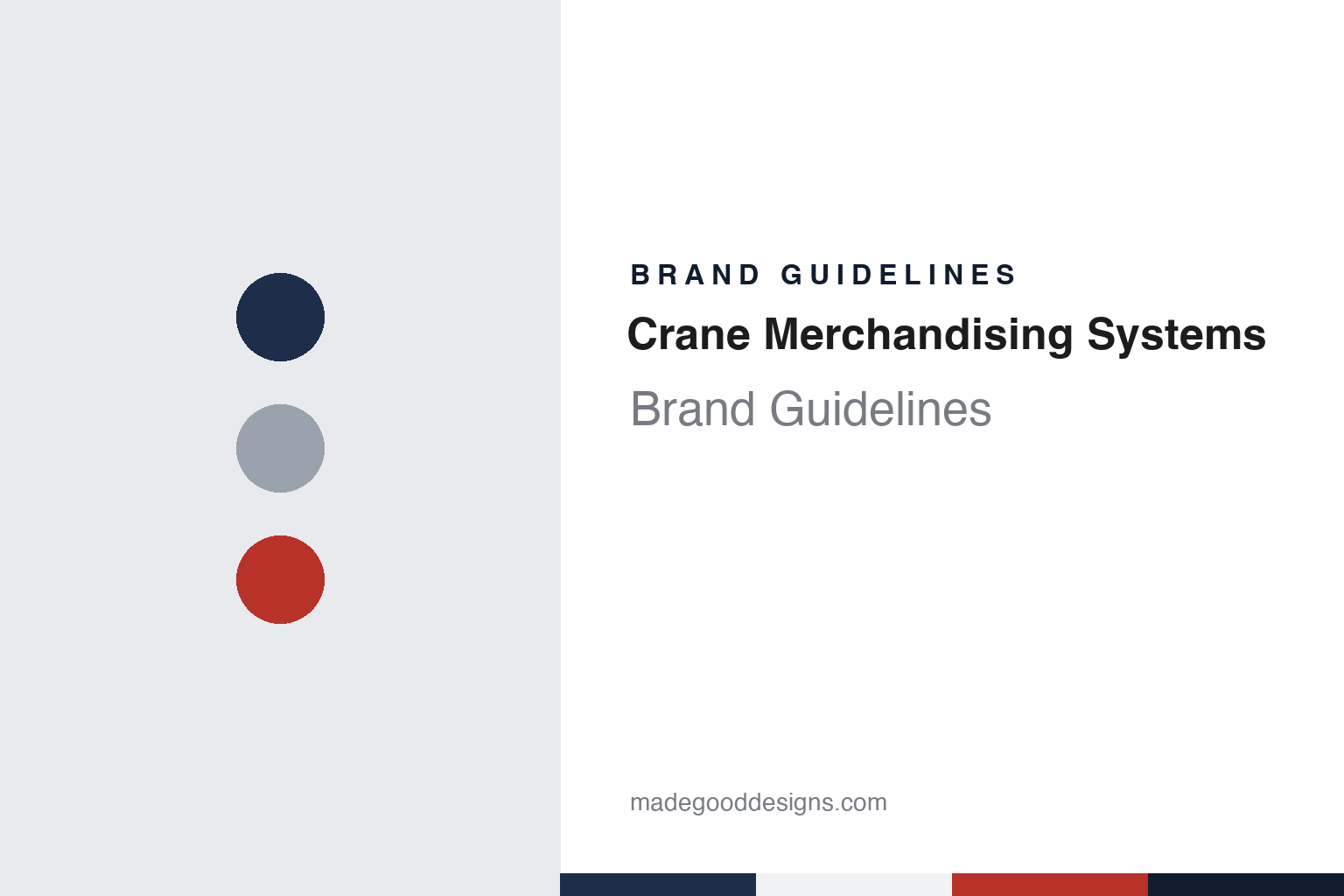
Crane Merchandising Systems Brand Guidelines
The St. Louis vending line that became Crane Convenience.
Aa
Two constants: a Crane navy, grey and red palette and a Grotesque sans register. Abstract homage — not a Crane product or mark; no machine, logo or nameplate is reproduced.
National Vendors
A coin mechanism in St. Louis.
Crane Merchandising Systems was the vending-machine business of the American industrial group Crane Co., and its roots run back to St. Louis in the 1920s. English Wikipedia says it began in 1926 as the National Sales Machine Company, set up by the St. Louis businessman B. E. Fry, who devised a machine that would accept only coins, unlike earlier machines such as the “Smoketeria” cigarette vendor, which could be worked with flat buttons or cardboard discs.
The Depression interrupted it. By 1931 the company was making machines for a range of food products, but it went under in 1932, Wikipedia says, and in the spring of 1933 Fry’s son, B. W. Fry, reopened it as National Vendors, Inc.; Al Diederich joined him in 1934 and gave the firm the administrative strength it needed through the 1930s and 1940s. During the Second World War, National Vendors took part in the war effort by making mortar ammunition casings, then returned to cigarette, candy and pastry machines.
Ownership changed twice in the next three decades. In 1956 the business was bought by the Universal Match Company, which let it introduce new products, and in 1967 it launched its first full line of automatic merchandising equipment. Crane Co., founded in Chicago in 1855 by Richard Teller Crane and long known to the public mainly for its bathroom fixtures, bought it in 1985, and it became Crane National Vendors, Wikipedia says. The company’s own timeline also names Dixie-Narco, Glasco and Polyvend among the vending businesses that joined Crane over the years.
Colour
Dixie-Narco and the Williston plant.
The largest of those additions was Dixie-Narco, a maker of cold-drink machines. In 1989 Dixie-Narco moved its production from Ranson, West Virginia, to a former Admiral freezer factory in Williston, South Carolina, and in 1997 it bought the assets of ECC Vending, the Glass Front Vender business; Crane acquired Dixie-Narco in 2007, the South Carolina broadcaster WMBF News reported in March 2009. In that report, Crane announced that it would consolidate its North American vending operations into the Dixie-Narco plant at Williston, in Barnwell County, with hiring expected to begin within 14 months.
For years Crane sold machines under several legacy names. In 2017, English Wikipedia says, it retired its National, Dixie-Narco, GPL and Automatic Products brands in favour of the single Crane Merchandising Systems name for all its products; the company’s own timeline places the retirements between 2014 and 2017. Its product names carried on: the BevMax cold-drink machines and the Merchant snack and combination machines, now offered in MEDIA2 versions, and coffee machines called CALI and COTI. In 2020 the company described its MEDIA platform as pairing interactive touch-screen displays with merchandising techniques.
The COTI came from Europe. A Crane Payment Innovations release reported by Vending Market Watch in October 2020 said the freestanding coffee machine had launched in Europe in 2015, had been named “Machine of the Year” at the 2017 European Vending Association conference, and was the first product released in North America after the merger of the two Crane businesses. The company also offers its own vending software, including VendMax, and keeps separate technical libraries for North America and for the UK and EMEA.
Typography
Design and documentation.
Vending machine makers sell to operators, not to the people who buy a coffee or a chocolate bar, so they present themselves in two registers at once. To operators they talk about capacity, reliability, telemetry and ease of refilling; to the public their machines must look inviting on a station concourse, in a university corridor or beside an office kitchen. The glass-front snack machine, with its spiral shelves in view, and the coffee machine with a large lit selection panel are the two faces most people know.
The front panel has become the main design surface. Makers fit touchscreens, illuminated buttons and printed or backlit graphics, and many machines are co-branded with a coffee roaster or a drinks company, so the maker’s own name often sits small on the cabinet. Cashless readers for cards and phones now sit beside, or in place of, the coin slot, and some makers build their own payment and remote-management systems alongside the machines.
Behind the cabinet is an industrial story. Makers’ own websites and brochures tend to show factory lines, sheet-metal cabinets and spare-parts services. Several of the makers in this guide are based in northern Italy and two in Peralta, in Navarre, and some have passed through mergers and private-equity ownership.
The trade meets at fairs such as EU’Vend in Cologne and Venditalia in Milan, where makers launch new ranges to operators and distributors. This guide sets out what can be checked about each brand — who founded it, who owns it, and where it says its machines are made — and marks clearly what rests only on the company’s own word.
Aa
A grotesque sans — one master name in place of four. (Specimen set in Archivo, a sans STAND-IN; NOT the Crane logo.)
Crane Merchandising Systems
Merged in 2020, renamed in 2026.
The 2020 merger ended Crane Merchandising Systems as a separate company. On 23 June 2020, according to a release from Malvern, Pennsylvania, reported by Vending Market Watch and Vending Times, it merged into Crane Payment Innovations (CPI), Crane’s maker of banknote and coin validators, cashless payment, cash-processing systems and asset-management software, so that operators would deal with a single point of contact. In 2023 Crane Holdings separated into two publicly traded companies, and CPI, together with Crane Currency, became part of Crane NXT, according to English Wikipedia and the company’s own history. Crane Currency, the banknote maker, was a similarly named but unrelated company that Crane Co. had bought in 2017, Wikipedia notes, and the encyclopedia adds that Crane Co. has since divested both of the businesses the public knew it for, bathroom fixtures and vending machines. CPI, now under Crane NXT, says it serves more than 100 countries with one of the world’s largest installed bases of payment systems.
The name changed again in 2026. In January, Vending Market Watch reported that CPI had renamed its vending business Crane Convenience, bringing together decades of work under legacy names including Dixie-Narco, National Vendors and Crane Merchandising Systems, with CPI remaining the parent company. The company says Crane Convenience is “not a new company” but a sub-brand under CPI, and its website describes it as “formerly known as Crane Merchandising Systems,” with more than 90 years of experience behind it.
For a design guide, Crane Merchandising Systems shows how a group can fold several historic vending names into one master brand, and then rename that brand again. Compare Royal Vendors and Vendo, two more vending-machine makers in this series. For this guide we use a deep navy, a cabinet grey and a signal red with a sans, an unofficial interpretation; no product or logo is reproduced.
Explore & save
Keep Crane Merchandising Systems’s identity on hand — save it to a board in the Made Good inspiration library.
Crane Merchandising Systems identity set
Pin the Crane navy, grey and red palette and the Grotesque sans register to your own board.