MacGregor Brand Guidelines
The hatch-cover pioneer that grew into a maker of cargo and load-handling equipment.
Aa
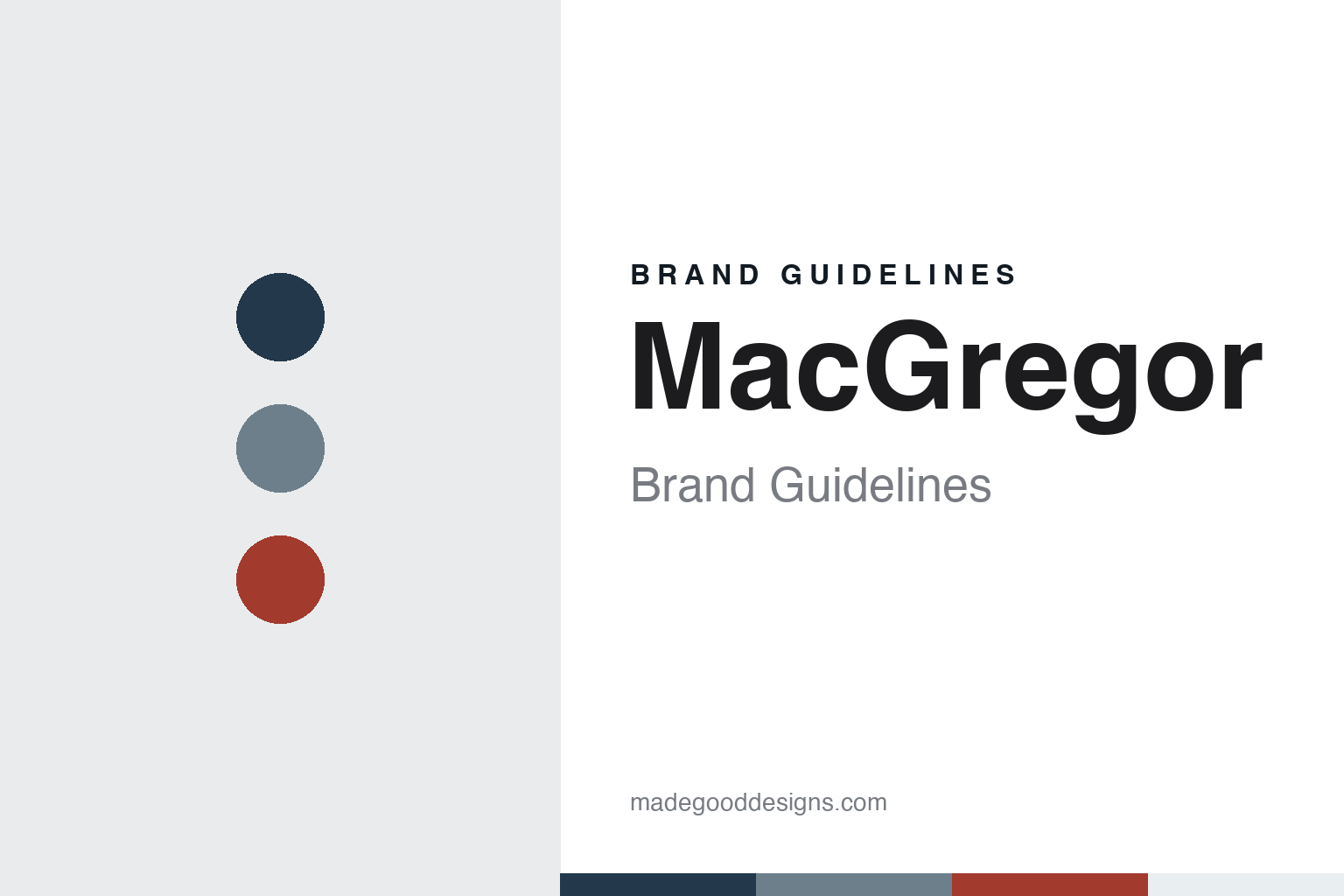
Two constants: a slate, steel and deck-oxide palette and a shipyard serif register. Abstract homage — not a MacGregor product or mark; no equipment, logo or nameplate is reproduced.
The hatch cover
Two engineer brothers and five folding leaves.
MacGregor’s story starts with a piece of ship’s equipment rather than a company. In the 1920s two engineer brothers, Robert and Joseph MacGregor, developed the first steel hatch cover for North Sea coal ships; they patented the design in 1929, The Maritime Executive reported in 2024. The company describes the design as “deceptively simple”: five articulated leaves that folded and stowed at the end of each hatch, and it places the brothers’ first work in Newcastle upon Tyne. In a 2017 article it said the brothers had blamed losses at sea on ineffective wooden hatch covers.
In 1937, to promote and sell the covers, the brothers formed MacGregor & Company in Whitley Bay, on the north-east coast of England, which the company calls “the actual beginning of the MacGregor story.” Marking its eightieth year, the company added that persuading shipbuilders and owners to give up the tried and tested wooden covers proved surprisingly difficult at first.
Later the business became part of a series of larger groups. In 1983, the company says, MacGregor merged with the Finnish firm Navire to form MacGregor-Navire, owned by the Finnish engineering group KONE. In 1992 it bought the container-lashing maker Conver-OSR. In 1993 the Swedish investment company Incentive acquired MacGregor-Navire from KONE and merged it with Hägglunds Marine, the Swedish crane maker, and in 1998 most of the business was sold to the private-equity firm Industri Kapital.
Colour
Hatch covers, cranes, lashings and offshore gear.
The longest chapter began in 2005, when the Finnish group Cargotec bought MacGregor to strengthen its cargo-handling business; the same year it added the Swedish lashing specialist Allset Marine Lashing, the company says. Under Cargotec, MacGregor grew largely by acquisition. In 2007 it bought the Norwegian offshore and subsea load-handling maker Hydramarine and Plimsoll Corporation of Singapore, a supplier of deck machinery for offshore operators.
In 2013 it bought the mooring and loading systems unit of Aker Solutions, bringing in Pusnes mooring and deck equipment and Porsgrunn steering gear, two Norwegian names the company traces to the nineteenth century; it tells the story of Roald Amundsen asking Pusnes, in 1911, for an anchor winch for his polar ship Fram. Later deals added the software company Interschalt, the fishery and research-vessel specialist Rapp Marine, completed in early 2018, and the marine and offshore businesses of TTS Group, completed in July 2019. In 2021 MacGregor set up a joint venture in China with CSSC Nanjing Luzhou Machine for certain cargo cranes, winches and steering gear.
The resulting range is broad. The Maritime Executive described MacGregor in 2024 as serving merchant ships from cargo to passenger and Ro-Ro vessels, as well as offshore operators and ports and terminals, with a large refurbishment business. The company groups its products under merchant, offshore, naval and port headings: cargo cranes, folding, side-rolling and lift-away hatch covers, container stowage and lashing systems, deck machinery and steering gear, RoRo equipment, offshore cranes with motion compensation, bow-loading systems and gangways, and port cranes for bulk, containers and heavy lifts.
Some products carry names of their own. On its website the company lists the MacPiler electric gantry crane, the Horizon gangway for walk-to-work transfers offshore, the Colibri 3D motion-compensated crane and the GravityVibe self-unloading system. It also lists a transfer system for liquefied carbon dioxide among its offshore loading products, alongside bow-loading and offloading systems for tankers.
Typography
Design and documentation.
Port and terminal equipment is sold to a small, specialist audience: port authorities, terminal operators, shipping lines and the logistics firms that move containers inland. The makers’ own websites and brochures tend to show the machines at work rather than on their own, because scale is the point. A ship-to-shore crane is pictured with its boom reaching out over the stacked deck of a container ship; a gantry is shown against the quay it serves.
The smaller machines are presented in the same working settings. Straddle carriers appear in long rows between container stacks, reachstackers lift boxes at the edge of a yard, and terminal tractors pull trailers and chassis between the quay and the gate. Forklift trucks and empty-container handlers are photographed in timber yards, steel mills and inland depots as well as in ports, since the same makers sell to heavy industry and distribution.
Automation has added a second kind of picture. Alongside the machines, the pictures now include control rooms and screens, and a maker such as Kalmar lists automation systems and charging solutions as products in their own right. Kalmar says the first fully automated straddle-carrier terminal opened in Brisbane in 2005, and ZPMC lists automated terminals in Xiamen and Shanghai among its projects.
Delivery is part of the story too. Large cranes are often moved fully assembled by sea: ZPMC says its own fleet carries large products whole, and English Wikipedia says it ships cranes in a fully erected state, so a crane standing upright on a heavy-lift vessel is a familiar image in the trade. The guides in this group follow makers across Finland, Sweden, the Netherlands, Germany, France, the United States and China, and set out what each company says about itself alongside what independent sources record.
Aa
A sturdy serif with the feel of a shipyard drawing office. (Specimen set in IBM Plex Serif, a serif STAND-IN; NOT the MacGregor logo.)
Triton’s MacGregor
The last piece of Cargotec to leave.
MacGregor was the last major business to leave Cargotec as that group split itself up. According to The Maritime Executive, Cargotec decided in 2022 to sell MacGregor, launched the sale process in May 2024 and on 14 November 2024 signed an agreement to sell it to funds managed by Triton, a European mid-market investor — the final step in a separation that had already seen the port-equipment maker Kalmar demerged as a standalone company in June 2024.
The sale closed on 31 July 2025. MarineLink reported on 1 August 2025 that Triton had completed the acquisition from Hiab — the name Cargotec had taken for its one remaining business — and quoted chief executive Jonas Gustavsson on the company’s lifecycle-focused strategy and Triton’s board member on plans to strengthen its aftermarket and service platform. Under the new owner, the magazine reported, MacGregor would continue to serve its maritime and offshore customers with the same broad portfolio of cargo and load-handling equipment. MacGregor says that since August 2025 it has operated as a standalone company under Triton’s ownership, headquartered in Gothenburg, Sweden.
The MacGregor name has stayed in use through every change of owner since 1983, and the company still opens its history page with the 1929 hatch cover.
For a design guide, MacGregor shows how a single invention can anchor a brand through decades of mergers and changes of owner. Compare Cargotec (now Hiab), its owner from 2005 to 2025, and Kalmar, its former sister company. For this guide we use a deep slate blue, a steel grey and a muted oxide red with a serif, an unofficial interpretation; no product or logo is reproduced.
Explore & save
Keep MacGregor’s identity on hand — save it to a board in the Made Good inspiration library.
MacGregor identity set
Pin the MacGregor slate, steel and deck-oxide palette and the shipyard serif register to your own board.