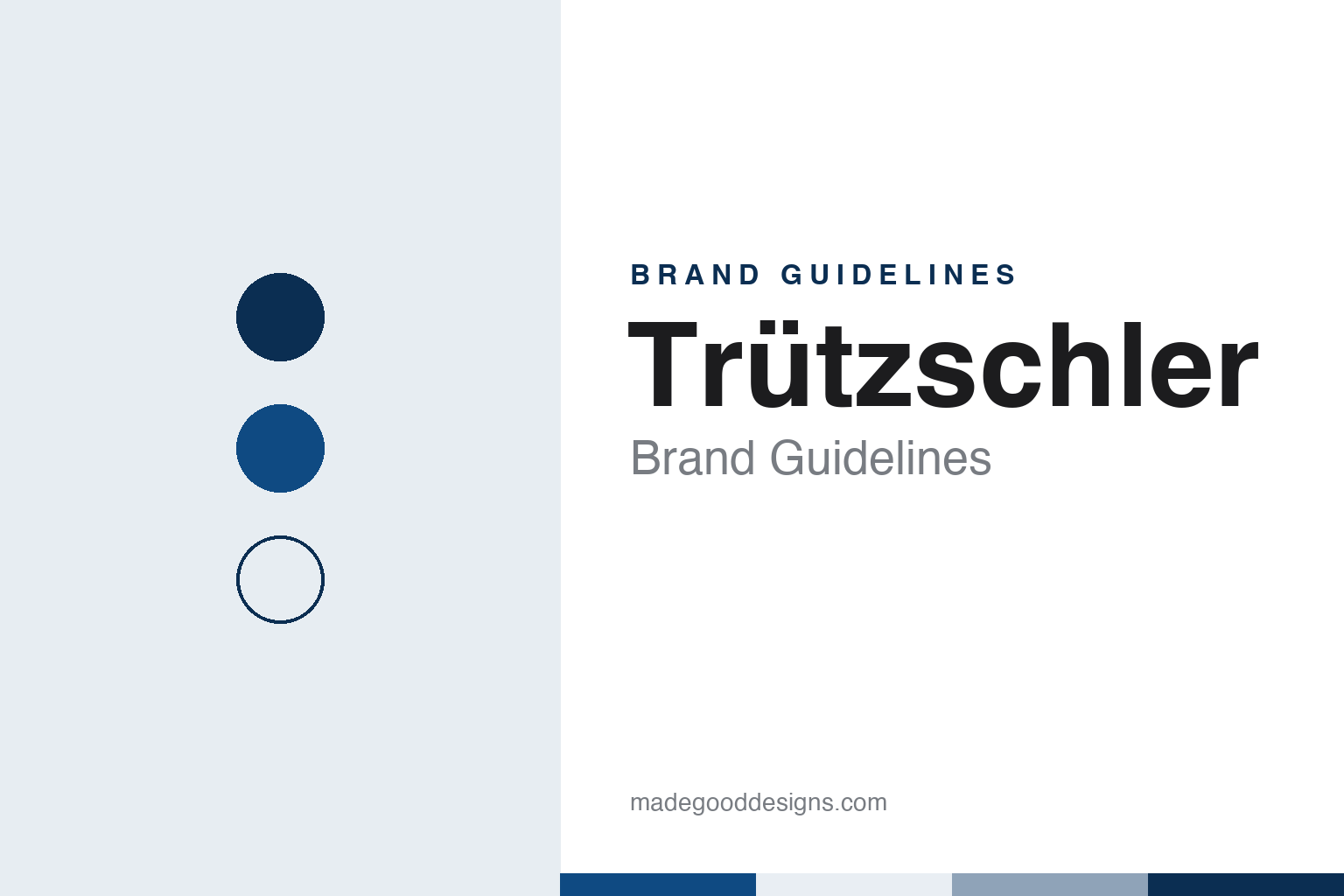
Trützschler Brand Guidelines
A Saxon forge, expropriated in 1948 and rebuilt in the Rhineland.
Aa
Two constants: a Trützschler blue and raw cotton palette and an Engineered sans register. Abstract homage — not a Trützschler product or mark; no machine, logo or nameplate is reproduced.
Crimmitschau
A registered trade, then a second start.
Trützschler dates itself to a single day. On 1 August 1888, the company’s history says, Paul Heinrich Trützschler registered a trade in mechanics and forging in Crimmitschau, in Saxony. Around 1899–1900 Bruno Gey joined as a partner and the firm became Paul Trützschler und Gey, a partnership that lasted until 1905, by the company’s account; the German business directory wer-zu-wem instead names Trützschler and Gey together as the founders in 1888.
Its first machines were tearing machines and carding willows, which open up fibre before spinning. From 1902 the range grew to take in cleaning and dust-removal systems for cotton, and the firm began to look for customers abroad. Sons followed the founder into the business: Willi and Bruno in 1913, Karl in 1920, when Paul Heinrich retired.
The second start came in 1948. The Saxon company, by then in the Soviet occupation zone, was expropriated. With a partner, Curt Müllges, Hans and Hermann Trützschler, sons of Willi and Karl, re-established the business at Odenkirchen, now part of Mönchengladbach. German Wikipedia, citing the Rheinische Post, gives the same sequence. Mönchengladbach is the group’s headquarters today.
Colour
From the card to the complete line.
In the Rhineland the company moved into carding. At ITMA Basel in 1967 it showed its first card, the DK. A card is the machine that combs loose fibres into a soft rope called sliver. German Wikipedia dates the other main additions: draw frames in 1992, the year the company’s history records its takeover of the Zinser draw frame, and combing in 2012, when Trützschler and Toyota presented a jointly developed comber at Shanghaitex. From November 2017, the company says, it took over full responsibility for combing from Toyota, from development to spare parts.
Card clothing, the fine toothed wire that covers a card’s rollers, followed in 2003, when Trützschler took over the non-American activities of John D. Hollingsworth and set up Trützschler Card Clothing at Neubulach in the Black Forest. It bought the American assets in 2009.
Nonwovens came through acquisition. Trützschler took a share in Erko of Dülmen in 2005, and in November 2006 Textile World reported that it had bought Fleissner from the Frankfurt engineering group Zimmer AG, which had acquired that once family-owned firm in 2003. Fleissner was older than Trützschler itself: Textile Network traced it in 2016 to a forge leased by Johann Christian Fleissner in Asch, Bohemia, in 1848, and said it moved to Egelsbach, near Frankfurt, after the Second World War. Its best-known product, the same article said, was the AquaJet, which bonds a web of fibres with high-pressure water jets; the company dates the AquaJet’s story to 1995 and records the 100th unit built at Egelsbach in 2013. Erko and Fleissner were folded into Trützschler Nonwovens in 2010, and the Bastian winder range joined in 2012. By 2008 Textile World was describing a group that could supply complete nonwoven lines.
The current card is the TC 30i, which was unveiled at ITMA 2023 in Milan and released for sale in January 2024, according to a company statement carried by Textile World, with a version for recycled fibres. In October 2026 the company listed the TC 30, the T-CAN automated can transport, STEELTOP flat tops and an air-through-bonding oven among its exhibits for ITMA Asia in Shanghai, on 20–24 November.
Typography
Design and documentation.
Textile machinery is sold through scale. A spinning frame can run the length of a mill hall, so makers often photograph it from one end, with spindles and yarn packages receding in a long line. Looms are shown mid-beat, with the rapier or the reed caught in motion. The pictures are less about a single object than about a repeated one, thousands of identical parts working in rows.
The opposite view is the close-up. Catalogues and websites in this trade move in tightly on needles, yarn guides, rings and travellers, because the product’s precision is hard to see from across a hall. Cones of coloured yarn supply the colour that grey and white machine casings lack, and flat-knitted sample panels show what a machine’s pattern work can do. 3D-knitted shoes and technical fabrics do the same for newer markets.
Software has joined the picture. Control touchscreens, status lights and mill-monitoring dashboards now appear next to the steel, as makers present automation and digital services alongside the machine. Saurer, for one, promotes LED operator guidance on its Autocoro 11 rotor machine.
The trade meets at its fairs, and these set much of the calendar for launches and imagery. ITMA, ITMA Asia, Techtextil and ShanghaiTex are the names that recur in these companies’ news pages, and a stand there works much as a catalogue does, with working machines, sample walls and yarn displays. Few makers in this guide publish a brand rulebook. Their identities show up instead in a company name carried over many decades, in product family names, and in how they picture the machine.
Aa
An engineered sans for a family of numbered machines. (Specimen set in Archivo, a sans STAND-IN; NOT the Trützschler logo.)
Trützschler
Five generations, nine plants.
Ownership has stayed where it began. Textile Network called Trützschler a family-owned group in 2016, and the company says that it remained with the family when Trützschler GmbH & Co. KG was merged into Trützschler Group SE in 2021, naming the shareholders as the Hans and Hermann Trützschler families. The fourth generation, Heinrich Trützschler and Michael Schürenkrämer, joined the management in 1990 and moved to a new supervisory board in 2018. In January 2025 two members of the fifth generation of shareholders, Charlotte Fontaine and Florian Schürenkrämer, took over from them as delegated spokespeople and supervisory board members, the company says. It also set up the Trützschler Foundation in 2021, for learning, sport and science among young people.
On manufacturing the company is specific. It says its machines are developed and produced at nine locations: four in Germany, at Mönchengladbach, Dülmen, Egelsbach and Neubulach, two in China, at Shanghai and Jiaxing, and one each at Sanand in India, Charlotte in the United States and Curitiba in Brazil. The American company dates from 1969, the Brazilian from 1975 and the Indian venture, Trumac, from 1977. German Wikipedia gave a workforce of about 3,000 in 2021; Textile World put it at some 2,200 in 2006.
The one identity decision the company records concerns the machines. At ITMA 2003, its history says, Trützschler machines appeared for the first time in a “friendlier colour design.” The name itself travels in two spellings. German keeps the umlaut, while the website, truetzschler.com, and the American company, American Truetzschler, write it out as “ue.”
For a design guide, Trützschler shows how a family company can carry one name through an expropriation, a change of region and several absorbed brands. Compare Rieter, another maker of spinning machinery, and Monforts, a finishing-machinery name from the same city. For this guide we use a card blue and a raw cotton with a sans, an unofficial interpretation; no product or logo is reproduced.
Explore & save
Keep Trützschler’s identity on hand — save it to a board in the Made Good inspiration library.
Trützschler identity set
Pin the Trützschler blue and raw cotton palette and the Engineered sans register to your own board.