Lakshmi Machine Works Brand Guidelines
Coimbatore’s 1962 spinning-machine maker, now LMW.
Aa
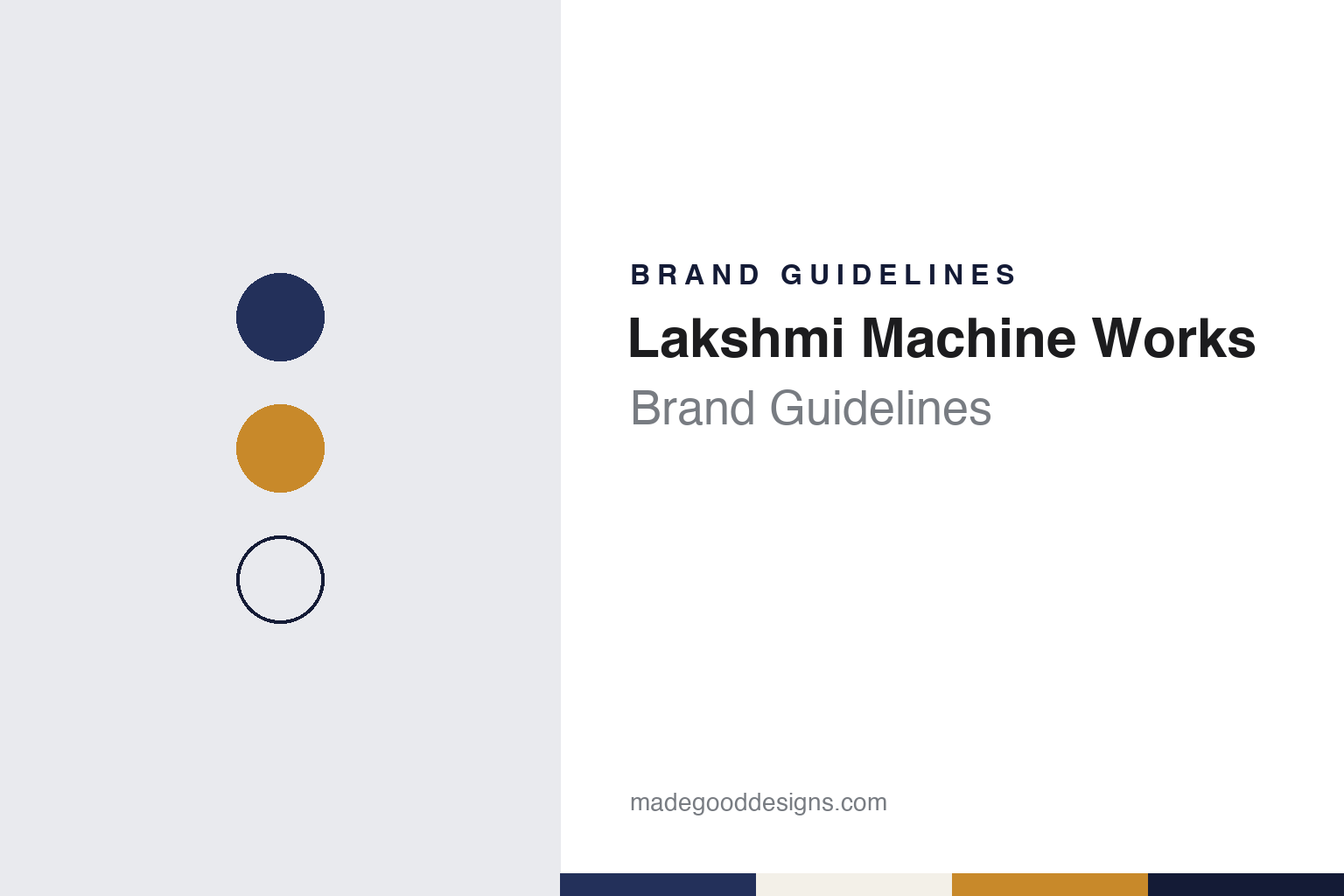
Two constants: an LMW indigo, cotton and turmeric palette and a Workshop sans register. Abstract homage — not an LMW product or mark; no machine, logo or nameplate is reproduced.
From a mill family to machine building
Spinning machines for Indian mills.
LMW grew out of a Coimbatore textile family rather than an engineering firm. English Wikipedia’s article on Lakshmi Mills says that mill was founded in 1910 by G. Kuppuswamy Naidu to make cotton yarn and cloth, and that its promoters went on to start several textile machinery companies, among them LMW, Lakshmi Automatic Looms, Lakshmi Card Clothing and Lakshmi Ring Travellers. The same article names G. K. Devarajulu, then a managing director of the mill, as the founder of LMW.
The machine works itself dates from 1962. The company says it was founded that year to give Indian textile mills the latest spinning technology, and its registered office is at Perianaickenpalayam in Coimbatore. In a 2023 interview with Machine Insider, K. Soundhar Rajhan, who joined LMW as a management trainee in 1971 and was by then its chief strategy officer, said Devarajulu set out to equip Indian industry with advanced machines in partnership with the Swiss maker Rieter, securing the licences needed to bring the technology to India. He tied that aim to self-reliance, at a time when India had few textile machinery makers.
The company’s own milestones trace how the range was filled in, one machine at a time. Its first textile machinery unit was commissioned in 1965. The first draw frames and speed frames followed in 1966, the first ring frame, the DJ5, in 1968, and the first comber, the LE7/4, in 1972. In 1977 LMW made its first card, the C1/2, and began shipping abroad, and from 1978, the company says, it could supply a complete spinning system. A second textile machinery unit opened in 1983, and rotor spinning machines followed in 1984 with the LM1/2.
Colour
A partner, then a parent.
The Rieter relationship took a formal shape in 1994, when the two firms set up Rieter-LMW Machinery in Coimbatore as a 50:50 joint venture, according to a Rieter press release of April 1, 2011. That release announced the end of the arrangement. Rieter had signed a contract that day to sell all its shares in the joint venture to Lakshmi Machine Works, which would keep production at the same Coimbatore site with its workforce of some 450 people; closing was expected in August 2011. Rieter said it had also reduced its shareholding in Lakshmi Machine Works by taking part in a share buy-back, and that it would focus on its own new plant at Wing in Maharashtra. LMW’s milestones list the acquisition under 2011.
By then LMW had spread beyond textiles. Machine Insider said in 2023 that it moved into machine tools in 1988, and Rajhan said that D. Jayavarthanavelu, Devarajulu’s son and later chairman and managing director, chose to start directly with CNC machines rather than conventional ones, in partnership with Mori Seiki. Rajhan said LMW now builds vertical machining centres for DMG MORI. He put about half of the machine tool business in the automotive sector, for parts such as gearboxes, steering systems and differentials. The company’s site lists a range of CNC lathes and machining centres, alongside a foundry division that makes precision castings for equipment makers.
The textile business also went abroad. The company dates a wholly owned step-down subsidiary in Suzhou, China, to 2008; Rajhan said he moved to China in 2009 to set up and run that greenfield plant for spinning machinery. A second subsidiary, LMW Global FZE in Dubai’s Jebel Ali free zone, followed in 2022. In 2015, the company says, it became the second-largest supplier of ring spinning machines in China. In 2023 Machine Insider described LMW as serving customers in 63 countries, with seven factories in India and two elsewhere.
Typography
Machines shown at scale.
Textile machinery is sold through scale. A spinning frame can run the length of a mill hall, so makers often photograph it from one end, with spindles and yarn packages receding in a long line. Looms are shown mid-beat, with the rapier or the reed caught in motion. The pictures are less about a single object than about a repeated one, thousands of identical parts working in rows.
The opposite view is the close-up. Catalogues and websites in this trade move in tightly on needles, yarn guides, rings and travellers, because the product’s precision is hard to see from across a hall. Cones of coloured yarn supply the colour that grey and white machine casings lack, and flat-knitted sample panels show what a machine’s pattern work can do. 3D-knitted shoes and technical fabrics do the same for newer markets.
Software has joined the picture. Control touchscreens, status lights and mill-monitoring dashboards now appear next to the steel, as makers present automation and digital services alongside the machine. Saurer, for one, promotes LED operator guidance on its Autocoro 11 rotor machine.
The trade meets at its fairs, and these set much of the calendar for launches and imagery. ITMA, ITMA Asia, Techtextil and ShanghaiTex are the names that recur in these companies’ news pages, and a stand there works much as a catalogue does, with working machines, sample walls and yarn displays. Few makers in this guide publish a brand rulebook. Their identities show up instead in a company name carried over many decades, in product family names, and in how they picture the machine.
Aa
A workshop sans for a catalogue of model codes. (Specimen set in Archivo, a sans STAND-IN; NOT the LMW logo.)
LMW
Three letters over a family name.
The company name has now caught up with its abbreviation. The change from Lakshmi Machine Works Limited to LMW Limited took effect on September 25, 2024, Capital Market reported that day. The company’s websites still add “formerly Lakshmi Machine Works Limited” after the new name, and its divisions run their own web addresses under the LMW prefix, for textile machinery, CNC machines and the foundry. Rajhan named Sanjay Jayavarthanavelu as chairman and managing director in 2023.
LMW describes its textile range by process, from blow room to winder. Its Textile Machinery Division sorts the machines into card sliver, combed sliver, spun yarn and post-spinning systems: cards such as the LC9S, which the company says has a 1.28-metre working width; the LK69 comber; the LRJ9 and LR90 ring frames; and the LW60 winder, launched in 2025. Most model codes begin with L, from the LC cards to the LW60. Spinpact, a suction compact system, sits alongside components such as spindles, rings, top rollers and flyers. The company calls itself the largest maker of spinning machinery in India and one of three companies in the world to make the entire range of spinning machinery; Machine Insider repeated that framing in 2023, naming Rieter among the others. LMW also says more than 50 million spindles of its machinery are installed worldwide.
The company shows its machines on the Asian trade-fair circuit. It exhibited at ITMA Asia + CITME in Shanghai in 2024 and at the Singapore Expo from October 28 to 31, 2025, and at CAITME 2024 in Tashkent, Uzbekistan. A post on its textile site in January 2026 presents RESPIN as a route from waste to value in spinning. Expansion continues at home. On October 21, 2026 the board approved a third unit for the machine tool division at Sangothipalayam in Coimbatore district, which Equity Bulls reported was meant to shorten delivery lead times.
For a design guide, LMW shows how a family-founded engineering company can move from a full name to its initials. Compare Rieter, its former joint-venture partner, and DMG MORI, for which it builds machining centres. For this guide we use an indigo, a cotton white and a turmeric with a sans, an unofficial interpretation; no product or logo is reproduced.
Explore & save
Keep Lakshmi Machine Works’s identity on hand — save it to a board in the Made Good inspiration library.
LMW identity set
Pin the LMW indigo, cotton and turmeric palette and the Workshop sans register to your own board.