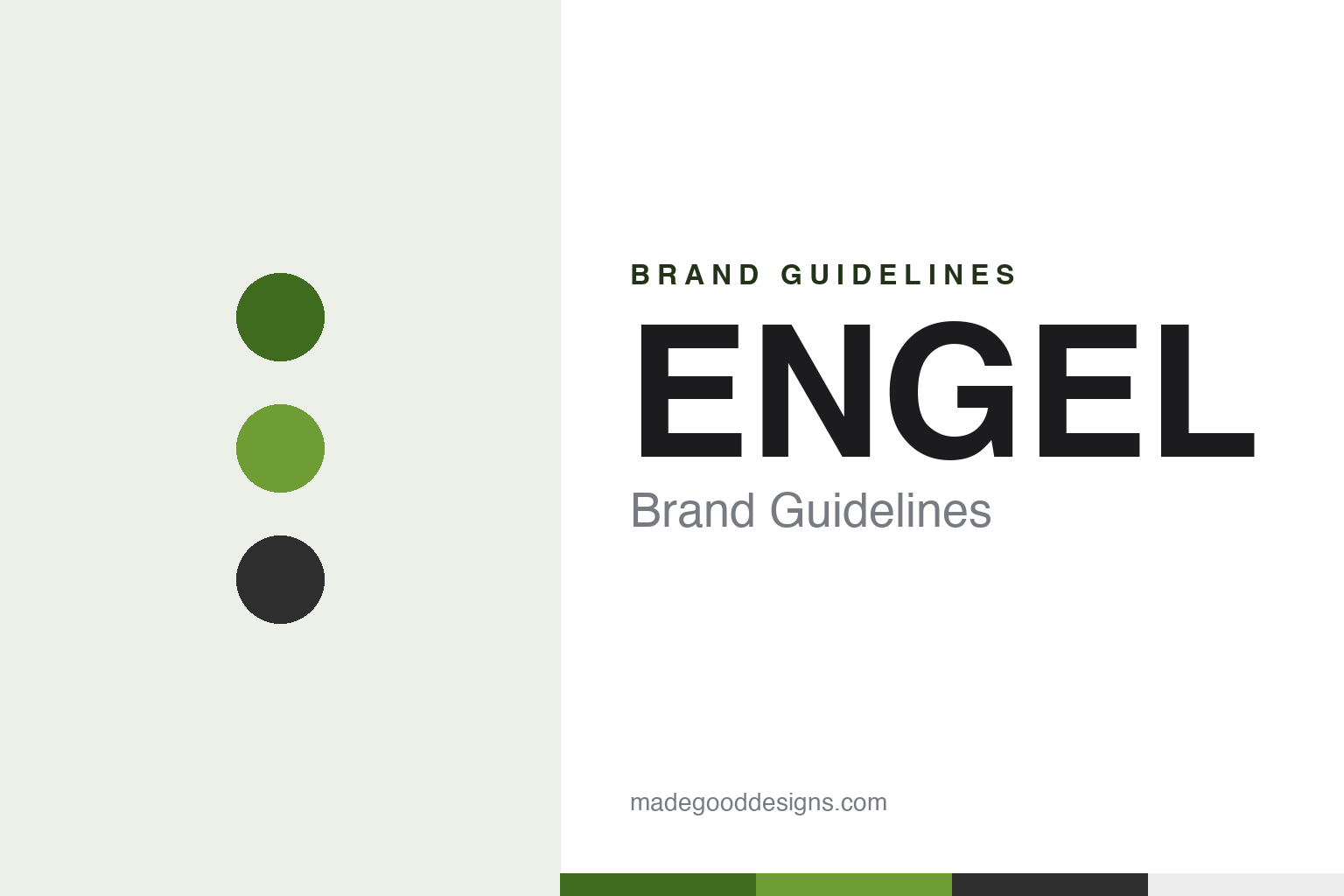
ENGEL Brand Guidelines
A 1945 locksmith’s shop in Upper Austria that turned to injection moulding.
Aa
Two constants: an ENGEL green and charcoal palette and an Industrial sans register. Abstract homage — not an ENGEL product or mark; no machine, logo or nameplate is reproduced.
A Locksmith’s Shop
From Schwertberg to plastics.
ENGEL began in 1945 as a locksmith’s shop in Schwertberg, Upper Austria, founded by Ludwig Engel. The regional paper MeinBezirk reported in 2018 that he had reached Austria the year before with his family as a refugee from what is now Serbia; Wikipedia describes him as a Danube Swabian. The workshop grew into a machine-building firm that, MeinBezirk says, made components for cableways and had 35 employees by 1948.
Presses came first. Wikipedia says punching machines for leather and other materials were built from 1948, and the Austrian business magazine trend says the company’s first plastics press was patented that year. Its first injection moulding machine followed, and here the dates differ by a year: Wikipedia and trend give 1951, while MeinBezirk says the first machine developed and built in Upper Austria was sold in 1952. Wikipedia describes that early machine as having a hand-lever clamping unit and water-hydraulic injection. MeinBezirk says Engel set up the process for series production from the start.
In 1965 the next generation took over: Ludwig Engel’s daughter Irene and her husband Georg Schwarz. trend credits their period with electronic control as standard from 1968 and with the first foreign offices in the 1970s; Wikipedia counts forty foreign representations by 1970. trend dates the first production site outside Austria, in Germany, to 1977.
Colour
Tonnage, tie bars and a second brand.
The next step was size. A large-machine plant opened at St. Valentin, in Lower Austria, in 1988, trend says, and Wikipedia says it allowed machines with more than 3,000 tonnes of clamping force.
In 1997 Peter Neumann, a son-in-law of Irene and Georg Schwarz, took over operational management, German Wikipedia says. The plants that followed went east: a supplier works at Kaplice in the Czech Republic in 2000, then production in South Korea and China, along with a second brand, Wintec, which German Wikipedia says is built at Changzhou. Stefan Engleder has led the business since 2016, trend says; the company’s website still lists him as CEO.
The range today, as ENGEL describes it, runs from 280 kN to 55,000 kN of clamping force, across hydraulic, hybrid and electric drives and horizontal and vertical layouts. It is organised by construction. The duo series covers two-platen machines from 4,500 kN upward; the victory series is tie-bar-less; the insert series is vertical and tie-bar-less; toggle machines form the electric range, which includes the e-mac. Robots and automation come from the Dietach plant and from TMA Automation at Gdańsk, according to Wikipedia.
The machines go to many industries. trend names car parts, packaging, electronics and medical technology. ENGEL’s website gives an export share of about 95 per cent, and Wikipedia says the machines from its Austrian plants go almost entirely abroad.
German Wikipedia says ENGEL received Austria’s Staatspreis Innovation in 2024 for a two-stage process for energy-efficient plastics recycling. German Wikipedia also records a curiosity: a limited 2021 Lego set of an injection moulding machine, modelled on an ENGEL victory.
Typography
Machines as a brand.
Injection moulding machine makers sell equipment that most people never see, so their visual language is built for a trade audience. The machine itself is usually the hero: a long horizontal body photographed side-on in factory light, often in a paint scheme the maker has kept for years. A colour on the guarding can do the work of a logo across a crowded production hall.
The second recurring picture is the open machine. Platens stand apart with a mould half showing, and a robot arm reaches in to lift a part from the tool. Close-ups of screws and barrels show the plasticising end of the process, where granulate becomes melt, and walls of moulded samples turn an abstract capability into objects a visitor can pick up: closures, housings, gears and containers. Where makers serve cleanroom production, the same machines appear inside enclosed, brightly lit cells.
Trade fairs give makers a place to show a machine running: K in Düsseldorf, Fakuma in Friedrichshafen, NPE in the United States and Chinaplas in Asia. Live moulding demonstrations make parts in front of visitors.
Behind the machines sits a quieter layer of typography and naming. Series names, short codes and clamping forces in kilonewtons carry much of the information, and controllers have become design objects in their own right, with screens and panels of their own. Many makers remain family-held or sit within larger groups, so names and marks can outlast changes of ownership, and the history is often part of the pitch.
Aa
An industrial sans for a machine maker. (Specimen set in Archivo, a sans STAND-IN; NOT the ENGEL logo.)
ENGEL
“be the first.”
The business is owned close to home, though sources describe it differently. Wikipedia says ENGEL has been entirely family-owned since 1945, and MeinBezirk said 100 per cent in 2018. ENGEL’s own press releases call it a family-owned company. trend, in a company profile updated in July 2023, was more precise: the parent, Ludwig ENGEL GmbH & Co KG, was majority family-owned, held by the Engleder family’s BE Beteiligungs GmbH and by Engel Gesellschaft m.b.H., in which the businessman Rudolf Fries held 25 per cent alongside the family. trend added that the group now presents itself to the outside world simply as ENGEL.
Production is spread widely. Wikipedia lists twelve plants: three in Austria, at Schwertberg, St. Valentin and Dietach, plus Kaplice, York in the United States, Pyeongtaek in South Korea, Shanghai and Changzhou in China, Mexico, Gdańsk in Poland, Pune in India and Kikinda in Serbia. trend counted nine in 2023. The newest two are documented: a site at Querétaro, Mexico, opened in March 2025, the company says, and Kikinda, announced in September 2026, which ENGEL says will make machined components and which the Upper Austrian paper Tips reported would reach about 150 staff in three years. The company gives its workforce as about 7,000.
The brand’s language is short. Its motto is “be the first,” which appears on its website and in trend. The name is set in capitals by the company, and product lines run in lower case: duo, victory, e-mac. ENGEL’s website stylesheet is built on a green with charcoal; that is what the code shows, not a published brand specification.
For a design guide, ENGEL shows how a machine maker can make a range legible through construction types, with short lower-case names doing the sorting. Compare ARBURG, another family-held moulding machine maker that presents itself in capitals, and Wittmann Battenfeld, a fellow Austrian maker. For this guide we use a deep green, a brighter green and charcoal with a sans, an unofficial interpretation; no product or logo is reproduced.
Explore & save
Keep ENGEL’s identity on hand — save it to a board in the Made Good inspiration library.
ENGEL identity set
Pin the ENGEL green and charcoal palette and the Industrial sans register to your own board.