ARBURG Brand Guidelines
A Black Forest workshop whose name joins a first name to a village.
Aa
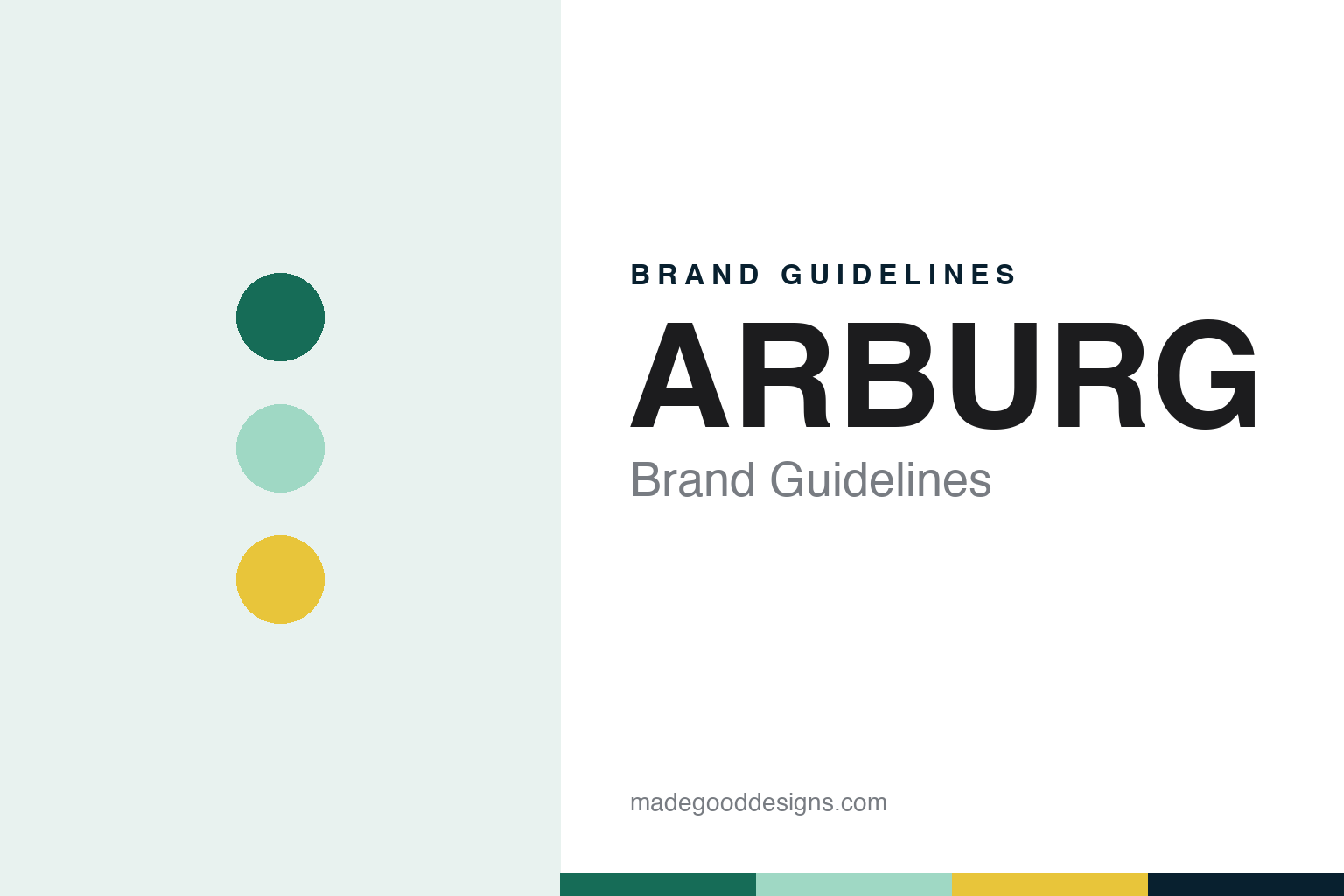
Two constants: an ARBURG mint and rapeseed palette and an Engineered sans register. Abstract homage — not an ARBURG product or mark; no machine, logo or nameplate is reproduced.
AR + BURG
A first name and a village.
ARBURG dates itself to 1923, when Arthur Hehl, a precision mechanic, set up on his own in Lossburg, in the northern Black Forest. A company history published in 2023 calls him a surgical mechanic and says the work began in the cellar of the family home. From 1926, the company says, he made surgical instruments there. A later extension became known as the “Fabrikle,” the little factory.
The name came two decades after the business. Karl Hehl, Arthur’s son, combined the first syllable of his father’s name with the last syllable of the village: AR + BURG. The company dates this to 1943, and the 2023 history to 1943/44; German Wikipedia gives 1943. ARBURG says the lettering dates from the same moment and “characterises ARBURG to this day.”
Injection moulding arrived through a product fault. After 1948 the firm made everyday metal goods such as potato baskets and hairpins, with Karl working on the technology and his brother Eugen Hehl on sales. It then added DuoLux flashguns. The 2023 history says exported units came back because moisture in tropical climates drained their batteries through metal plug contacts, and that plastic was the answer. No small machine on the market could overmould the plugs, so Karl Hehl built one in 1954. Eugen’s remark on the family’s knowledge of plastics at the time, that they knew as little about it as a cow does about dancing, is quoted in that history.
Colour
The Allrounder principle.
Demand from others turned a workshop tool into a product. The C1 went into series production in 1956, the company says, and ARBURG showed at the K trade fair in Düsseldorf for the first time in 1959. German Wikipedia says the thousandth machine was sold in 1960.
The defining idea came in 1961: a machine with a pivoting clamping unit and an interchangeable injection unit, which Wikipedia says was patented as the Allrounder principle and allowed up to ten working positions. The name is still on the machines. Combining horizontal and vertical injection units made two-colour moulding possible in 1962, and the company says one of the first such parts was a telephone dial plate.
Controls became the second thread. ARBURG says an Allrounder 270 H of 1975 was the first injection moulding machine with a microprocessor controller. It says on-screen control followed in 1982, the Selogica controller in 1993, electric Allrounders in 2001 and the Gestica controller in 2016. The 2016 launch was the Allrounder 1120 H, a hybrid with 6,500 kN of clamping force.
ARBURG has spoken about design in some detail. In a 2018 statement carried by kunststoffFORUM, managing partner Juliane Hehl quoted the company motto as “ugliness sells badly” and said the first series machine was filed on a wooden model in the 1950s until it had a design worthy of the technology. She named 1995 as a milestone: the machines changed from hammer-finish green to the mint green and rapeseed yellow combination for which, she said, ARBURG is known worldwide.
The next step, she said, was bringing designers in from the start of the 1120 H. The Ammerbuch studio Design Tech, led by Jürgen R. Schmid, worked on it, and it won an iF Design Award in 2018, in the product discipline. Red Dot lists Design Tech as designer of two more ARBURG winners, the Gestica control and the freeformer 3D printer, and Wikipedia dates those awards to 2018 and 2014. The Red Dot jury said Gestica drew on the feel of smart mobile devices while staying independent in its interpretation.
Typography
Machines as a brand.
Injection moulding machine makers sell equipment that most people never see, so their visual language is built for a trade audience. The machine itself is usually the hero: a long horizontal body photographed side-on in factory light, often in a paint scheme the maker has kept for years. A colour on the guarding can do the work of a logo across a crowded production hall.
The second recurring picture is the open machine. Platens stand apart with a mould half showing, and a robot arm reaches in to lift a part from the tool. Close-ups of screws and barrels show the plasticising end of the process, where granulate becomes melt, and walls of moulded samples turn an abstract capability into objects a visitor can pick up: closures, housings, gears and containers. Where makers serve cleanroom production, the same machines appear inside enclosed, brightly lit cells.
Trade fairs give makers a place to show a machine running: K in Düsseldorf, Fakuma in Friedrichshafen, NPE in the United States and Chinaplas in Asia. Live moulding demonstrations make parts in front of visitors.
Behind the machines sits a quieter layer of typography and naming. Series names, short codes and clamping forces in kilonewtons carry much of the information, and controllers have become design objects in their own right, with screens and panels of their own. Many makers remain family-held or sit within larger groups, so names and marks can outlast changes of ownership, and the history is often part of the pitch.
Aa
An engineered sans, set beside a wordmark from 1943. (Specimen set in Barlow, a sans STAND-IN; NOT the ARBURG logo.)
ARBURG
“Wir sind da.”
The company remains with the families. Wikipedia says it is owned by the Hehl and Keinath families, and ARBURG says the third generation, Juliane Hehl, Michael Hehl and Renate Keinath, took over in 2005. A change came on 12 January 2026, when Volker Nilles, formerly an executive at KraussMaffei, became the chief executive, PolyForm NEXT reported, in a management team of six that includes Juliane and Michael Hehl.
The freeformer has gone. Presented at K in 2013, it was a 3D printer that worked with standard plastic granulate. K-Zeitung reported in September 2025 that ARBURG would close its additive manufacturing unit on 31 December 2025, with service and spare parts continuing for existing users, and that innovatiQ, bought in 2020, was to be sold. VDI-Z also reported the exit. AMKmotion, a drive maker, joined the family in 2021, the company says.
Where the machines are made is a question with a changing answer. The 2023 company history said production for customers worldwide had until then taken place only in Lossburg, and ARBURG’s website still says, “We manufacture your plastics processing machines centrally in Lossburg, Germany.” It also says key components are made in-house. But K-Zeitung reported in March 2026 that a site at Pinghu, China, assembles a variant of the Golden Electric range and would build the new Allrounder Trend for Asia from mid-2026, with plasticising units and controls coming from Lossburg. A United States factory was not a priority for now, it added. The company gives its workforce as about 3,300.
Its brand promise is German even in English: “Wir sind da,” glossed as “We are here for you.” The website stylesheet has moved to dark ink and green tones, but those are code values rather than a published specification.
For a design guide, ARBURG shows how much a maker can gain by keeping one name, one wordmark and one machine colour in plain view. Compare ENGEL, the Austrian family-held maker that also uses capitals, and KraussMaffei, the Munich maker where Nilles once worked. For this guide we use a deep green, a mint and a rapeseed yellow with a sans, an unofficial interpretation; no product or logo is reproduced.
Explore & save
Keep ARBURG’s identity on hand — save it to a board in the Made Good inspiration library.
ARBURG identity set
Pin the ARBURG mint and rapeseed palette and the Engineered sans register to your own board.