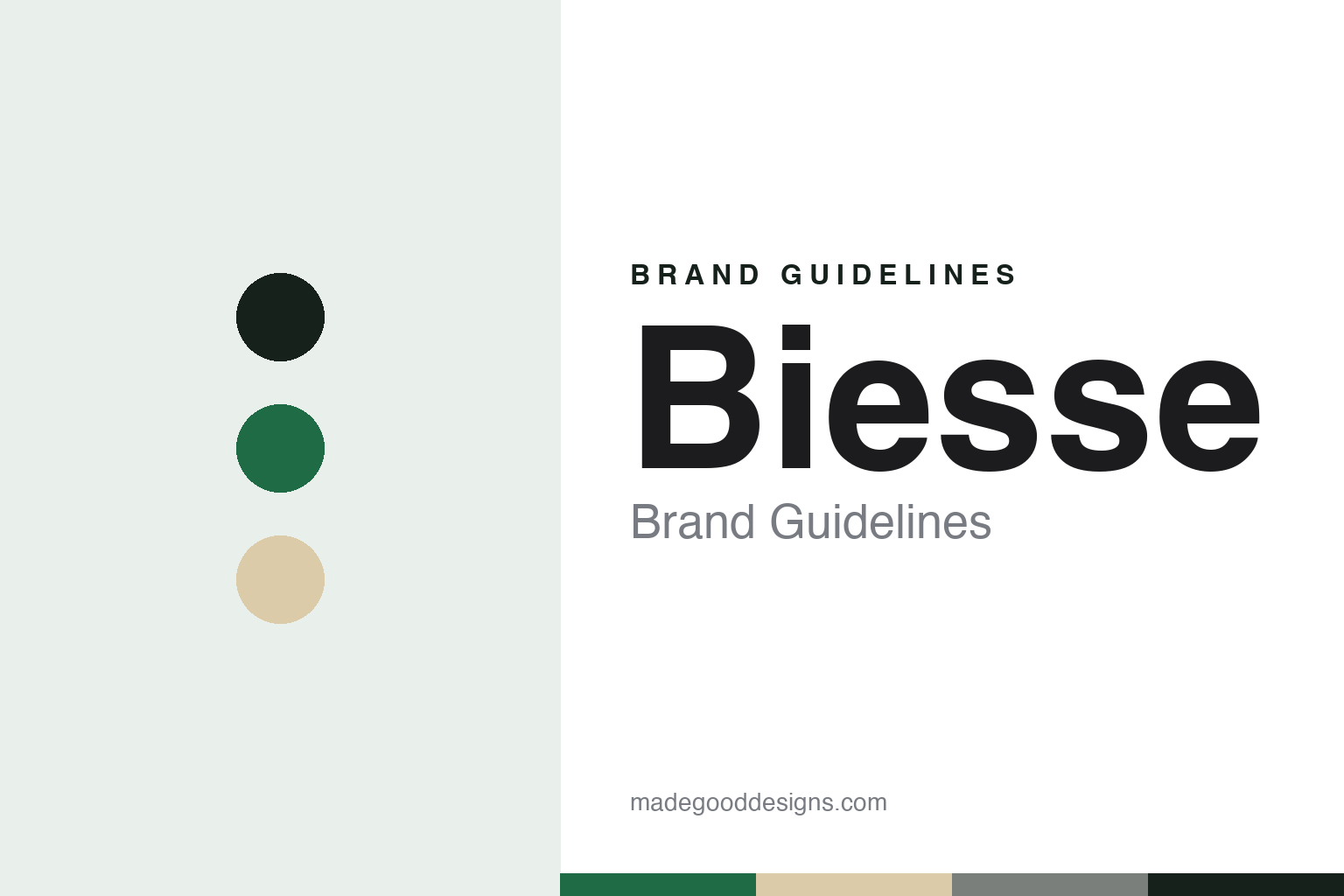
Biesse Brand Guidelines
A Pesaro drilling-machine maker that learned to work in glass and stone as well as wood.
Aa
Two constants: a Rover green, sawdust and stone grey palette and an open geometric sans register. Abstract homage — not a Biesse product or mark; no machine, logo or nameplate is reproduced.
Pesaro, 1969
Drilling machines for a furniture district.
Biesse was founded in Pesaro, on Italy’s Adriatic coast, in 1969. Italian Wikipedia names the founder as Giancarlo Selci, and ItalyPost, in a 2026 interview with his son Roberto Selci, the present chief executive, also says his father founded it. Biesse’s own history says only that it was set up to design, manufacture and distribute machines for processing wood.
The Höchsmann woodworking machinery lexicon, a trade reference run by a machinery dealer, fills in some detail. It says the company began by concentrating on drilling machines for wood processing, and it credits Selci with a multiple drilling machine for furniture in 1960, nine years before the company existed. Italian Wikipedia says that within a few years Biesse had become an integral part of the Italian furniture district. Höchsmann says it became a public limited company in 1979.
The move into numerical control is where the sources part. Höchsmann places the presentation of Biesse’s first numerically controlled drilling machine in 1982. Biesse says it launched Rover in 1983, calling it the first numerical control machining centre for wood. Höchsmann then dates the first CNC machines, the gantry models Rover 7 and Rover 36, to 1985. The claim of a first is Biesse’s own.
Rover has stayed the signature. Höchsmann records a new Rover series in 1991 with what it calls a grass-green design, and a long run of later generations, including the Rover C that replaced several older models after LIGNA 2005. The green in this guide’s palette nods to that 1991 note, and it is our choice rather than a brand colour.
Colour
From wood to glass, stone and components.
Biesse widened its materials before it widened its map. Its history says a business sector for glass and stone machines was born in 1987 and that the first United States branch opened in 1989, which it treats as the start of internationalisation. In 1991 it founded HSD as a unit to design and make electromechanical components. Its site now lists HSD at Gradara, near Pesaro, with a German base at Nersingen.
For years its German sales ran through a partner. Höchsmann says Koch Maschinenfabrik handled them until Biesse set up an office in Elchingen in 1997, and that the long distribution agreement stopped when a northern branch was built at Löhne in 2000.
Biesse listed on the Italian stock exchange in 2001, in the STAR segment. Teleborsa described it in October 2026 as listed on Euronext STAR Milan. Acquisitions followed in stages. Höchsmann records 60 percent of Bre.Ma. Brenna Macchine in 2006. Biesse’s history adds Movetro and Montresor in 2017; Forvet, a maker of automated glass machines, in 2021; and in 2023 the GMM group, which brought GMM, Bavelloni and Techni Waterjet.
The map changed too. Biesse says its first production plant outside Italy opened in India in 2008; Höchsmann dates the new factory at Nelamangala, near Bangalore, to November that year. China went the other way. Höchsmann records a plant at Dongguan in 2011, and Roberto Selci told ItalyPost that it was acquired in 2010 and that Biesse has since stopped manufacturing there.
The brand caught up with all this in the 2020s. Biesse says its “One Company” project of 2020 brought a new organisation, a new brand and a new product architecture, along with a rationalisation of its manufacturing hubs. A company release dated 22 September 2022 announced a new visual identity, “deemed necessary to align group positioning and brands,” with a staged release of the main touchpoints starting at the Glasstec fair in Düsseldorf that month. Selci said the scale of the transformation was the reason to express it visually. Höchsmann’s logo archive shows earlier marks from the 1980s, 1995, 2002 and 2010, and files the current one under December 2022. The website now sets out the business as Wood, Glass, Stone, Materia and Metal.
Typography
The workshop on show.
Woodworking machinery is sold on the look of the work as much as the look of the machine. A nesting CNC table loaded with a sheet of birch ply, the parts of a cabinet marked out across it, is one of the category’s standard pictures. So is an edge bander with panels feeding through in a line, each one leaving with a finished edge.
The colour of the machine often does a lot of the recognition work. Sliding table saws and planers tend to appear in a maker’s machine green or grey, photographed square-on against pale timber, with curls of shavings gathered under a planer as the proof that it has been running. Hand-held tools get a closer view: a plunge saw on a rail, its dust port in frame.
The setting changes with the customer. Factory shots show long lines and automated handling for furniture producers, while other pictures move to a joinery workshop with a bench, a stack of boards and a single operator. Many makers use both, because their ranges run from the small shop to the industrial plant.
Trade fairs are the category’s shop window. LIGNA in Hanover, Xylexpo in Italy, IWF in Atlanta and Holz-Handwerk in Nuremberg are where new machines are shown running, often linked together on a stand to suggest a working production line rather than a row of separate products. For a sector that sells to engineers and cabinetmakers alike, the running demonstration matters as much as the brochure. This guide looks at what can be checked about each brand: who founded it, who owns it and what it says about where its machines are made.
Aa
An open geometric sans for a multi-material group. (Specimen set in Manrope, a sans STAND-IN; NOT the Biesse logo.)
Biesse
A listed company with a family at the top.
Biesse is public but not widely held. Il Sole 24 Ore’s market profile lists Bi.Fin. Srl, the Selci family’s company, with 51 percent of the shares and 67.53 percent of the voting rights, the other 49 percent being on the market. ItalyPost describes Roberto Selci as president, chief executive and largest shareholder. In May 2026, Forbes Italia reported, the board named Stefano Porcellini a director, deputy chief executive and future chief financial officer.
Asked whether Biesse would stay listed, Selci told ItalyPost that it remains fully committed to the public market. He also said the Pesaro plant was using a temporary reduced-hours scheme while demand was weak, and Teleborsa quoted him in October 2026 on a complex market with weak demand in the third quarter. The company’s 2026–2028 plan, he said, centres on research, talent and new technological content, with a first generation of machines built on new concepts targeted between 2027 and 2030.
Pesaro remains the headquarters and a production base. Selci says India now mainly makes entry-level wood-processing machines, with production vertically integrated from sheet-metal cutting to painting, and that the next step there is glass and stone. Biesse’s website counts about 4,400 employees, and Selci puts the installed base above 50,000 machines worldwide. He calls wood the company’s historical core and says the GMM purchase strengthened its stone range.
Software has become part of the offer. Selci points to B/On and the recent purchase of Orchestra as the means of connecting machines to a customer’s whole production workflow, and to the reopening of the Pesaro Academy for training. Biesse names furniture, construction, automotive and aerospace among the sectors it serves.
For a design guide, Biesse shows how a machine name like Rover can outlast several reorganisations of the company around it. Compare HOMAG, which put its own acquired names under one badge in 2017, and SCM Group, the Italian machinery group based in Rimini. For this guide we use a green, sawdust and stone grey with a sans, an unofficial interpretation; no product or logo is reproduced.
Explore & save
Keep Biesse’s identity on hand — save it to a board in the Made Good inspiration library.
Biesse identity set
Pin the Biesse Rover green, sawdust and stone grey palette and the open geometric sans register to your own board.