Felder Brand Guidelines
The Tyrol family firm that went from a parents’ house in Absam to three machine brands at Hall.
Aa
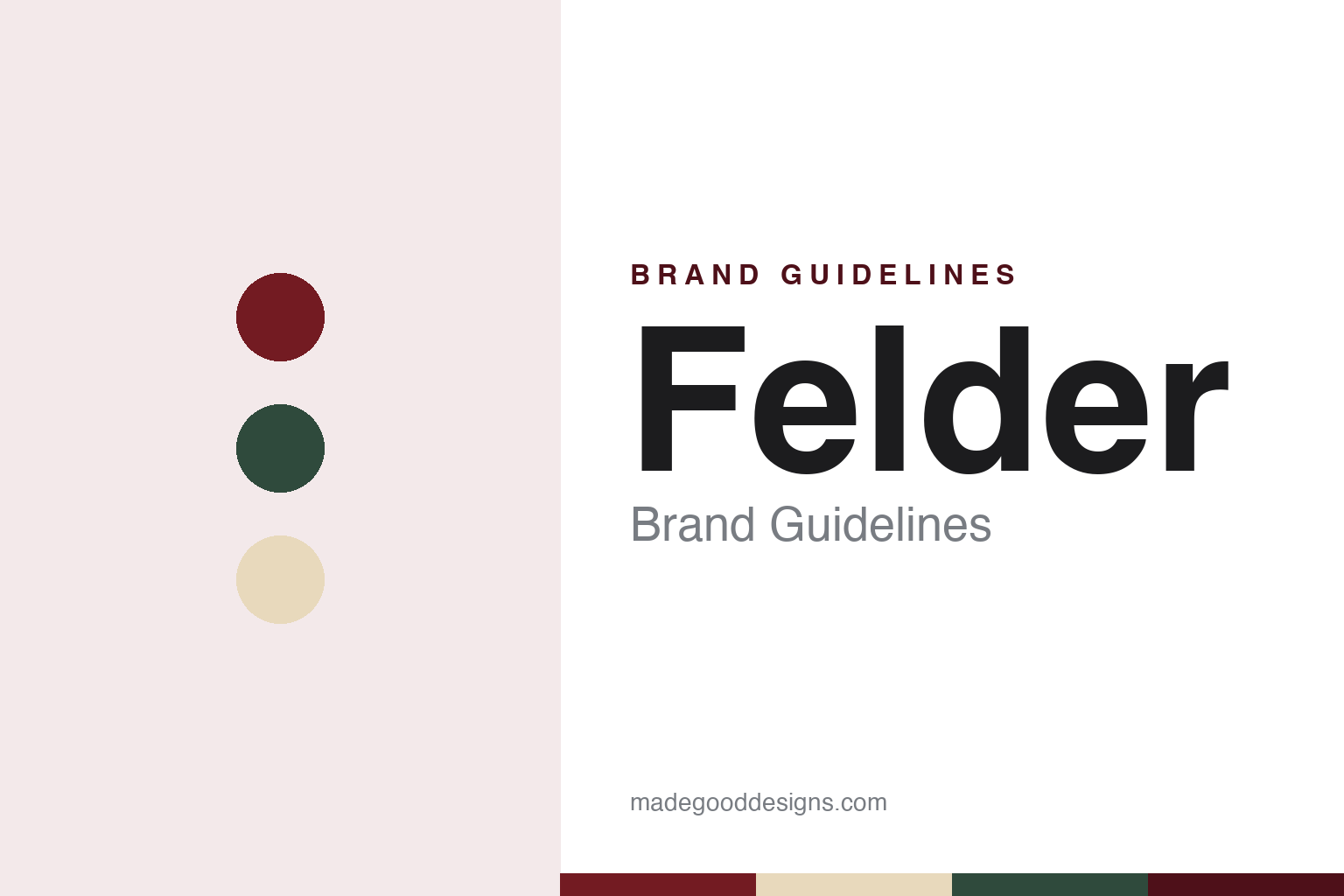
Two constants: a Felder burgundy, limewood and spruce palette and a Workshop sans register. Abstract homage — not a Felder product or mark; no machine, logo or nameplate is reproduced.
Absam
A workshop in a parents’ house.
Felder began in the Tyrol in 1956. The company says Johann Felder and his wife Gertraud founded the business, as Johann Felder junior, in a workshop in his parents’ house in Absam, and showed the first Felder woodworking machines that same year at trade fairs in Vienna and Innsbruck. The Tiroler Tageszeitung gave the same year in 2016, calling it a one-man business, as did Furniture & Joinery Production. The machinery reference Hoechsmann differs slightly, listing the founding under 1955 and the fairs under 1956.
Furniture & Joinery Production’s 2016 anniversary profile adds a telling early detail. When cast iron ran short in 1958, the company set up its own foundry in the garden of the house. A larger foundry with an automatic furnace followed in 1975.
Growth came from one kind of machine. Felder moved within Absam in 1961, exported its first machine, to Switzerland, in 1962, and in 1963 reached series production with the BU 4 combination machine, a single unit that does the work of several. The BU 5 took it into Germany, and later BU models reached further markets, the same profile says. A heavier combination series arrived in 1970, and in 1979 the firm bought its first CNC milling centre, among the last investments at Absam.
The move to Hall in Tirol is dated differently depending on the source. The company and Furniture & Joinery Production say 1982, with 65 employees, because Absam had no more room. Hoechsmann says 1981, and the Tiroler Tageszeitung said 1989. In 1988, the company says, Johann Felder founded Felder Scandinavia in Stockholm, its first subsidiary, while the BF 3 and BF 4 combination machines sold well enough to need a new hall.
Colour
Three brands, one site.
In 1990, the company says, it presented the world’s first combination machine with a sliding table, a claim it makes for itself. Single-purpose machines followed, including the K6 panel saw, and Felder moved from combination specialist to a supplier of a full range for workshops and industry. The range now runs from sliding table saws, planers and spindle moulders to edge banders and five-axis CNC machining centres, which the company counts at well over 180 machines.
The brand structure dates from the turn of the century. Hammer arrived in 1997 as the affordable line. Format-4 followed in 2001 as the premium line for professional users; the company now writes it FORMAT4. Felder itself keeps its founding date on the website, with the words “Since 1956.” In February 2015 Furniture & Joinery Production reported that Format-4 had handed over its 30,000th machine, a Kappa 550 panel saw, to a workshop owner in Bavaria.
Format-4 is also where the firm’s design recognition sits. Furniture & Joinery Production says the new Format-4 models received the iF Design Award in 2003 and 2009 and the Adolf Loos Prize in 2004. Wood & Panel, in 2016, listed the same two prizes with a Bavarian state award.
Two acquisitions have widened the group beyond Hall. In 2019 Otto Mayer Maschinenfabrik of Lombach, Germany, joined it, bringing vertical panel saws and pressure beam saws under the MAYER name, with what the company calls 70 years of experience. In 2023 came EMC of Imola, an Italian maker of wide belt sanders for wood and metal; Hoechsmann also records that integration. Felder’s own developments in the period include the Silent-Power spiral cutterblock of 2012 and the F4Solutions software of 2018.
Felder’s other honours are for how it runs as an employer and innovator. In December 2018 it was a regional winner in the large-company class of “Jobs through Innovation,” an award from Austria’s Chamber of Labour and its Research Promotion Agency, the company’s press page says.
Typography
How the category presents itself.
Woodworking machinery is sold on the look of the work as much as the look of the machine. A nesting CNC table loaded with a sheet of birch ply, the parts of a cabinet marked out across it, is one of the category’s standard pictures. So is an edge bander with panels feeding through in a line, each one leaving with a finished edge.
The colour of the machine often does a lot of the recognition work. Sliding table saws and planers tend to appear in a maker’s machine green or grey, photographed square-on against pale timber, with curls of shavings gathered under a planer as the proof that it has been running. Hand-held tools get a closer view: a plunge saw on a rail, its dust port in frame.
The setting changes with the customer. Factory shots show long lines and automated handling for furniture producers, while other pictures move to a joinery workshop with a bench, a stack of boards and a single operator. Many makers use both, because their ranges run from the small shop to the industrial plant.
Trade fairs are the category’s shop window. LIGNA in Hanover, Xylexpo in Italy, IWF in Atlanta and Holz-Handwerk in Nuremberg are where new machines are shown running, often linked together on a stand to suggest a working production line rather than a row of separate products. For a sector that sells to engineers and cabinetmakers alike, the running demonstration matters as much as the brochure. This guide looks at what can be checked about each brand: who founded it, who owns it and what it says about where its machines are made.
Aa
A sturdy workshop sans for a family name. (Specimen set in Barlow, a sans STAND-IN; NOT the Felder logo.)
Felder
“Made in Austria, made in Tyrol.”
Felder has stayed in the family. In 2000, the company says, the sole trader Johann Felder became a limited partnership, Felder KG, with Gertraud, their daughter Elisabeth and their sons Hansjörg and Martin holding shares. The Tiroler Tageszeitung described the business as wholly family owned in 2016.
The latest handover was reported by the Spanish trade publisher Interempresas in February 2025. On 31 December 2024 Martin Felder passed management and his shares to his sons Daniel and Patrick, who had spent almost 20 years in procurement and production. Hansjörg Felder gave a stake to Tamara and Alexander, who moved from marketing to customer service and sales, and stayed on as managing director and partner. The company now calls itself a third-generation family business led by those five names, and Interempresas marked its 70th anniversary in January 2026.
Place is the main brand message. The anniversary page says “Made in Austria, made in Tyrol,” and describes “Quality Made in Austria”; those are the company’s words. The company places MAYER’s production at Lombach and EMC’s base at Imola. Hall has grown steadily: in June 2016 the managing directors told the Tiroler Tageszeitung they planned to take the halls from 65,000 to 81,000 square metres, with 550 staff on site and an export share of 95%, and the company says it passed 81,000 square metres by 2018. Its pages now give more than 750 employees on one and more than 800 on another, with more than 250 sales and service points in 84 countries.
No brand guidelines are published. Hoechsmann files Felder logos dated from 2010 to 2021, some labelled for the group. The website’s stylesheet uses a dark burgundy with Open Sans for text, and the group presents its brands side by side in one navigation bar, with a short line for each.
For a design guide, Felder shows how a family firm can run separate brands at different levels from one site, and make that place the promise. Compare Altendorf, another European sliding-saw name, and MARTIN of Ottobeuren. For this guide we use a burgundy, a limewood tone and a spruce green with a sans, an unofficial interpretation; no product or logo is reproduced.
Explore & save
Keep Felder’s identity on hand — save it to a board in the Made Good inspiration library.
Felder identity set
Pin the Felder burgundy, limewood and spruce palette and the Workshop sans register to your own board.