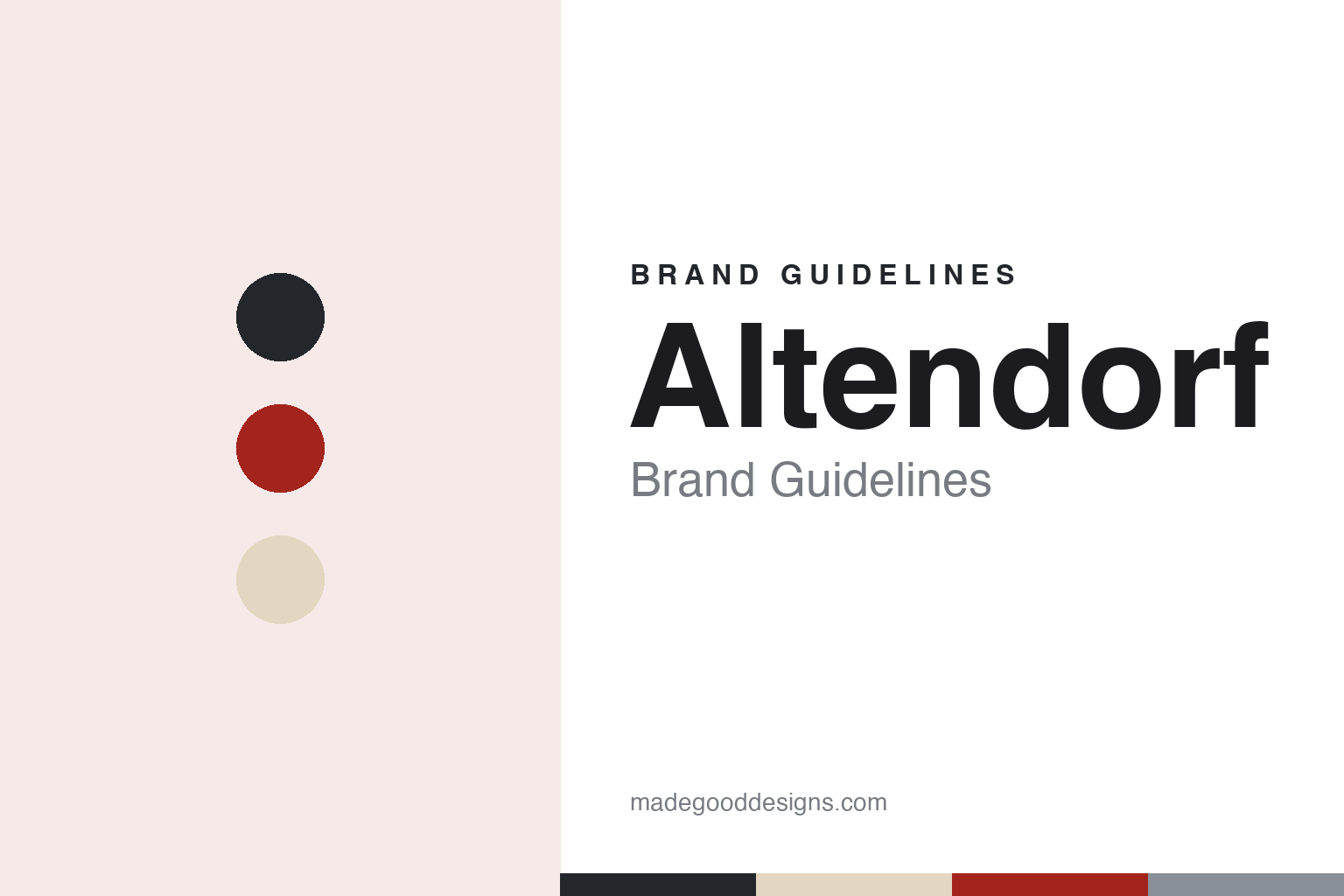
Altendorf Brand Guidelines
The Minden maker whose name became shorthand for the sliding table saw.
Aa
Two constants: an anthracite, saw red and birch palette and a condensed sans register. Abstract homage — not an Altendorf product or mark; no machine, logo or nameplate is reproduced.
System Altendorf
A Berlin furniture draughtsman builds his own saw.
Altendorf dates itself to 1906 and to Berlin. English Wikipedia describes Wilhelm Altendorf as a furniture designer and draughtsman who set up a factory for business equipment in the city and, unhappy with the woodworking machines on offer, built his own: a saw in which the workpiece travels past the blade on a sliding carriage. The company calls the result “System Altendorf.” Its history page says he first wanted a machine for a straight edging cut on a plank, and that adding the 90-degree cut gave the principle of the sliding table saw. Altendorf presents this as the invention of the category, and both the trade lexicon Wood Tec Pedia and the investor Avedon Capital repeat that account.
The move to the town now tied to the name came after the First World War. English Wikipedia says the business left Berlin for Minden, in Westphalia, in 1919, a date Wood Tec Pedia also gives. When demand for woodworking machines waned, the same Wikipedia article says, Wilhelm Altendorf turned to other products, among them a car with a wooden body, a cigarillo-making machine, a prefabricated house and, in 1939, a child’s high chair.
His sons Willy and Kurt Altendorf joined around 1930 and took over management in 1948. In 1956 they made the decision that shaped the company, narrowing production to the sliding table saw alone. The company’s timeline pairs that year with the start of series production and an aluminium sliding table it calls the world’s first. Wood Tec Pedia records annual output of 1,000 machines in 1963 and a new Minden factory commissioned in 1974; the company gives 3,000 saws a year by 1975.
Colour
One machine, and the name that came with it.
Altendorf is known for the F 45. The company says the machine is known internationally simply as “The Altendorf,” and Avedon Capital says the name is often used worldwide for the product category itself. Its slogan is “We know what counts,” its anniversary line is “From Pioneer to The Craftsman’s Best Friend,” and for its centenary it published a book, The Saw, which it describes as both a history and a technical book.
The machine has changed a good deal while keeping its name. Wood Tec Pedia dates the POSIT series of CNC-controlled panel saws to 1993 and says the F 45 POSIT of 1995 was the first sliding table saw in the world with a PC interface and four CNC-controlled axes. It records a new generation of the F 45 and F 45 ELMO, in anthracite, at the centenary in 2006. Timber Trades Journal, reporting in June 2007, described the first saw of 1906 being shown beside the latest F 45 ELMO with a 12-inch touch screen; managing director Andreas Ploeger told the journal the aim was to bring frequently used functions “out from the depths of the controller menus and into the daylight.” Wood Tec Pedia dates a new F 45 control concept to 2015.
The range now runs through the F 25, F 30, F 35 and F 45. The company launched the F 35 in May 2025 and the F 30, which Wood Tec Pedia says replaces the WA 8/80 series, in March 2026. Wood Tec Pedia says the saws are used in joinery and carpentry workshops and in businesses processing wood, metal and plastics.
Two anniversary machines put design on the front of the saw. Wood Tec Pedia says the 2017 F 45 Edition 111 marked 111 years with 111 saws, each with a front panel showing 111 annual rings. For 2026 the company announced a numbered F 45 Anniversary Edition of 120 machines with a dedicated front design, under the campaign line “Precision that connects generations.”
The company says it received the “Brand of the Century” award from the publisher Die Deutsche Wirtschaft in 2024, and English Wikipedia says it was included in the Lexicon of German World Market Leaders in 2010. The Hebrock K Series edgebander, the company says, won an iF Design Award in the Industry/Tools category. Altendorf describes itself as the world market leader in premium sliding table saws.
Its unit figures vary by date and by what is being counted. Wood Tec Pedia gives about 150,000 machines built up to 2017. The company’s history page says more than 200,000 sliding table saws have been sold, and its group page gives 250,000 machines sold.
Typography
How woodworking machinery makers present themselves.
Woodworking machinery is sold on the look of the work as much as the look of the machine. A nesting CNC table loaded with a sheet of birch ply, the parts of a cabinet marked out across it, is one of the category’s standard pictures. So is an edge bander with panels feeding through in a line, each one leaving with a finished edge.
The colour of the machine often does a lot of the recognition work. Sliding table saws and planers tend to appear in a maker’s machine green or grey, photographed square-on against pale timber, with curls of shavings gathered under a planer as the proof that it has been running. Hand-held tools get a closer view: a plunge saw on a rail, its dust port in frame.
The setting changes with the customer. Factory shots show long lines and automated handling for furniture producers, while other pictures move to a joinery workshop with a bench, a stack of boards and a single operator. Many makers use both, because their ranges run from the small shop to the industrial plant.
Trade fairs are the category’s shop window. LIGNA in Hanover, Xylexpo in Italy, IWF in Atlanta and Holz-Handwerk in Nuremberg are where new machines are shown running, often linked together on a stand to suggest a working production line rather than a row of separate products. For a sector that sells to engineers and cabinetmakers alike, the running demonstration matters as much as the brochure. This guide looks at what can be checked about each brand: who founded it, who owns it and what it says about where its machines are made.
Aa
A condensed workshop sans. (Specimen set in Barlow Semi Condensed, a sans STAND-IN; NOT the Altendorf logo.)
Altendorf
From family firm to one name in Minden.
The Altendorf family ran the company for most of its history; English Wikipedia lists third- and fourth-generation managing partners up to 2017. That year the family left. Wood & Panel Europe and Private Equity Wire reported on 10 October 2017 that the growth investor Avedon Capital Partners had taken a majority stake, in a deal closed on 6 October, with managing directors Jörg F. Mayer and Wolfgang Ruhnau holding a minority. The reports described it as a succession solution, and the price was not disclosed. Avedon’s website lists Altendorf in its portfolio, with 2017 as the year of investment.
Avedon’s plan was to add neighbouring product lines. Private Equity Wire reported on 3 May 2018 that the group had closed its purchase of Hebrock and ebm Maschinenbau, edgebanding machine makers based at Bünde and Hüllhorst, again as a succession solution for a founding family. For several years the two names ran side by side, with the group’s site describing “Two great brands. One strong group.”
That ended in 2026, the company’s 120th year. Altendorf announced on 27 April that the Hebrock machines would continue as the Altendorf F Series and K Series. On 9 September it said a new production facility in Minden had opened on 4 September, with edgebander production moved from Hüllhorst, and that the business had merged into Altendorf GmbH on 1 August. CEO Rainer Hundsdörfer described it as “a clear commitment to Minden.”
On manufacturing, the same release says Minden is Altendorf’s only production site in Germany, with a second plant in China closely integrated with it. Wood Tec Pedia dates the Qinhuangdao operation to 1995. Wood Tec Pedia says the company also produced in Brazil in 2011.
For a design guide, Altendorf shows how a single machine can carry a company’s whole identity, and how a group can return to one name after running two. Compare Felder of Hall in Tirol and MARTIN of Ottobeuren, which also build sliding table saws. For this guide we use anthracite, saw red and birch with a condensed sans, an unofficial interpretation; no product or logo is reproduced.
Explore & save
Keep Altendorf’s identity on hand — save it to a board in the Made Good inspiration library.
Altendorf identity set
Pin the Altendorf anthracite, saw red and birch palette and the condensed sans register to your own board.