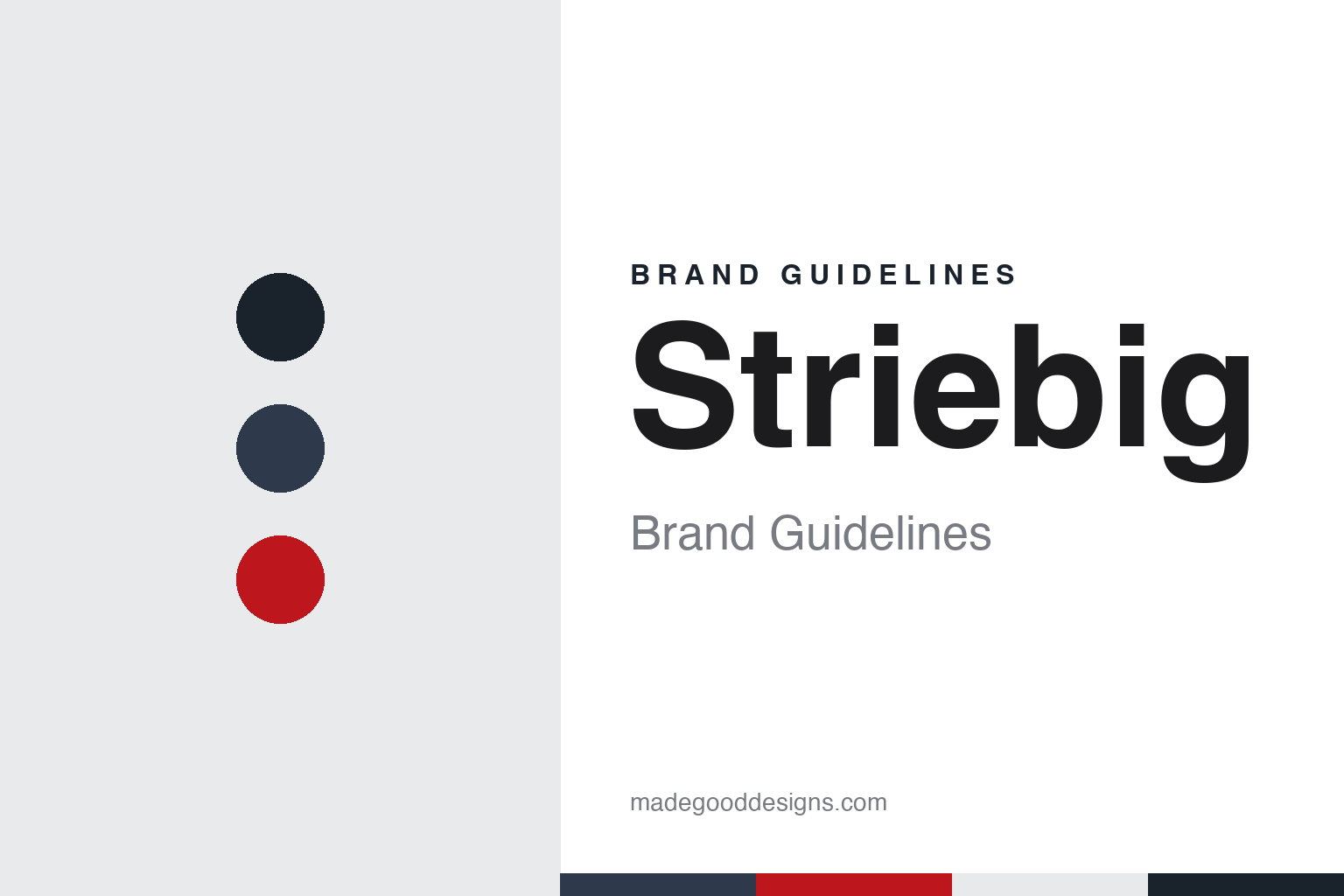
Striebig Brand Guidelines
The Lucerne maker built on the vertical panel saw.
Aa
Two constants: a Striebig red and slate palette and a Swiss sans register. Abstract homage — not a Striebig product or mark; no machine, logo or nameplate is reproduced.
Upright
A carpenter stands the panel on end.
Striebig began with a problem in one carpenter’s workshop. Large chipboard panels reached the market in the mid-1950s, Wood Tec Pedia says, and changed how joiners worked. Ludwig Striebig, a master carpenter from Littau, near Lucerne, decided to stand the panel and the saw upright.
In 1958, the company’s timeline says, he built a vertical panel saw for his own workshop: a wooden frame and a beam with a moving saw unit. Wood Tec Pedia adds that the cutting device was a hand-held circular saw that could travel vertically and swivel into a horizontal position. The company says this created the basic concept of vertical sawing.
Which year counts as the founding depends on the source. Wood Tec Pedia gives 1958. It also says Striebig applied for a patent on 17 March 1961, and the company’s timeline counts from that period too: it dates series production to May 1961 and presented its EDITION 60 model in 2021 for its 60th anniversary. The stock corporation, Striebig AG, followed in 1977.
Wood Tec Pedia says interest from Swiss colleagues persuaded him to give up his carpentry business and build saws instead, and that the first machines, the Model 62, went out from July 1961 with frames and beams already in metal. The company’s timeline dates the start of a foreign dealer network to 1964.
The address has changed less than it might seem. In autumn 2007 the company moved into a new production and administration building at Littau, and Littau itself merged into the city of Lucerne on 1 January 2010, English Wikipedia says. The company now gives its seat as Lucerne.
Colour
One category, seven models.
Striebig’s whole identity rests on one category. The company says it still concentrates exclusively on vertical sawing, and its website’s tagline reads “Präzision und Performance. In vertikal.” It calls itself “the original” and describes its founder as the inventor of the machine. Wood Tec Pedia says Striebig is “considered the inventor” of the vertical panel saw, and Furniture & Joinery Production used the words “inventor and a global market leader” in its April 2026 report on the Otto Martin purchase.
The case for the format, as the company makes it, is floor space: a vertical panel saw needs only about half the room of a horizontal one, it says.
The model names run from plain numbers to words. After the Model 62 came the Models 64 and 68. The AUTOMAT followed in 1978 and the ECONOM in 1979. The company’s timeline dates the TEMPOMAT to 1982 and Wood Tec Pedia to 1984. The COMPACT arrived in 1999.
The current website lists seven models. COMPACT is the entry point and STANDARD “the standard”; EVOLUTION and CONTROL were first launched around 2001, and the company dates their latest redesigns to 2018 and 2019; and the STRIEBIG 4D, shown in May 2013, is what the company calls its high-end vertical sawing centre. EDITION 60 and STANDARD S complete the list. Software has joined the steel: the 2018 and 2021 redesigns brought cutting-optimisation programs called ExpertCut and BaseCut.
The company tracks its machine count in round numbers. Its timeline marks the 30,000th saw in 1998, delivered to Scobalit; the 40,000th in 2008, through its Italian partner Albricci; and the 50,000th in June 2023, delivered to its UK partner TM Machinery Sales of Leicester. A company news item says that saw went to Architectural & Metal Systems, an aluminium extrusion firm in Ireland.
Awards in the company’s timeline include an Innovation Award at IWIE in Birmingham in 1983, a German federal prize for innovation in the crafts in 1991, and the Design Preis Schweiz in 2001, with recognition in industrial design for EVOLUTION and CONTROL. It also reports a gold medal for EDITION 60 at DREMA in Poznań in September 2024.
Typography
Machines for wood.
Woodworking machinery is sold on the look of the work as much as the look of the machine. A nesting CNC table loaded with a sheet of birch ply, the parts of a cabinet marked out across it, is one of the category’s standard pictures. So is an edge bander with panels feeding through in a line, each one leaving with a finished edge.
The colour of the machine often does a lot of the recognition work. Sliding table saws and planers tend to appear in a maker’s machine green or grey, photographed square-on against pale timber, with curls of shavings gathered under a planer as the proof that it has been running. Hand-held tools get a closer view: a plunge saw on a rail, its dust port in frame.
The setting changes with the customer. Factory shots show long lines and automated handling for furniture producers, while other pictures move to a joinery workshop with a bench, a stack of boards and a single operator. Many makers use both, because their ranges run from the small shop to the industrial plant.
Trade fairs are the category’s shop window. LIGNA in Hanover, Xylexpo in Italy, IWF in Atlanta and Holz-Handwerk in Nuremberg are where new machines are shown running, often linked together on a stand to suggest a working production line rather than a row of separate products. For a sector that sells to engineers and cabinetmakers alike, the running demonstration matters as much as the brochure. This guide looks at what can be checked about each brand: who founded it, who owns it and what it says about where its machines are made.
Aa
A Swiss-style sans for a brand of one idea. (Specimen set in Barlow, a sans STAND-IN; NOT the Striebig logo.)
Striebig
A second brand after six decades.
In 2026 the company moved beyond its own category by buying Otto Martin Maschinenbau of Ottobeuren, the German maker of sliding table saws, routers, planers and sanders. Striebig’s timeline dates the takeover to January 2026; Furniture & Joinery Production reported on 30 April 2026 that it was acquiring 100 per cent of the shares from Martin’s owners, members of the founding family. Striebig says the Ottobeuren site and the Martin brand will stay, and the two shared a stand at Holz-Handwerk in Nuremberg in March 2026.
Managing directors Robert Haas and Stefan Moor, who head the company according to its website, said Martin’s range complements Striebig’s and spoke of expanding internationally. Its company page still says Striebig concentrates exclusively on vertical sawing.
The company presents its saws as Swiss. Its models are described as “Swiss Made,” and its website footer carries the Swiss Label, a mark it says stands for quality. Its careers page says the company has concentrated on this category in Lucerne for more than 60 years, with work running from development and manufacture to sales and service. Wood Tec Pedia says that in 2017 around one machine in four was sold in Switzerland, with an export share of around 75 per cent, and that around 1,800 saws a year were being produced in 2008. The company’s trade-fair calendar for 2026 runs from Eurobois in Lyon and Holz-Handwerk to IWF in Atlanta, DREMA in Poznań and FIMAP in Porto.
Its website uses a strong red as its theme colour alongside a dark slate. The site was built by the Swiss agency DACHCOM, according to its legal notice, and sets the brand name in capitals on model names.
For a design guide, Striebig shows how a single idea can become a whole brand, down to the slogan. Compare MARTIN, the Ottobeuren maker it bought in 2026, and Altendorf, the German sliding table saw maker. For this guide we use a red and a slate with a sans, an unofficial interpretation; no product or logo is reproduced.
Explore & save
Keep Striebig’s identity on hand — save it to a board in the Made Good inspiration library.
Striebig identity set
Pin the Striebig red and slate palette and the Swiss sans register to your own board.