BAE Batterien Brand Guidelines
The Berlin battery works running since 1899.
Aa
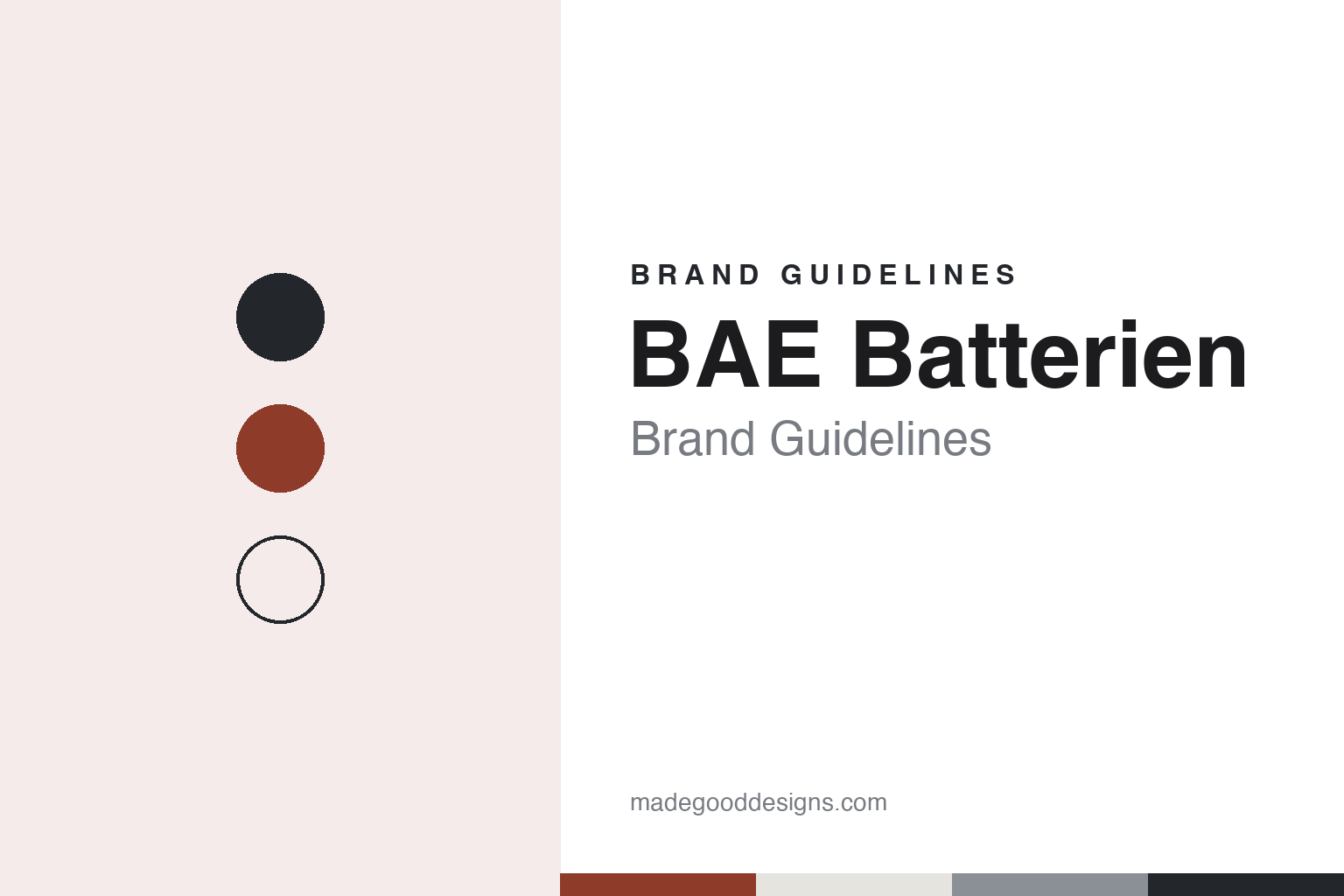
Two constants: a BAE clinker red, graphite and grey palette and a works serif register. Abstract homage — not a BAE Batterien product or mark; no battery, logo or label is reproduced.
Akkumulatorenwerke Oberspree
A battery works in Berlin’s electrical district.
BAE Batterien makes lead-acid batteries in Berlin-Oberschöneweide, on a factory site where batteries have been made since 1899. The business began that year as the Akkumulatorenwerke Oberspree AG. German Wikipedia says the first halls were built by the Gesellschaft für elektrische Unternehmungen to make lead accumulators for AEG; the company’s own history credits Ludwig Löwe as founder and links the choice of site to AEG’s arrival there two years earlier. The district, the company says, became known as “Elektropolis.”
The works soon passed to the Accumulatoren-Fabrik AG (AFA), whose parent plant was in Hagen and which later became Varta. The date is given differently: the company says 1901, while German Wikipedia and the Berliner Zentrum Industriekultur give 1905. The sources agree that the VARTA name, an abbreviation for the sale, charging and repair of portable accumulators, began here in 1904. From 1905 the plant made portable lead batteries for torches, telegraphs and signal equipment, and from the 1920s starter batteries for cars, German Wikipedia says.
In 1922 Günther Quandt took a majority of AFA. The Berliner Zentrum Industriekultur says the Quandt group made the works Europe’s leading supplier of lead batteries for electric vehicles and aircraft, and credits the architect Jean Krämer with a large production hall on Ostendstraße built for assembly-line work; German Wikipedia attributes the 1920s Ostendstraße building to Bruno Buch.
During the Second World War the plant worked for the German military. The Berliner Zentrum Industriekultur states that the firm had accumulators for U-boats and V2 rockets produced by forced labourers, women and men. German Wikipedia’s article on Varta, citing a 2003 study of the former Nazi forced-labour camp in Schöneweide, records that AFA used foreign forced labourers, prisoners of war and concentration-camp prisoners at plants including Hagen, Hannover-Stöcken, Posen and Vienna, and that hundreds of imprisoned women did forced labour at the group’s Pertrix works in nearby Niederschöneweide.
Colour
Expropriation, a VEB and the Treuhand.
In 1945 AFA lost the works. The plant lay in the Soviet sector of Berlin; German Wikipedia says the owners were expropriated and the business became a Soviet-German stock company making torches and batteries mainly for the Red Army. The company and the Berliner Zentrum Industriekultur both say it was renamed the Akkumulatorenfabrik Oberschöneweide (AFO), and that in 1958 it was merged with the Berliner Elementefabrik, Belfa, to form the VEB Berliner Akkumulatoren- und Elementefabrik, the BAE of today’s name. German Wikipedia calls it the largest producer of batteries and accumulators in the GDR; from the late 1970s its products were sold under the AKA electric marketing brand.
Under the planned economy BAE concentrated on batteries for railways. The company says that by the end of the 1980s it was the largest supplier of rail-vehicle batteries to the Comecon countries; the Berliner Zentrum Industriekultur describes it as one of the leading suppliers of such batteries to the socialist states.
After reunification BAE passed to the Treuhandanstalt in 1990, the company says, and made batteries under licence for VARTA. When that agreement ended it was privatised in 1993 as BAE Batterien GmbH; German Wikipedia describes a management buy-out by East Berlin plant directors and industry figures that kept it from closing. In 2005 a new investor was sought by tender, and the Dutch businessman Jan IJspeert took over, serving as managing director from 2007 while keeping the historic name, German Wikipedia says.
Typography
How industrial battery makers present themselves.
Industrial batteries are rarely seen by the people who depend on them. They sit under the seat of a forklift truck, in a locked room behind a telephone exchange or in the cabinets that keep a data centre running when the mains fail, so the makers in this guide have to show their products in places most readers will never visit.
Their pictures tend to come from a small set of scenes. There are rows of cells on a factory floor, forklift batteries packed into steel trays, standby racks lined up in data centres and telecom rooms, and cutaway diagrams that open a cell to show its plates, separators and chemistry. Newer lithium makers add architects’ renderings of large cell factories, and the oldest firms reach back to photographs of early lead and nickel works and to the railway, telephone and submarine customers they first supplied.
The trade is also a story of ownership. Many of these names have passed through electrical groups, private equity funds, stock markets and energy companies, and several survive mainly as brands inside larger groups. Regulators have looked at the trade too: in 2017 Germany’s competition authority fined two makers of industrial batteries over a shared lead surcharge, and a French heritage inventory has recorded one maker’s Bordeaux factory buildings as industrial architecture.
This guide sets out what can be checked about each brand — who founded it, who owns it, where it says its batteries are made and which product names it uses — and marks clearly what rests only on the company’s own word. The colours and typefaces shown are our own interpretation, not official brand assets.
Aa
A works serif for a company named after its East German predecessor. (Specimen set in Source Serif 4, a serif STAND-IN; NOT the BAE Batterien logo.)
BAE Batterien
Standby, rail and motive power from Oberschöneweide.
Today BAE describes its core business as lead batteries for stationary systems where power must not be interrupted: backup supply for data centres, hospitals, energy utilities and telecommunications. It also makes batteries for rail vehicles and industrial trucks, and batteries for photovoltaic systems, the company says. Its stationary range comes in vented, low-maintenance versions and sealed VRLA gel versions, with grid-plate types named OGi and OGiV and tubular-plate types named OPzS and OPzV; its brochure carries the name SECURA. The company says its products are certified to DIN EN ISO 9001, 14001 and 45001.
In 2021 the circle around BAE grew. BEST Magazine reported on 9 April 2021 that the German lead-acid maker Moll Batterien, insolvent for a year, had been bought by an investor consortium led by Jan IJspeert, managing director of BAE Holding and BAE Batterien, with the transfer due on 1 May. The magazine described BAE as a medium-sized company with a 120-year tradition in industrial lead batteries, whose core business is stationary batteries, alongside motive power and railway applications.
The site itself carries the brand’s history. The Berliner Zentrum Industriekultur counts BAE among the last traditional manufacturers in Oberschöneweide, and German Wikipedia notes that the factory buildings are a listed monument complex whose old industrial halls have been restored since the late 1990s.
For a design guide, BAE Batterien shows how a battery maker can carry a long and difficult factory history, from AFA and VARTA through forced labour, a VEB and privatisation, under a name taken from its East German predecessor. Compare VARTA and MIDAC. For this guide we use a clinker red, graphite and a lead grey with a serif, an unofficial interpretation; no product or logo is reproduced.
Explore & save
Keep BAE Batterien’s identity on hand — save it to a board in the Made Good inspiration library.
BAE Batterien identity set
Pin the BAE clinker red, graphite and grey palette and the works serif register to your own board.