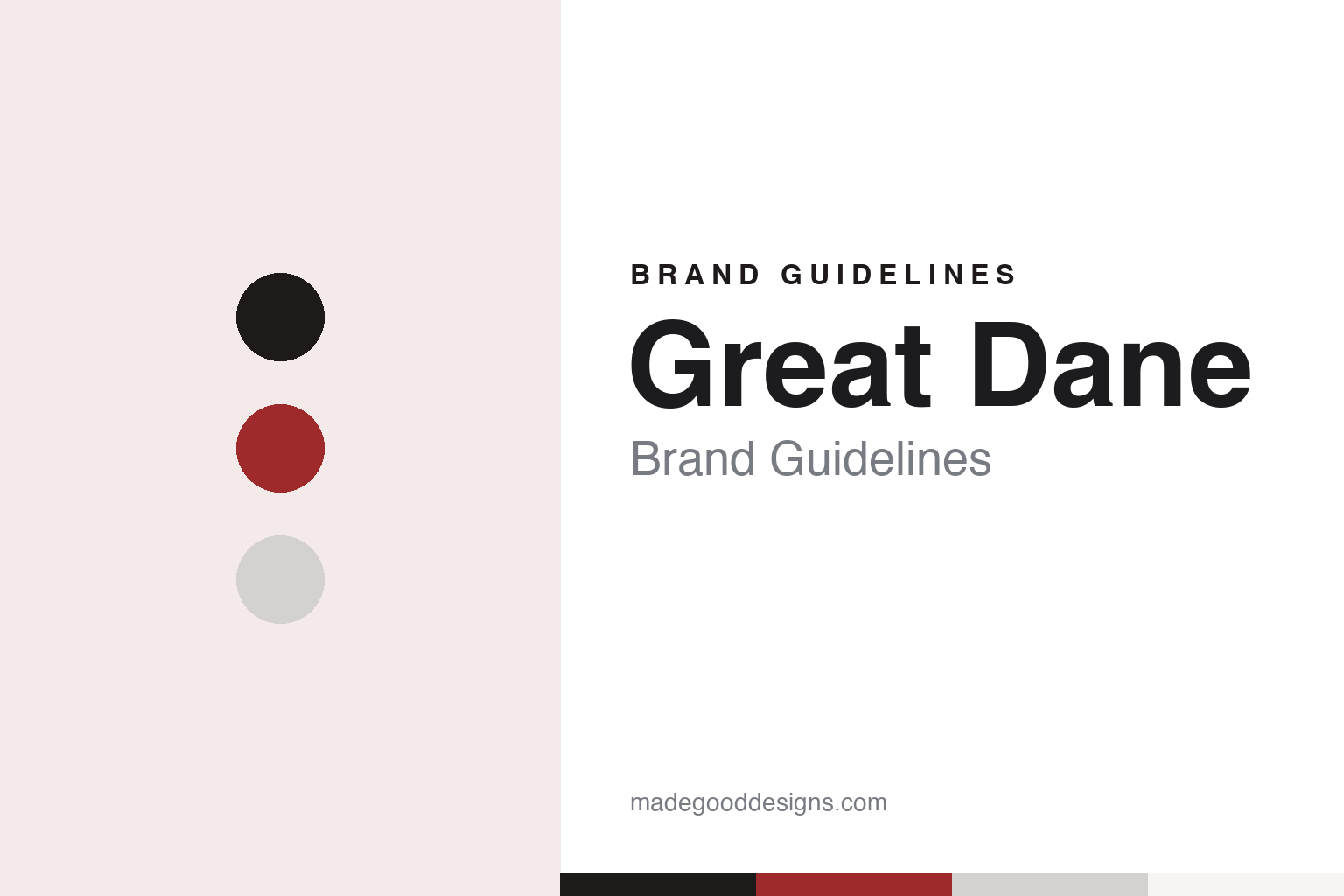
Great Dane Brand Guidelines
The Savannah blowpipe shop whose trailers took a dog’s name.
Aa
Two constants: a red, black and silver palette and a condensed sans register. Abstract homage — not a Great Dane product or mark; no trailer, logo or nameplate is reproduced.
Blowpipes to trailers
Sawmill ducting, steel plate and a highway opportunity.
Great Dane began in Savannah, Georgia, in 1900 as the Savannah Blow Pipe Company. English Wikipedia names its founders as J.P. Wheless and T.H. McMillan; the company’s own history describes it fabricating sheet-metal blowpipe systems and cyclone dust collectors for mills in the American Southeast. By 1916 it was making light structural steel and steel plate in a new 10,000-square-foot plant on Lathrop Avenue in Savannah, a site the company says it used for nearly a century.
Trailers came later, and the sources date the turn differently. The company says that during the Depression its chairman approved its first over-the-road trailer and that in 1931 the business became The Steel Products Company; English Wikipedia gives 1916 for that name. In a 2025 interview with Trailer/Body Builders, executive vice president Chris Hammond dated the company’s first flatbed trailer to 1911. The first highway trailers were flatbeds, and tank trailers and enclosed vans followed by 1934, English Wikipedia says.
The name came from those trailers. The company credits William Lowndes, a trailer builder from Greenville, South Carolina, and his employees with calling them “Great Danes,” after the dog, a nickname that became the brand. In the Second World War the company built trailers for the US Army: English Wikipedia says about 12,000 on government contracts, and the company says it received the Army-Navy “E” award five times. Trailer/Body Builders reported in 2025 that Great Dane was a charter founder of the Truck Trailer Manufacturers Association in 1941.
Colour
Reefers, a red oval and plants across the country.
Refrigerated trailers became a Great Dane speciality. The company says its early reefers used a gas engine and blower to push air over blocks of ice, and English Wikipedia dates the first of them to 1947, followed by the Sno-Zone line. After the 1956 Interstate highway act, the company built longer and lighter trailers in aluminum, and by the end of the decade had phased out structural steel to concentrate on trailers, its history says.
In 1958 the company changed its name from The Steel Products Company to Great Dane Trailers. To mark the change, the company says, a red background was added to its signature logo; English Wikipedia describes the dog oval as black before that date. Piggyback trailers for railroads followed in 1961 and maritime containers in 1963, and in 1966, the company says, it partnered with Adamson & Hatchett in Dukinfield, England, and Van Hool in Koningshooikt, Belgium.
Manufacturing spread well beyond Savannah. The company lists a platform-trailer plant in Memphis bought with Arrow Trailers, a dry-van plant in Brazil, Indiana — the largest, according to English Wikipedia — a research and development centre opened in 1974, the SuperSeal reefer plant in Wayne, Nebraska, in 1988 and a dry-van plant in Terre Haute in 1996. In 2002 it bought plants from Strick and Trailmobile, and it later opened a reefer plant in Statesboro, Georgia, and a dry-van plant in Elysburg, Pennsylvania, in 2016. English Wikipedia says the original Savannah plant closed in 2009. In March 2007 Truckinginfo reported that Great Dane had shipped more than 60,000 trailers from nine factories in 2006, a company record.
The company also renamed its ranges. When it dropped “Trailers” from its name — in 2011, English Wikipedia says — dry vans became Champion, reefers Everest and flatbeds Freedom, with Alpine and Sahara truck bodies and a new oval on the rear of its vans, the company says.
Typography
How trailer makers present themselves.
Truck trailer makers sell a product that spends its working life on the road, and much of their imagery starts there: a long semi-trailer seen side-on on a motorway, a curtainsider rounding a bend, a tipper on a building site. The trailer is often the largest flat surface in a fleet, so the maker’s own name tends to sit small, on a plate, a mudguard or the front wall, while the customer’s livery fills the sides.
Bodies set the look of each category. Refrigerated box trailers are usually shown in plain white, with a cooling unit on the front wall, because the panels are built to be clean and easy to brand. Curtainsiders carry printed fleet colours on their sliding sides. Tippers are shown with their steel or aluminium bodies raised, and low-loaders with a heavy load chained down.
Factory photography is the second register. Makers show lines of bare chassis waiting for axles, paint and coating halls, sandwich panels being bonded and finished trailers parked in rows outside the plant. Product names tend to be short codes or coined words that sort ranges by body type, which helps fleets order the same specification year after year.
The third register is the trade fair and the dealer yard. IAA Transportation in Hanover and similar shows give makers a stand where new chassis, lighter bodies and telematics are lined up for fleets and the trade press. Dealers, rental firms and used-trailer centres then carry the brand into regional markets, where the customer is usually a haulier, a fleet manager or a logistics buyer rather than a member of the public.
Aa
A condensed sans for a name painted on trailer doors. (Specimen set in Barlow Condensed, a sans STAND-IN; NOT the Great Dane logo.)
The Crown years
From a public conglomerate to a family-held company.
Great Dane’s ownership has changed more than once. In the 2025 Trailer/Body Builders interview, president Rick Mullininx said that in the 1980s Great Dane had been taken public as part of Transway and was left heavily indebted after a leveraged buyout. The turning point came from a smaller rival: Pines Trailer, the family business of Phill Pines, had formed a partnership with the Crown family of Chicago in 1988, and in January 1997 that partnership acquired Great Dane, Transport Topics and Trailer/Body Builders reported in July 2010. The merger created Great Dane Limited Partnership, which the company describes as one of the world’s largest trailer makers. The 2010 reports named Bill Crown as chief executive of Great Dane and president of CC Industries, the Crown family’s holding company.
Today Great Dane describes itself as privately held, with offices in Savannah and Chicago; in 2025 Mullininx called it “a privately held Crown company.” Its range covers dry and refrigerated trailers and truck bodies and steel, aluminum and combination platform trailers, its website says, and English Wikipedia reports a new all-aluminum flatbed, the Freedom Ultra, in 2026. The company names the patented ThermoGuard reefer lining and the FleetPulse smart-trailer system among its recent developments; Mullininx said in 2025 that FleetPulse began at Great Dane and is now its own company.
The brand itself was refreshed in February 2022, when the company introduced an updated version of its Great Dane logo, including an update to “Champ,” the company says. It marked 125 years in 2025.
For a design guide, Great Dane shows how a nickname and one colour change can carry a company for nearly a century. Compare Wabash, which sold Great Dane a Tennessee plant in 2004, according to English Wikipedia, and Stoughton Trailers. For this guide we use a deep red, near-black and silver with a condensed sans, an unofficial interpretation; no product or logo is reproduced.
Explore & save
Keep Great Dane’s identity on hand — save it to a board in the Made Good inspiration library.
Great Dane identity set
Pin the Great Dane red, black and silver palette and the condensed sans register to your own board.