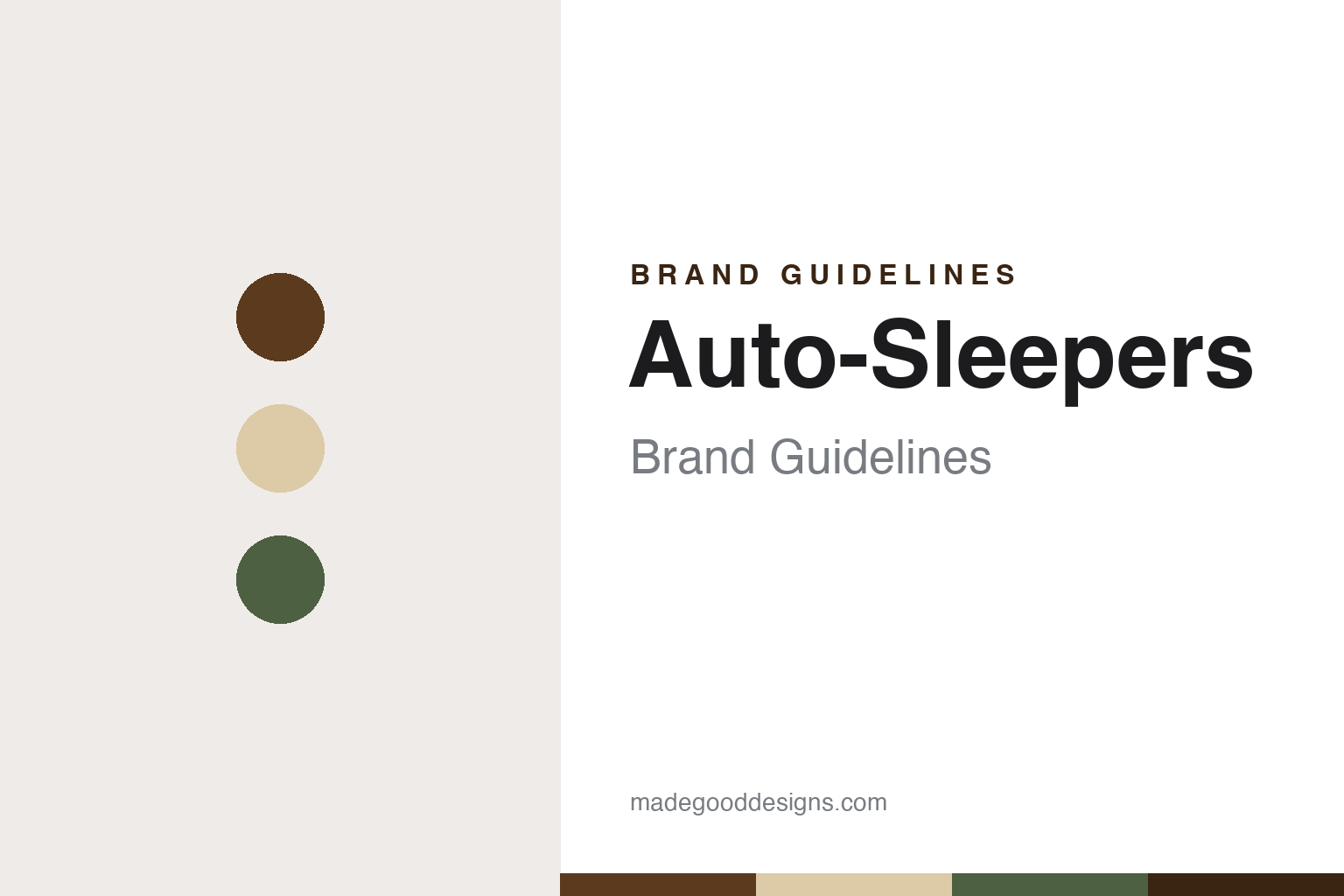
Auto-Sleepers Brand Guidelines
The Cotswolds motorhome maker that began with one family’s holiday van.
Aa
Two constants: an oak brown and Cotswold limestone palette and a traditional text serif register. Abstract homage — not an Auto-Sleepers product or mark; no vehicle, logo or badge is reproduced.
A Holiday Van
A Morris J2, the South of France and five more orders.
Auto-Sleepers began with a holiday. In 1961, the company says, the Trevelyan family and their two young sons wanted a touring holiday with a difference, so they built their own motorhome on a Morris J2 van and drove it to the South of France. A second conversion, on an Austin, caught the attention of Henlys of Bristol, a dealer, which ordered five more. The family took on a local builder, Bob Halling, as a subcontractor, and he later became Works Manager. The same outline appears in the Caravan and Motorhome Club’s profile of the company and in a 60th-anniversary feature by Peter Vaughan in What Motorhome in June 2021, which notes that the company has always been based in the Cotswolds. Trigano’s accounts also give 1961 as the founding year.
The name needs a small note. The company is Auto-Sleepers, with the plural, and calls each vehicle an Auto-Sleeper in the singular; its own pages use both forms.
Its home is Willersey, a Gloucestershire village in the Cotswolds with a Worcestershire postal address near Broadway, and that is where the company says its design, engineering and manufacturing teams still work. What Motorhome says Commer vans were the mainstay of the early years, with Bedfords and Ford Transits joining later. Until the late 1970s, the magazine says, every Auto-Sleeper was van-based, with a solid-sided elevating roof and handcrafted light oak furniture that together became a trademark of the marque.
Colour
William Towns, glass fibre and a high-top.
The first big design moment came at the end of the 1970s. What Motorhome names the Bedford CB22 as the first coachbuilt, followed by the SV100, on a Bedford CF, styled by William Towns, who also designed for Aston Martin. It had a monocoque body in reinforced glass fibre, and the magazine says it looked like no other motorhome of its day. The company’s own history calls the SV100 the start of a new era in its design, and English Wikipedia describes the monocoque as a two-piece clamshell unit. Similar bodies followed on Ford, Mercedes, Talbot and Volkswagen vehicles, under names including Amethyst, Clubman, Talisman and Legend.
The second moment was quieter. The CX200 of 1981, What Motorhome says, was a high-top van conversion with a toilet compartment, at a time when campervans almost always had an elevating roof, and it calls the model a landmark for the whole industry. The idea was carried on by the Harmony, Rambler and Symphony on the Talbot Express.
Construction changed again in the late 1990s, when more conventional sandwich-built coachbuilts arrived on Peugeot chassis, and the monocoques faded, with a brief return in 2011 for the 50th anniversary. Mercedes-based coachbuilts began as a Marquis-only range called County, named after English counties where the dealer had branches, the magazine says, before joining the main line-up.
Today’s website divides the range into campervans and motorhomes on Fiat and Mercedes-Benz bases. The names now point at the map: Broadway, Burford, Bourton and Kingham, which What Motorhome describes as recalling Cotswold villages. In 2021 the magazine called Auto-Sleepers the top-selling van conversion brand in the UK.
Recognition comes mostly from the British motorhome trade and its clubs. The company lists wins at the Caravan and Motorhome Club’s Motorhome and Campervan Design Awards in most recent years, and the Club’s own site confirms the Symbol as a 2026 winner among fixed-roof van conversions of six metres and under. The company also lists Practical Motorhome awards in 2026 for the Burford Duo and the Fiat Active FL 635.
Typography
Design and documentation.
Motorhome makers tend to sell a picture before they sell a vehicle: a white van on a pitch by the sea, doors open, with the road implied behind it. The colour itself has a history in the category. Chausson says it was the first maker to “dare” white bodywork, on its 1984 overcabs.
The second image is more technical. Layout is what buyers compare, so makers lean on plans, cut-away views and model numbers that stand for a floor plan. Chausson’s 2027 catalogue, for instance, explains a lounge feature by listing the numbered models that have it, and Rapido’s vans run from V55 to V68. Rapido’s website offers a comparison tool and 360-degree views of its models, and Chausson’s invites buyers to compare its ranges by the way they want to travel.
The third setting is the dealer forecourt. Chausson says it reaches more than 15 European countries through specialist distributors, and Trigano, its parent, created the Libertium dealership network in 2023 and says it has 70 sales outlets. Rapido’s history shows how early this mattered: Le Journal des Entreprises counts ten dealers in the brand’s first years of rigid caravans.
The category’s annual stage is the Caravan Salon in Düsseldorf. The fair calls itself the world’s leading trade fair for mobile travel, and reports 259,000 visitors in 2026, with 834 exhibitors from 41 countries in 15 halls and on the outdoor grounds. It says those visitors covered more than 250,000 square metres of motorhomes, caravans, roof-top tents and equipment, which puts whole vehicles, not just pictures of them, in front of the public. The next edition runs from 27 August to 5 September 2027.
Aa
A traditional text serif. (Specimen set in Source Serif 4, a serif STAND-IN; NOT the Auto-Sleepers logo.)
Auto-Sleepers
A family firm that became part of a French group.
The ownership story is not simple, and the sources do not all agree. English Wikipedia says the Trevelyan family sold the business in 1997 to Steven Riley and Bill Cook, keeping a small holding, and that in 2000 it went to Ian Capes and Stuart Johnson, whose Marquis company was acquired by the Italian group SEA in 2005. It also says directors Geoff Scott and Mike Crouch took the shareholding in June 2009. The Caravan and Motorhome Club’s profile says the company joined Trigano in 2009; Auto-Sleepers’ own history gives 2017.
Trigano’s own accounts give the detail, as published in the French official bulletin BALO on 2 February 2018. They say Trigano had held the B shares of Auto-Sleepers Investments, carrying 49.99 per cent of votes and dividends, since it acquired SEA in 2013. On 3 January 2017 it took control by buying 52 per cent of the A shares, with the remaining A shares to follow by 2021. Caravan Times reported on 12 January 2017 that the deal also covered Marquis Leisure, the dealer network, and that Scott and Crouch stayed in their roles and remained shareholders.
The company says it still designs and builds in Willersey, and describes computer-cut components finished by hand in-house, with furniture-grade plywood and cam-and-dowel assembly. In its 65th year it joined Made in Britain, Caravan Times reported on 9 October 2026, under a protected mark for manufacturers in Great Britain and Northern Ireland. The anniversary also brought the LXV Collection, four models the company calls exclusive anniversary editions.
Its website loads the Merriweather serif and the Raleway sans from Google Fonts.
For a design guide, Auto-Sleepers shows how a brand can keep its origin story at the front through changes of owner: one family, one van, one village. Compare Chausson, a sister brand under Trigano, and Swift, another British maker. For this guide we use an oak brown and a Cotswold limestone with a serif, an unofficial interpretation; no product or logo is reproduced.
Explore & save
Keep Auto-Sleepers’s identity on hand — save it to a board in the Made Good inspiration library.
Auto-Sleepers identity set
Pin the Auto-Sleepers oak brown and Cotswold limestone palette and the traditional text serif register to your own board.