World Vision Brand Guidelines
A Korean War charity that learned to raise money with a camera.
Aa
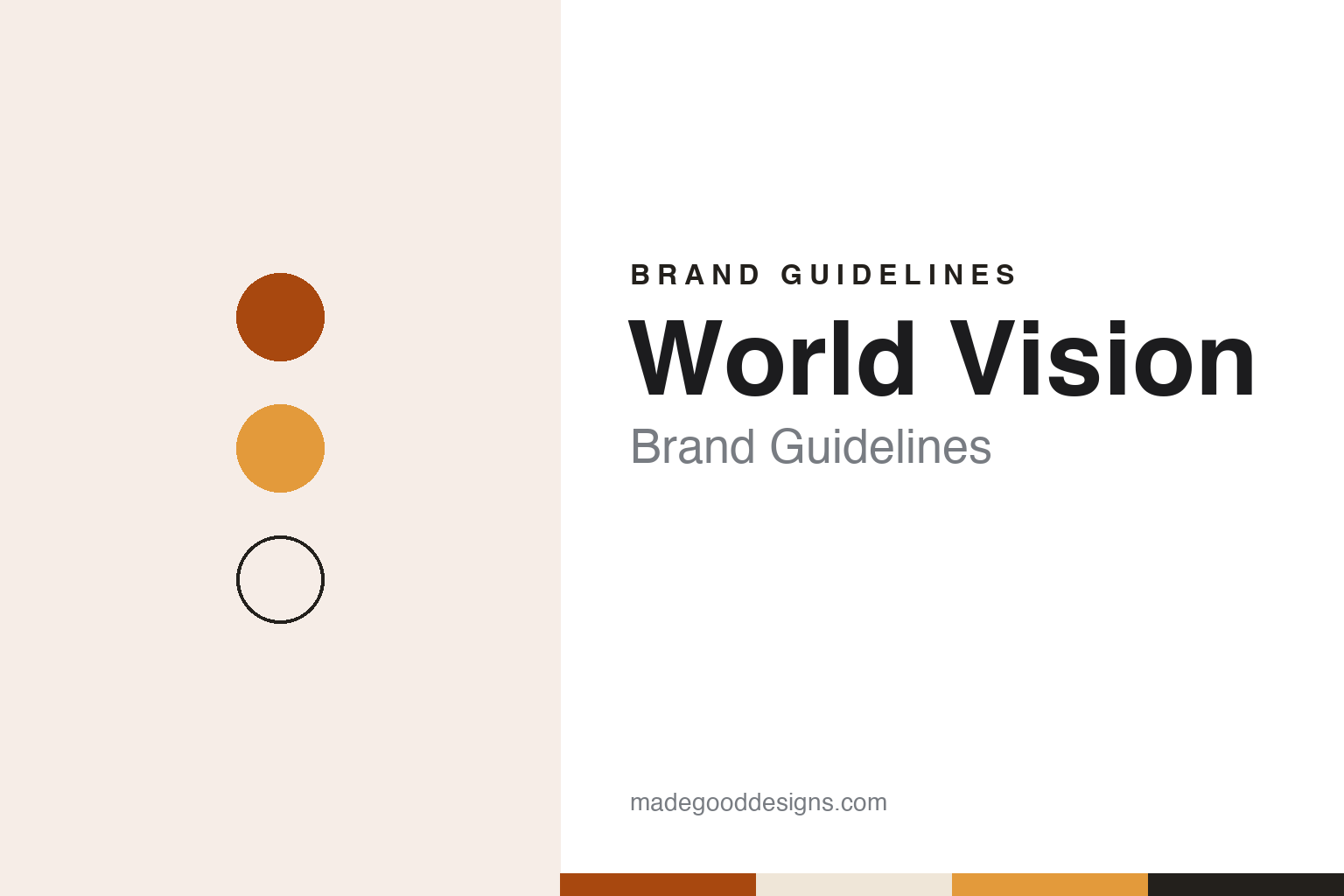
Two constants: a burnt orange, sand and ink palette and a humanist sans register. Abstract homage — not a World Vision asset; no logo, photograph or sponsorship material is reproduced.
A camera in Asia
An evangelist, a Korean pastor and a war.
World Vision was founded in 1950. Accounts of its beginning differ in emphasis. Christianity Today, in a 2005 profile, says the American evangelist Robert “Bob” Pierce incorporated what had been a personal crusade as World Vision that year. English and Korean Wikipedia name two founders: Pierce and the Korean Presbyterian minister Kyung-Chik Han of Young Nak Church, who, English Wikipedia says, invited Pierce to speak in Korea weeks before the Korean War broke out. The first office opened in Portland, Oregon, later in 1950, and a second followed in Korea in 1954.
Pierce had come to Asia through the Youth for Christ movement. English Wikipedia’s page on him says that on a trip to China a missionary teacher, Tena Hoelkeboer, presented him with an abandoned child, and that he agreed to send a monthly sum for her care. English Wikipedia’s page on World Vision United States traces the idea of funding for children to such a promise. A 2019 Christianity Today review of David King’s history God’s Internationalists says that once China closed to missionaries Pierce turned to Korea, and that by the end of the 1950s World Vision was caring for about 13,000 children, with 79 percent of its annual budget committed to orphans.
The early marketing tool was the film. Christianity Today describes Pierce dragging a movie camera across Asia, showing the pictures to church audiences in North America and asking them to “adopt” a child. English Wikipedia says the films were shown mainly in churches and carried the anti-communist language of the Cold War. Pierce clashed with his board and resigned in 1967; he went on to lead the organisation that became Samaritan’s Purse.
The group’s work widened after him. King’s account, as summarised by Christianity Today, has World Vision building refugee centres and hospitals during the Vietnam War, and growing from eight to 40 countries of operation in the 1970s. From 1966 the American body also used the name World Vision International, English Wikipedia says; from 1977 that name was kept for a separate umbrella organisation, and the founding body became World Vision United States.
Colour
From church film nights to television.
World Vision’s public face has always followed its media. After the films came what King calls “planned famines”: youth groups fasting for 40 hours to raise money, a format the same review describes alongside a “Love Loaf” campaign that asked families to skip one meal a week. In the 1980s the marketing team moved towards direct mail and television, and by 1984, Christianity Today reports, 86 percent of World Vision’s donors came through television.
The pictures themselves caused argument. The same review records internal fights over the use of images of malnourished children and over the value of child sponsorship. English Wikipedia says the organisation claims to uphold the dignity of children and families in its communications, and that in places too dangerous for news crews its own videographers have supplied footage to broadcasters.
Sponsorship has been questioned from outside as well. In a 2008 report on famine in Ethiopia, the reporter Andrew Geoghegan of the Australian programme Foreign Correspondent visited his sponsored child and described a gap between what he had been told and what he found, English Wikipedia says. World Vision replied that it “unapologetically takes a community-based approach to development,” with money going to community projects rather than directly to a family.
The structure is a federation. English Wikipedia describes World Vision International as setting global standards and overseeing a partnership of interdependent national offices, some operated directly and others registered locally with their own boards. Each national member signs a Covenant of Partnership and accepts a shared Statement of Faith. King credits the federal model with giving Latin American, Asian and African offices real independence from American evangelical opinion.
Faith remains part of the name’s meaning. World Vision’s American site calls it “a faith-based global charity powered by Jesus’ love.” Its staff come from Protestant, Catholic and Orthodox traditions, English Wikipedia says, and Richard Stearns, a former president of World Vision US, described a strict policy against proselytising.
The mark carries that faith plainly. World Vision New Zealand says the logo is “a symbol of hope,” with a cross in the corner standing for its Christian faith and a corner horizon for hope and optimism, while the logotype reflects a multicultural partnership. In August 2017 Transform magazine reported a brand project led by the Australian office of Interbrand, which changed the logo and wider identity to reach a new generation of supporters; it named Gill Sans as the key font, with a bolder, subtler wordmark paired with posters.
Typography
How these groups present themselves.
A campaigning group has to be recognised in places a company rarely goes: on a banner at a protest, on the side of a boat, on a lapel, on the cover of a report about something grim. That pressure shapes how these organisations present themselves, and the published guidelines of two of them show how it is handled.
Greenpeace’s visual identity guidelines say its yellow campaign banners have been used in non-violent direct actions for more than 40 years, and they build a colour rule around them. Its display type, Zodiac Sans, was drawn from the shape of inflatable boats, according to the studio that made it. Ships are a medium in their own right: the guidelines keep the rainbow for Greenpeace vessels. Even the logo began, by the group’s own account, as a felt-tip word on a beer mat.
Amnesty International offers the matching case at a smaller scale. Its candle in barbed wire, which Wikipedia says was first drawn for a Christmas card, appears on a pin badge the group sells, and its 2015 toolkit sets a minimum height for the wordmark. The same toolkit asks for yellow to be used sparingly and keeps the logo out of cover photos on social media. The Nobel Prize’s record notes that the group’s findings are published in special reports, so the report cover is one of its everyday surfaces.
Field photography has rules of its own. Amnesty’s toolkit says images should never be sensationalist and should show people as individuals with their own stories, with the date, names and location in the caption. Greenpeace’s guidelines, for their part, cite a single picture from the whaling campaigns, a small inflatable between the harpoon and the whale, as an image that tells its story on sight.
Aa
A humanist sans — Transform reported Gill Sans as the key font in 2017. (Specimen set in Cabin, a sans STAND-IN; NOT the World Vision logo or its typeface.)
Gaza and other tests
A conviction the charity has contested.
The most serious chapter of World Vision’s recent history began on 15 June 2016, when Israel arrested Mohammad el-Halabi, its manager in Gaza, at the Erez crossing. Prosecutors accused him of diverting World Vision funds and materials to Hamas. World Vision stopped working in Gaza after the arrest, Christianity Today reported, and the Australian government suspended its funding for the Gaza programme, according to English Wikipedia.
The charity hired Deloitte and the law firm DLA Piper to investigate. The lead lawyer told Christianity Today that the review, covering more than 280,000 documents, “did not find even a hint of funds being diverted to Hamas.” World Vision did not publish the audit, English Wikipedia says. On 15 June 2022 the Beersheba District Court convicted him on terrorism charges, relying heavily on a confession he later withdrew and on classified evidence, and that August he was sentenced to 12 years. World Vision called the verdict unjust and cited irregularities in the trial. The UN human rights office and other observers criticised the secrecy of the proceedings.
He has continued to deny the charges. English Wikipedia says he was released to Gaza on 1 February 2025 in a prisoner exchange, and that Israel’s Supreme Court suspended his appeal in March 2026. In February 2026 the Israeli research group NGO Monitor published documents it said came from Hamas’s interior ministry, which it presents as showing that he was a Hamas operative and that the group worked to obstruct the trial. That is NGO Monitor’s reading of the documents.
This was not World Vision’s first clash in the region. In 1982 it publicly criticised Israeli actions at Palestinian refugee camps in Lebanon and came under attack from conservative evangelicals and the Israeli government, English Wikipedia says.
At home, its Christian identity has met legal and public tests. In August 2010 the Ninth Circuit court of appeals held that World Vision counted as a religious corporation and could dismiss two employees over their beliefs. In March 2014 World Vision US said it would hire Christians in same-sex marriages, then reversed the change two days later after protests from donors and evangelicals.
For a design guide, World Vision shows how a charity’s identity can be shaped by the medium it raises money in, from church film to television to the sponsored child’s face. Compare Save the Children, another name built on the care of children, and Oxfam. For this guide we use a burnt orange, sand and ink with a sans, an unofficial interpretation; no product or logo is reproduced.
Explore & save
Keep World Vision’s identity on hand — save it to a board in the Made Good inspiration library.
World Vision identity set
Pin the World Vision burnt orange, sand and ink palette and the humanist sans register to your own board.