Boxabl Brand Guidelines
The North Las Vegas folding house that went from crowdfunding to Nasdaq.
Aa
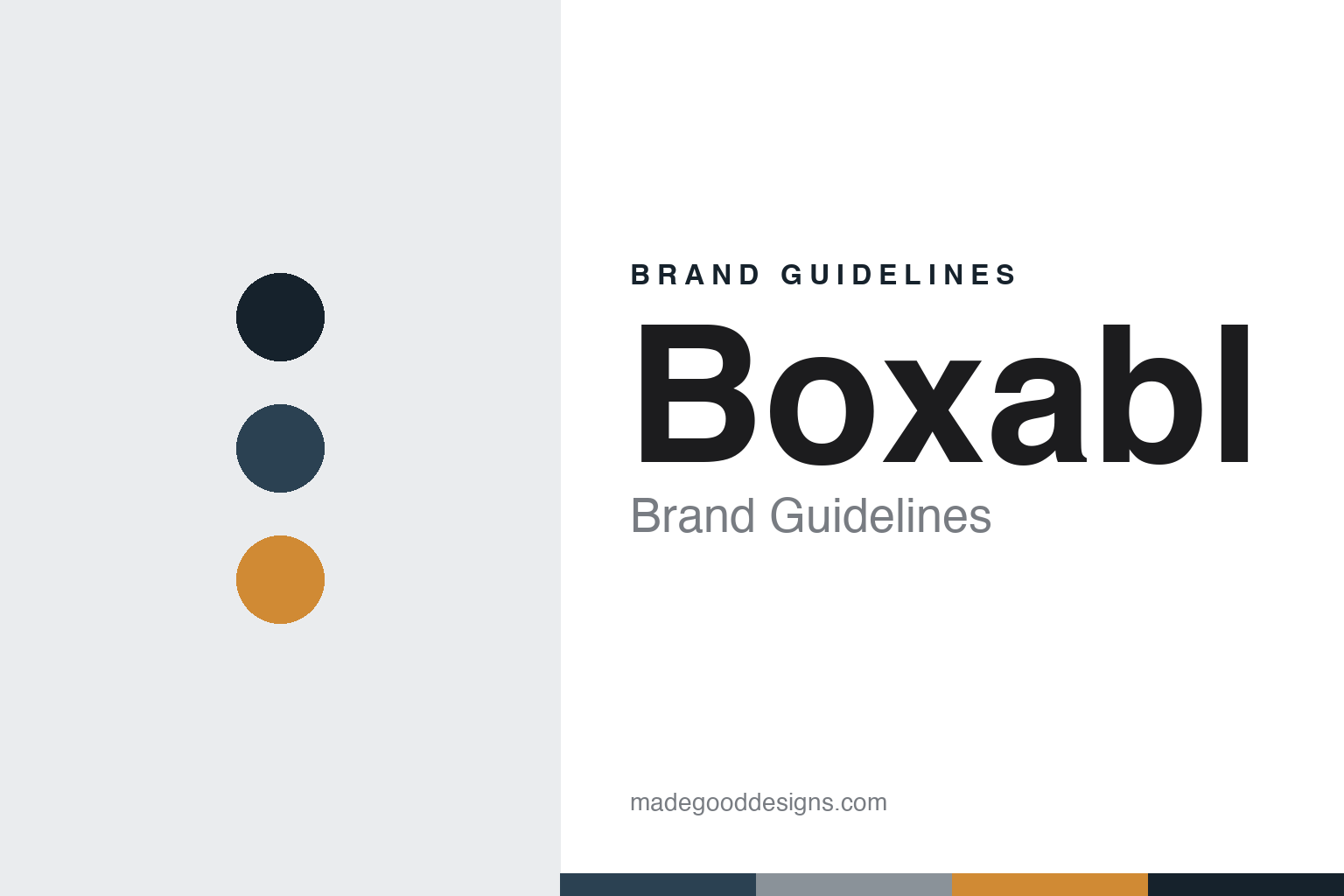
Two constants: a Boxabl slate and amber palette and an Industrial sans register. Abstract homage — not a Boxabl product or mark; no building, logo or nameplate is reproduced.
The Room Module
A father and son, and a house that folds.
Boxabl makes factory-built housing in North Las Vegas, Nevada. The company dates its inception to 2017, and its founders are Paolo Tiramani and Galiano Tiramani, who now lead it as co-chief executives, HousingWire reported in August 2025. Startup Fortune described them as father and son in July 2026. Citing the company’s filings, it called Paolo an industrial designer and mechanical engineer with more than 150 patent filings, and said Galiano had earlier founded a cryptocurrency exchange and ATM network.
The idea began small. KVVU, the Las Vegas television station, reported in January 2022 that Boxabl started as a concept for backyard accessory dwelling units, or ADUs, in California. Galiano Tiramani described the business more broadly to the station: “we just make the room module, and then sell the room module to the builder.”
The folding is the point of the brand. Freethink explained in August 2022 that a Casita ships in a folded form just 8 feet wide, against the 14 feet it gave as typical for modular homes, which are subject to oversized-load rules. The house is made of steel, concrete and expanded polystyrene foam, the same report said, and arrives with its appliances, plumbing, electrics and HVAC already fitted; local utilities connect them on site.
Production is in North Las Vegas. KVVU reported that Boxabl had moved into a new factory there a few months before January 2022, by which point Galiano Tiramani said the waitlist held more than 70,000 names. Freethink reported a second factory by August 2022, a waitlist of 120,000 and about 200 houses built by that June. In July 2024 the company said factory buildings 1, 2 and 3 were open, and Startup Fortune put the footprint at 400,000 square feet in 2026. Boxabl says the Casita is manufactured inside its own facilities.
Colour
The Casita, the Baby Box and a catalogue.
The Casita has carried the name almost alone. Its stated size has moved over time: 375 square feet in KVVU’s 2022 report, 380 in Freethink’s, and 361 square feet in the company’s current releases, which describe a studio with a full kitchen, bathroom and utilities that unfolds on site in under an hour. The website now lists Casita Studio, One Bedroom and Two Bedroom versions. Beside them sits the Baby Box, a 120-square-foot unit that the company says is built to RV code for setups with no foundation.
The first large job was for the military. KVVU reported in January 2022 that Boxabl was finishing its first contract, for 150 homes for military housing sites; Freethink later reported that 156 Casitas had gone to the Department of Defense. That work did not run entirely smoothly. Bisnow reported in September 2023 that more than 150 units installed at Guantánamo Bay, Cuba, in 2021 and 2022 reportedly leaked, and that units installed for an Arizona mining company ran into permitting issues.
Approvals come state by state. In July 2024 the company said its Casita had been approved under the California Residential Building Code. In February 2026 it announced that California’s Department of Housing and Community Development had cut inspections of the Casita Studio line to 25 percent of units, and in May 2026 it said it had received approval to sell and deploy the Casita Studio across Texas.
The newer story is a system rather than one product. In June 2026 Boxabl launched a beta catalogue and configurator for what it calls Phase 2, saying three standardised box sizes could generate configurations for most residential types, from single-family homes to townhomes and garden apartments. The images it released were renderings. Its September 2026 project round-up listed a 12-unit stacked Casita scheme for Catholic Charities in Oklahoma City, and in October 2026 it said Sage Memorial Hospital in Ganado, Arizona, had broken ground on workforce housing with a first phase of 15 Studio Casitas.
Typography
Design and documentation.
Home builders that work in factories have an unusual problem of presentation. Their product is a house, a thing people expect to see standing on a street, yet much of what makes it distinctive happens indoors, long before anyone arrives on site. So the imagery of the category tends to start at the plant: walls moving along a line, panels stacked by size, roof sections waiting under a gantry. In a brochure, these pictures do the work that a craftsman’s portrait does elsewhere.
The second stage is the arrival. A section of house on a flatbed, a crane lifting a module over a hedge, a timber package unloaded in a clearing: these are the category’s most recognisable photographs. Log and timber makers add their own version, with stacks of numbered logs and yards of drying wood, so that the raw material becomes part of the sales story.
Then comes the place where buyers actually meet the product. Show villages and display parks let a family walk through several finished models in one afternoon, and sales lots do the same job along an American highway. Alongside them sits the catalogue, a storefront that travels by post. Its cover can show a single finished house, and its inside pages turn to cut-away drawings and floor plans, numbered and named like models of car.
That naming habit shapes the graphic side of the category. A plan may carry a code, a series title or a family name, and it has to sit comfortably beside a line drawing, a dimension table and a photograph. The result is a design language closer to a technical manual than a lifestyle magazine, softened by warm wood tones and a little domestic optimism. The guides that follow look at how individual builders have used it, and at the company history behind each one.
Aa
An industrial sans — “Housing Meets Mass Production.” (Specimen set in Archivo, a sans STAND-IN; NOT the Boxabl logo.)
Boxabl
Small investors, regulators and a public listing.
Boxabl raised its money largely from small investors. Bisnow reported in 2023 that its funding came mostly through crowdfunding, and the company says it has more than 50,000 investors. Startup Fortune named Republic and StartEngine as platforms used.
That public funding brought public scrutiny. In September 2023 Bisnow reported that Boxabl had acknowledged in a filing that it was “the subject of inquiries from the Securities and Exchange Commission.” Citing Business Insider, it said the SEC had issued two subpoenas to people familiar with the company; it also noted that the agency had not accused the company of wrongdoing and that inquiries do not always lead to enforcement actions. In July 2024 the company announced that the SEC’s Division of Enforcement had told it on July 12 that it had concluded its investigation and did not intend to recommend an enforcement action “at this time.”
The listing followed. Boxabl agreed in August 2025 to merge with FG Merger II Corp., a special purpose acquisition company; stockholders approved the deal on June 9, 2026, and it closed in July. FG Merger II was renamed BOXABL Inc., and the shares began trading on Nasdaq under BXBL on July 20, 2026.
The company’s filings give the production record. Startup Fortune reported that the 2025 annual report counted 795 Casitas made and 312 delivered, in 10 states, as of March 27, 2026, with 73 made in 2025 against 140 in 2024. The same report said the company had recorded substantial doubt about its ability to continue as a going concern, citing slower sales tied to delays in statewide modular approvals and customer readiness.
The brand speaks in big, plain lines. The website carries “The Future of Housing, Folded Into a Box” and “Housing Meets Mass Production,” with the name in capitals, and its releases add concepts that stretch the idea, such as the UFO, an “Unidentified Folding Object” off-world habitat, and a Server Pod for data centres.
For a design guide, Boxabl shows how one mechanical idea, a house that folds, can serve as product, name and sales pitch at once. Compare Katerra, another American attempt to run construction like a factory, and Champion Homes, another American maker of factory-built homes. For this guide we use a slate and an amber with a sans, an unofficial interpretation; no product or logo is reproduced.
Explore & save
Keep Boxabl’s identity on hand — save it to a board in the Made Good inspiration library.
Boxabl identity set
Pin the Boxabl slate and amber palette and the Industrial sans register to your own board.


