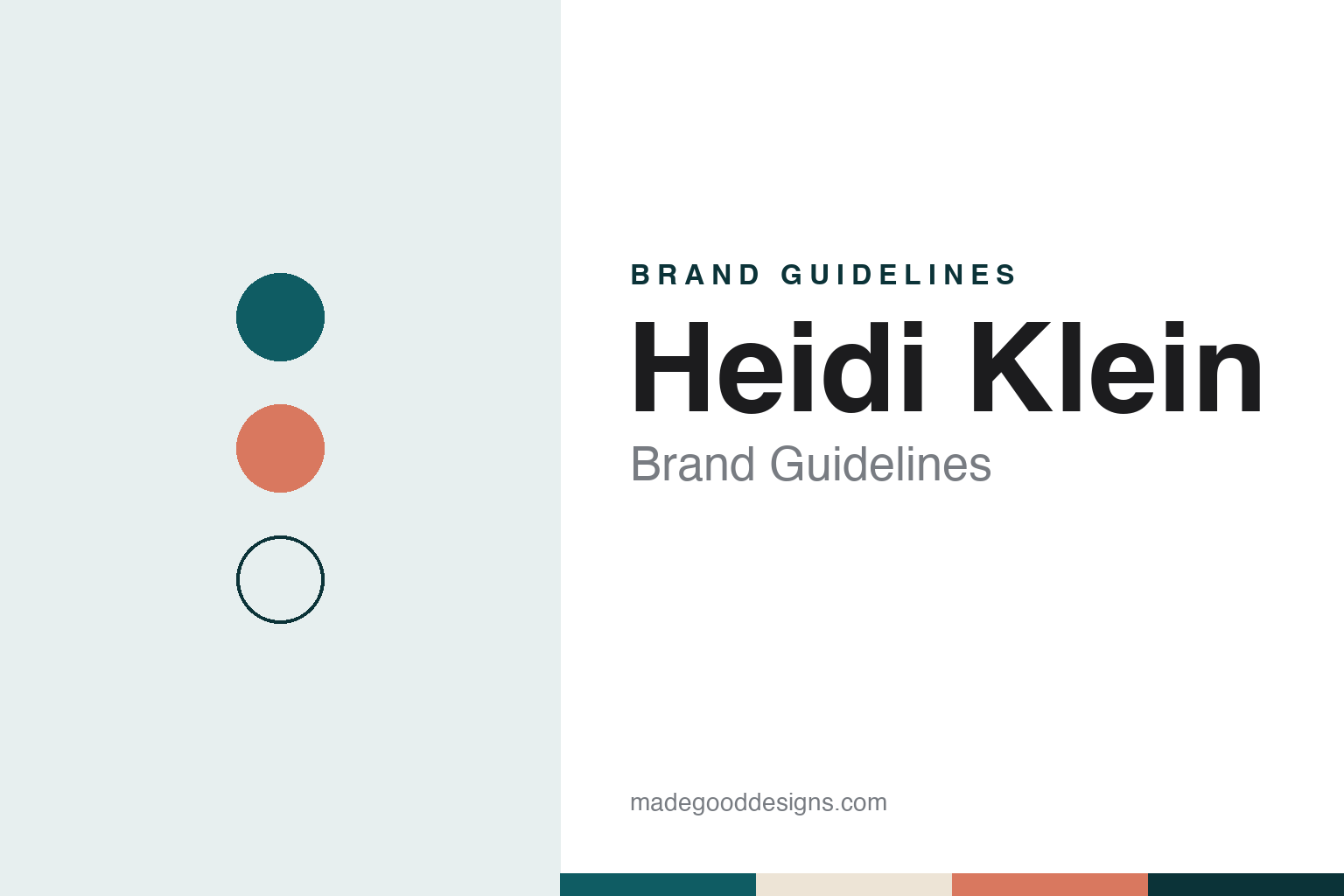
Heidi Klein Brand Guidelines
The Notting Hill holiday shop that became a swimwear label.
Aa
Two constants: a teal, sand and coral palette and a Resort serif register. Abstract homage — not a Heidi Klein product or mark; no garment, print or logo is reproduced.
A holiday shop
Two consultants and a shop open all year.
Heidi Klein began as a shop rather than a clothing line. The British Fashion Council’s London Fashion Week profile traces it to a Notting Hill concept store of 2002, set up by Heidi Gosman and Penny Klein, and Luxury London gave the same start when it interviewed Gosman in August 2024. No single person is called Heidi Klein: the name sets the first name of one founder beside the surname of the other. Companies House shows the company was incorporated on 12 July 2001, and the company’s own story page tells it slightly differently, saying the idea came in 2002 and the doors opened a year later.
Gosman told Luxury London that the two met at a consultancy in London, where they worked on a research project about airport spending. The idea followed a February diving holiday for which she could find almost nothing to buy: a few bikinis and one-pieces at the end of a rack on Bond Street, and a poor changing room. The pair saw a gap for a holiday shop that traded all year round. They spent about a year on a business plan and weighed a small shop in Wandsworth funded by a bank loan against raising money from investors. They chose investors, she said, and their first presentation fell three days after the attacks of 11 September 2001. Money from the City paid for a Notting Hill site and a public relations agency.
The shop itself was the first piece of brand design. Gosman said she wanted it to feel like a Hamptons home, scented with coconut oil, with a curated edit of boutique labels. Staff were trained to fit swimwear, which she compared with the lingerie fitting then offered by La Perla and Marks & Spencer, and the fitting rooms were large, with solid doors in place of curtains and bathrobes for customers. On the first day the shop had a page in The Times Magazine and a large piece in Vogue, she recalled.
Colour
From other labels to its own line.
For its first two years the shop sold third-party labels. The Heidi Klein line followed in 2004, because there were gaps the founders could not fill for their customers, Gosman told Luxury London; she said it “flew off the shelves.” About a year later, she recalled, someone from Barneys New York walked into the Notting Hill shop and asked to stock it.
The label’s look rests on places and prints. Suitcase reported in April 2016 that the shop felt like the holiday destinations its collections are named after, and the habit continues: the company’s Resort ’27 lookbook is arranged under place names including Meknes and Marrakesh. The British Fashion Council profile describes three collections a year, using Italian fabrics, bespoke colours and hand-painted prints. The company’s website divides the range into swimwear, ready to wear, nightwear and a line called Pure Beach. It says each piece has adjustability built in, mix-and-match sizing, heavyweight hardware and signature trims. Gosman calls fit the brand’s unique selling point and says the team spends hours in fit sessions.
In June 2023 the label made a capsule collection with Temperley London, trade reports said. FashionUnited described it as Alice Temperley’s first move into swimwear, with her label’s prints on Heidi Klein shapes. Apparel Resources named poppy and leopard prints on a lace-up one-piece, a rope bikini and a bandeau bikini with sarong, and quoted Temperley calling the two “both British, female-led businesses.”
The company says it works with factories in Portugal and the far east and audits its suppliers. It lists certified organic cotton under GOTS, recycled polyester under GRS and recycled viscose among its materials, and says it is reviewing its packaging. Those are its own statements. Gosman told Luxury London that manufacturing and customs were among the hardest parts of the job, and that Brexit had added another layer of difficulty; she named the Covid-19 pandemic, when few people were travelling, as one of the biggest setbacks.
Typography
Prints, places and the shop floor.
Swimwear and resort labels sell a place as much as a garment, so their visual identity tends to start with the setting. Seafolly’s website speaks of Bondi Beach and the Australian beach lifestyle; Vilebrequin’s speaks of Saint-Tropez in 1971. For a designer, the useful question is how that place is carried through photographs, shop interiors and the small printed items around a sale.
The printed fabric is the first thing to study. In this category a swatch can work like a logo: Vilebrequin’s chief executive told The Week in 2017 that it made a sea-turtle print every year in a different colour, and its website describes lining up a back pocket by hand so the pattern runs across it. A print archive, where a label keeps one, gives it a repeatable source of colour and motif from year to year.
Lookbooks then supply the setting. Beach huts, pool edges, towels and harbour walls appear often in this kind of photography, and they do the job a product shot cannot, by showing the clothes in the place they are meant for. Collection names often work the same way: Ragtrader’s report on Seafolly’s summer 2020 range lists names such as Summer Memoirs and Check In, each tied to a print.
Boutique displays and packaging finish the picture. A stack of folded prints reads as a colour field; a swing tag, box or pouch carries the mark away from the shop. Each brand in this guide sets out who founded it, who owns it now and what it says about where its goods are made, and marks what rests on the company’s own word. The palettes here are our own interpretations, not official colours.
Aa
A resort serif for a label named after its founders. (Specimen set in Cormorant Garamond, a serif STAND-IN; NOT the Heidi Klein logo.)
Ownership
Founders on the board, control elsewhere.
The founders’ names are on the label, but company filings show control has sat elsewhere for some time. Companies House records Pentland Group, the British group behind Speedo, as holding 75% or more of Heidi Klein’s shares and votes; the earliest date in that record is 6 April 2016. The Industry.Fashion listed Heidi Klein among Pentland’s brands in June 2016, beside Speedo, Hunter Boot and Ellesse.
That record ends on 14 October 2020. On that date Companies House shows Pentland ceasing to be a controller, three new directors joining the board and two existing directors leaving it. The company’s latest group accounts, for the year to 31 December 2024, name Fitex International Trade Co Limited, registered in the British Virgin Islands, as the immediate parent and an individual as the ultimate controlling party. Gosman and Klein have both been directors since 2001 and remain on the board in those accounts, and the company’s website still signs its story “Heidi & Penny.” The group includes Beach Beautiful Limited and a United States subsidiary, Heidi Klein, Inc.
Its shops have changed with the business. The British Fashion Council profile, whose latest collection entry is June 2020, listed two London flagships, a Manhattan boutique and in-resort stores. By August 2024 Luxury London counted one shop, in Chelsea, plus 15 online stockists including Net-a-Porter and Selfridges. The company’s store page now announces a new Chelsea flagship, opening on 5 November 2026, and lists a shop at Porto Montenegro.
For a design guide, Heidi Klein shows how the experience of a shop can set the terms for a label: the fitting service and the all-year holiday idea came before the first garment of its own. Compare Speedo, the swimwear brand of its former controlling group, and Orlebar Brown, another London resort label. For this guide we use teal, sand and a coral with a serif, an unofficial interpretation; no product or logo is reproduced.
Explore & save
Keep Heidi Klein’s identity on hand — save it to a board in the Made Good inspiration library.
Heidi Klein identity set
Pin the Heidi Klein teal, sand and coral palette and the Resort serif register to your own board.


