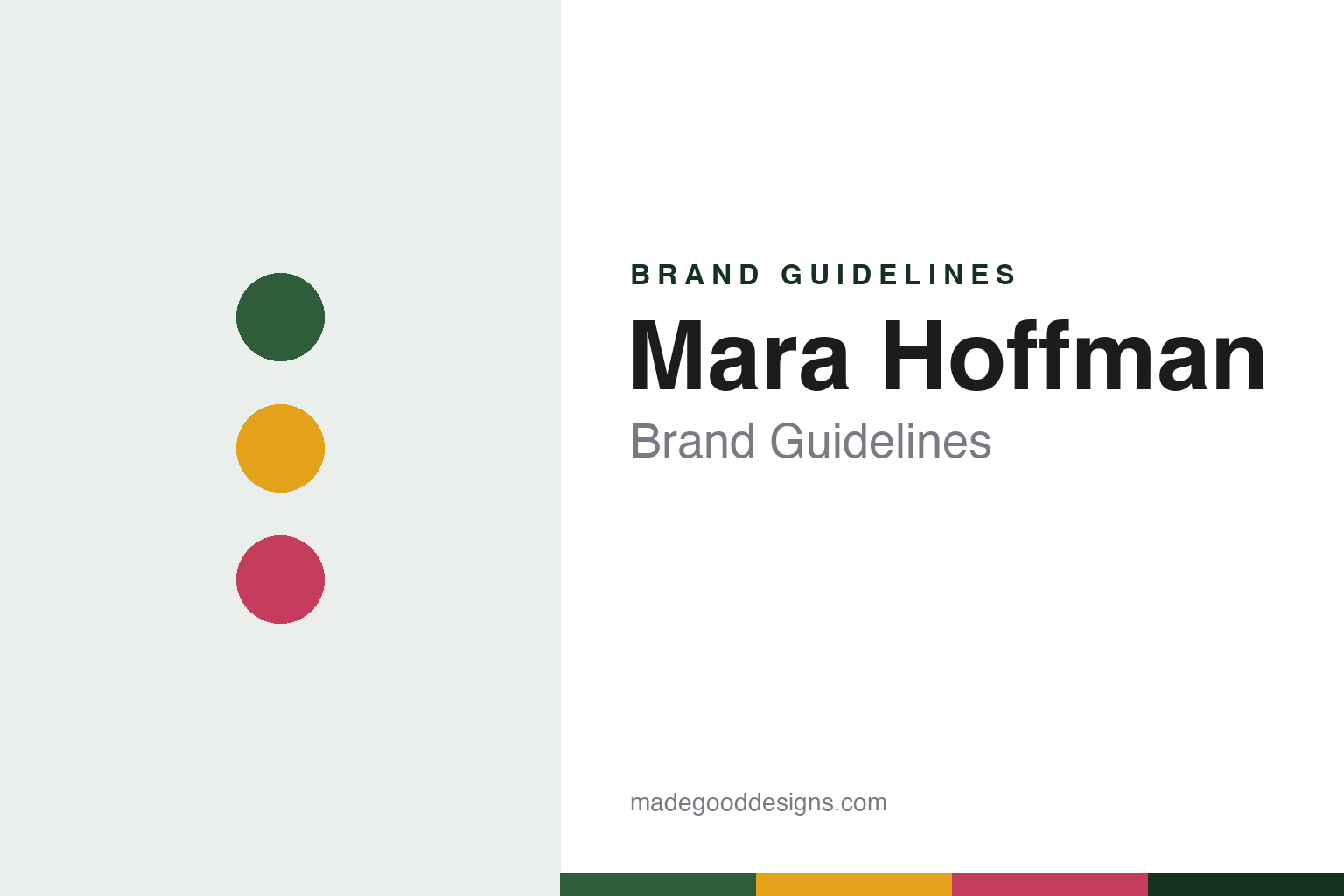
Mara Hoffman Brand Guidelines
The New York print label that paused after 24 years.
Aa
Two constants: a green, marigold and hibiscus palette and a Rounded sans register. Abstract homage — not a Mara Hoffman product or mark; no garment, print or logo is reproduced.
Out of Parsons
A label run from an apartment.
Mara Hoffman no longer makes new clothing collections: in May 2024 its founder announced that the Spring 2024 collection would be its last “for the time being,” and no later collection appears on its website. Its story starts in New York in 2000. FashionUnited, The Impression and the brand itself all say Hoffman founded the label that year after graduating from Parsons School of Design; Marie Claire, by contrast, gave 1999 for the start of what it called a resort wear brand. In an interview with The Helm in April 2020, Hoffman said she incorporated in May 2000.
The Helm described the early years in detail. Hoffman carried bags of clothes into boutiques and asked for five minutes of the owner’s time, returning weeks later with new pieces if she made no sale. Meeting the costume designer Patricia Field in a consignment shop led to a sale, then to a visit from Field’s buyers to the studio apartment where Hoffman was reworking T-shirts and dyeing clothes in the bathtub. She made and delivered that order herself.
The business stayed in apartments for years, she said, with one assistant when she could afford it. A wholesale showroom in Los Angeles, eM productions, took her on, and she financed production through factoring and a small-business loan, taking her orders to the bank. Her first order from Barneys came about three years in. Hoffman told The Helm she had never taken an investor or a business partner, and that this let her make decisions alone, which she counted as both a strength and a difficulty. The Impression and Snobette gave her title in 2024 as president and creative director.
The brand’s story page says the aim from the start was “inspiring and delighting through colors, prints and bold shapes,” and Snobette reported in 2024 that the label was known for prints and swimwear. Hoffman told The Helm that colour was central to her work from the beginning.
Colour
Two changes of direction.
The label changed course twice. In the 2008 recession, Hoffman told The Helm, customers no longer wanted its silk price points, so the company moved production overseas and turned to cheaper fabrics, including synthetics. Growth followed, and she said the label reached 450 stores, department stores among them.
The second change came in 2015, by most accounts; Marie Claire dated it to 2014. Hoffman said she told her director of production the company had to change, and the two began vetting materials, factories, dyes, printing and transport. They started with swimwear, which she called the lowest-hanging fruit, moving it to recycled polyester and nylon made from plastic bottles, while saying that remained an imperfect answer because it was still plastic. FashionUnited reported in February 2019 that the brand had used Repreve recycled fibres in its swimwear since Resort 2017 and that Repreve had honoured Hoffman with a Leading the Change award during New York Fashion Week. The brand’s statements of October 2023 say all its swimwear used recycled nylon or recycled polyester. Marie Claire reported a swimwear fabric update in 2023 that replaced nylon and polyester with a water-resistant material made from wood pulp.
The brand says it moved most of its prints from wet printing to engineered digital printing, so that a print is adjusted to the garment pieces rather than the other way round, allowing small production runs and less fabric waste. It also describes Fairtrade Certified factories, a traceability partnership with Retraced and a public supplier list on Open Supply Hub. These are the company’s claims. Marie Claire independently reported the supply-chain rebuild and Fair Trade certification.
On manufacturing, the brand’s website says all its swimwear was made in Los Angeles and a large share of its ready-to-wear in New York’s garment district, with many organic cotton styles produced in India, close to where the cotton is grown. The Helm noted one Spring 2020 dress as made in India. Marie Claire reported that from 2018 most of each collection was offered up to size 3XL. Snobette named Pendleton, Anthropologie and Converse among the label’s collaborators.
Typography
Prints, places and the shop floor.
Swimwear and resort labels sell a place as much as a garment, so their visual identity tends to start with the setting. Seafolly’s website speaks of Bondi Beach and the Australian beach lifestyle; Vilebrequin’s speaks of Saint-Tropez in 1971. For a designer, the useful question is how that place is carried through photographs, shop interiors and the small printed items around a sale.
The printed fabric is the first thing to study. In this category a swatch can work like a logo: Vilebrequin’s chief executive told The Week in 2017 that it made a sea-turtle print every year in a different colour, and its website describes lining up a back pocket by hand so the pattern runs across it. A print archive, where a label keeps one, gives it a repeatable source of colour and motif from year to year.
Lookbooks then supply the setting. Beach huts, pool edges, towels and harbour walls appear often in this kind of photography, and they do the job a product shot cannot, by showing the clothes in the place they are meant for. Collection names often work the same way: Ragtrader’s report on Seafolly’s summer 2020 range lists names such as Summer Memoirs and Check In, each tied to a print.
Boutique displays and packaging finish the picture. A stack of folded prints reads as a colour field; a swing tag, box or pouch carries the mark away from the shop. Each brand in this guide sets out who founded it, who owns it now and what it says about where its goods are made, and marks what rests on the company’s own word. The palettes here are our own interpretations, not official colours.
Aa
A rounded sans for a label built on colour. (Specimen set in Outfit, a sans STAND-IN; NOT the Mara Hoffman logo.)
The pause
A last collection and a new studio.
Late in the label’s life it opened its first shop. Domino reported on the new SoHo store in February 2022, describing a large palm tree named Gloria at the door, rotating artworks curated by Lisha Bai of Studio Archive Project, and a design Hoffman and Bai developed together. A letter on the brand’s website called it the first flagship, after 21 years in business.
Recognition came in the same period. In October 2023 the company worked with the textile recycling startup Circ on the Nyssa dress, made in a run of 35 from lyocell derived from 50% recycled textile waste, Fashion Dive reported, and the brand said it would move all its virgin lyocell to Circ lyocell within three years. In 2023 the Council of Fashion Designers of America gave Hoffman its Environmental Sustainability award, calling her “a pioneer in the space for successfully scaling an eco-friendly company,” Fashion Dive reported. The brand says the award was presented on 6 November and that she was the third recipient, after Patagonia and the United Nations.
On 19 May 2024 Hoffman announced the end of new collections in a letter on Instagram and the brand’s website, with a Vogue interview the same day, Marie Claire reported. After “a gorgeous run of 24 years,” she wrote, it was time “to take a pause for an inbreath.” The company would sell the final collection and existing stock until it ran out, and the New York flagship had closed, Fashion Dive reported. FashionUnited called it shuttering the business. Hoffman wrote that fashion’s structure “is archaic and was never built to prioritize Earth and its inhabitants,” and Marie Claire quoted her telling Vogue that the demands on a small company made it “almost impossible to be privately held and run after a certain point.”
The label is therefore not trading as a maker of new clothing. Its website closes with thanks for “a beautiful 24 year run” and points to Mara Hoffman Studio, which describes its work as photography, creative direction and visual storytelling. The past collections, from Pre-Fall 2021 to Spring 2024, remain listed there.
For a design guide, Mara Hoffman shows how far a brand built on colour and print can change what sits behind the look, and how a founder can end a label in her own words. Compare Patagonia, an earlier winner of the same award, and Frankies Bikinis, another American swimwear label. For this guide we use green, marigold and a hibiscus pink with a sans, an unofficial interpretation; no product or logo is reproduced.
Explore & save
Keep Mara Hoffman’s identity on hand — save it to a board in the Made Good inspiration library.
Mara Hoffman identity set
Pin the Mara Hoffman green, marigold and hibiscus palette and the Rounded sans register to your own board.