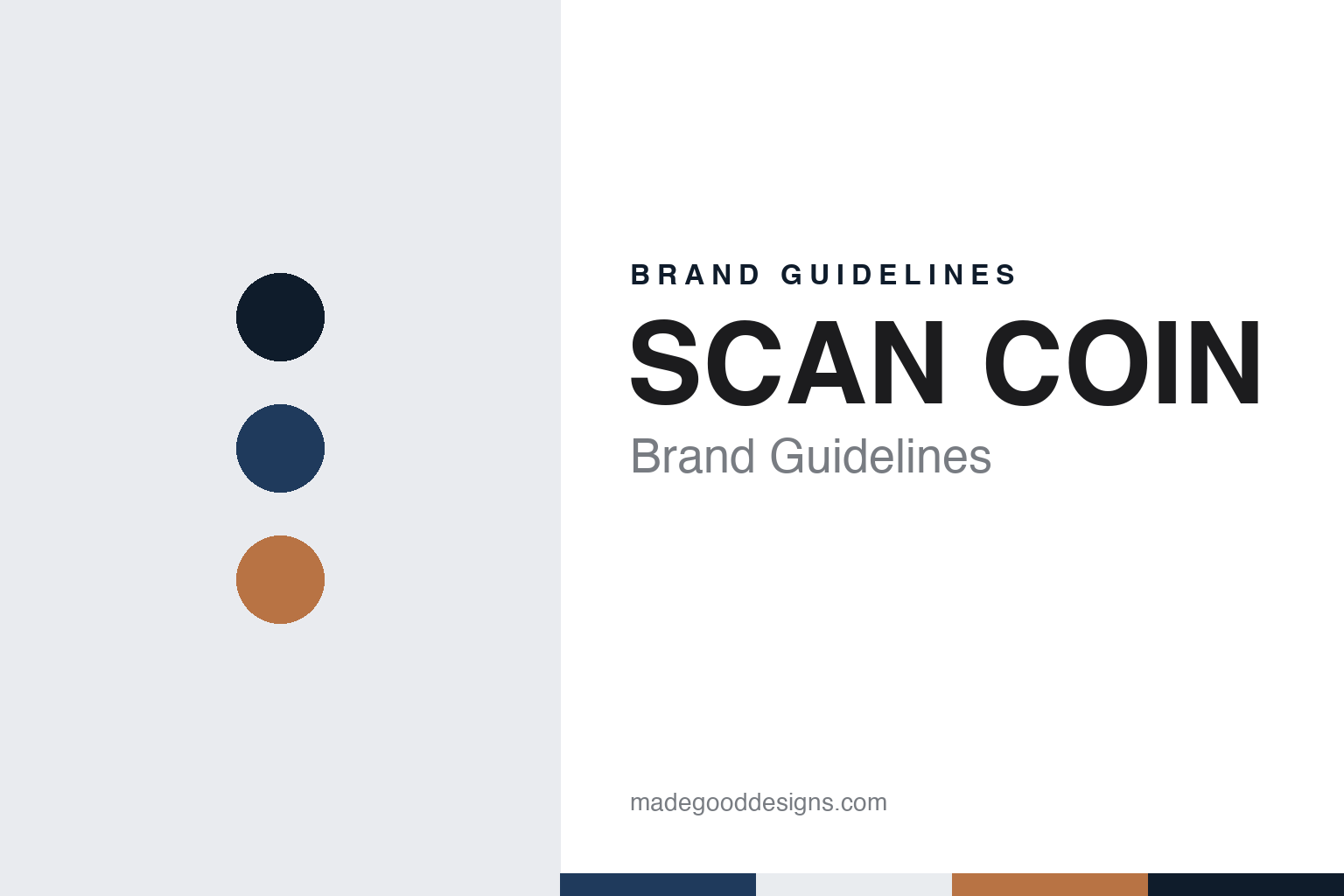
SCAN COIN Brand Guidelines
The 1966 Malmö coin sorter now part of PayComplete.
Aa
Two constants: a navy, steel and copper palette and an industrial sans register. Abstract homage — not a SCAN COIN product or mark; no machine, logo or nameplate is reproduced.
A Malmö basement
An engineer’s idea for sorting coins.
SCAN COIN began in Malmö in 1966. Swedish Wikipedia, drawing on Rikard Smitt’s 2007 book on Malmö companies, traces the idea to Bertil Persson, a newly qualified engineer at Restello, a firm in nearby Lund, who had worked out a new design for sorting coins. With the businessman Knut Tidell, who ran the company from 1966 to 1981, and Jim Nissmo, he founded SCAN COIN, and the three set up in a basement on Torpgatan in Malmö.
The first machine, the SC 12000 T, went to a branch of the Malmö savings bank, according to the same account. Sales started in Sweden and Norway and then spread abroad. Brazil became an important market: Tidell built a business relationship with the Brazilian banker Mario Mondolfo, and that led in time to sales of thousands of coin counters, Swedish Wikipedia says, so that SCAN COIN was no longer a small firm. Japan came next; the same article suggests SCAN COIN may have been the first Swedish company to export electronics there, though it frames that only as a possibility. In 1981 Tidell received an exporter-of-the-year prize from the Swedish export development foundation, presented by King Carl XVI Gustaf, Swedish Wikipedia says.
The name was meant to set a regional tone: the “SCAN” stood for Scandinavia, which Swedish Wikipedia notes proved somewhat narrow for a business that sold around the world. The company has kept the name, written in capitals, through every change of owner since.
By the time Swedish Wikipedia last described it in detail, in 2022, SCAN COIN had its own sales companies in 13 countries and distribution partners in around a hundred more, and about 400 employees.
Colour
From coins to notes, and from families to funds.
Growth needed money, and the ownership changed several times. Gunnar Sandberg, known from the electrical firm ElektroSandberg, put in capital in return for a majority stake and within a few years held all the shares, Swedish Wikipedia says. Hans-Eric Ovin, hired for his international experience, including at IBM, to follow up sales in South America, later became a half-owner. Under him the range widened from coins alone to machines for banknotes as well, and during the 1990s the Ovin family became the sole owner. In 2011 the Swedish private equity firm Segulah took a majority.
The customer list explains the product range. Swedish Wikipedia names banks, supermarkets, security and cash-in-transit companies, transport operators, central banks and mints. For banks the company made coin and note counters and deposit machines; for shops, machines that fill tills with change and take in the day’s takings; for cash centres, large-scale counting, sorting and packing of coins and notes; and for mints, equipment for checking and packing newly struck coins. Among its trademarks it lists CashComplete, a closed cash-handling system for retail, Active sorting, a technology used across several coin sorters, and CoinCasher, a self-service coin deposit machine.
The current catalogue, now published under the PayComplete name, still runs from small machines to whole halls. It lists the SC-3003 and SC-350/360 coin counters, the ICX Active-9 coin sorter and the SC-8550 note sorter, and, for cash centres, cage and pallet loaders, coin lifts, coin wagons and checkweighers for coin rolls and sachets.
Typography
Cash handling, behind the counter.
Cash-handling makers sell machines that most people meet without ever choosing them. Their products appear in bank lobbies and in the walls of branches, behind teller counters as cash recyclers, beside supermarket tills as coin counters, and in the printing halls where banknotes are made. The maker’s name is often a small plate on a large machine, so the brand does much of its work in brochures, trade stands and service contracts rather than on the street.
The machines themselves come in families. NCR’s first serious ATM generation, the 5070 of 1983, was developed at its Dundee plant in Scotland and came in lobby and through-the-wall versions, with modules that could be taken out for repair or refilling, according to English Wikipedia. That modular build lends itself to cutaway diagrams, which trace the path a note takes through a machine from cassette to dispenser.
Trade fairs and bank technology conferences are where new machines are shown. Diebold demonstrated a cash machine prototype at the American Bankers Association’s annual meeting in 1966, and in October 2015 showed two ATM concepts at the Money20/20 show in Las Vegas, English Wikipedia says. The ATM Industry Association gives its own awards, which makers list on their websites.
Ownership in this sector changes often. Diebold took over Germany’s Wincor Nixdorf in 2016, NCR split off its ATM business as NCR Atleos in 2023, and in February 2026 the cash carrier Brink’s agreed to acquire NCR Atleos, ATM Marketplace reported. This guide sets out what can be checked about each brand — who founded it, who owns it and where its machines are made — and marks clearly what rests on the company’s own word.
Aa
An industrial sans for a machine-maker’s capitals. (Specimen set in Archivo, a sans STAND-IN; NOT the SCAN COIN logo.)
SCAN COIN
A Swedish name inside an American group.
In March 2015 SCAN COIN changed hands again. The electronics trade site Evertiq reported on 18 March 2015 that SuzoHapp had completed the purchase of the Malmö company, describing it as a provider of automated coin and note processing. SuzoHapp’s chairman, James Brendel, called it “a transformative milestone” and said it was the group’s fourth acquisition of cash-handling technology in 15 months, Evertiq reported. Swedish Wikipedia gives the American investment firm ACON Investments as SuzoHapp’s owner at the time.
SuzoHapp itself was a merger. The group’s own history says SUZO was founded in Rotterdam in 1955 and HAPP, a supplier of amusement and gaming parts, in 1986, and that the two merged in 2005. It lists SCAN COIN, “founded in 1966,” as its 2015 acquisition, followed by the Coinco payment lines in 2018. In 2021, it says, the cash-handling side of the business formally rebranded as PayComplete. The old SCAN COIN web address now leads to a SCAN COIN page on the PayComplete site, which presents the machines alongside recyclers, smart safes and its Connect software.
PayComplete has kept reshaping itself. In April 2026 it said it had sold its European cash components business for vending machines, laundries and car washes to MatiPay, to concentrate on smart safes, cash and coin recyclers and processing equipment for banks, mints and cash centres. On 24 September 2026, in a statement from Schaumburg, Illinois, where it is headquartered, PayComplete said new investors now held a controlling interest after a recapitalisation; it did not name them.
For a design guide, SCAN COIN shows how a founder-era name can survive as a product brand inside a larger group. Compare Laurel, a coin and note machine maker that began in the same era, and Cummins Allison. For this guide we use a navy, a steel grey and a coin copper with a sans, an unofficial interpretation; no product or logo is reproduced.
Explore & save
Keep SCAN COIN’s identity on hand — save it to a board in the Made Good inspiration library.
SCAN COIN identity set
Pin the SCAN COIN navy, steel and copper palette and the industrial sans register to your own board.


