ANSUL Brand Guidelines
A chemical acronym from Marinette that became a fire suppression brand.
Aa
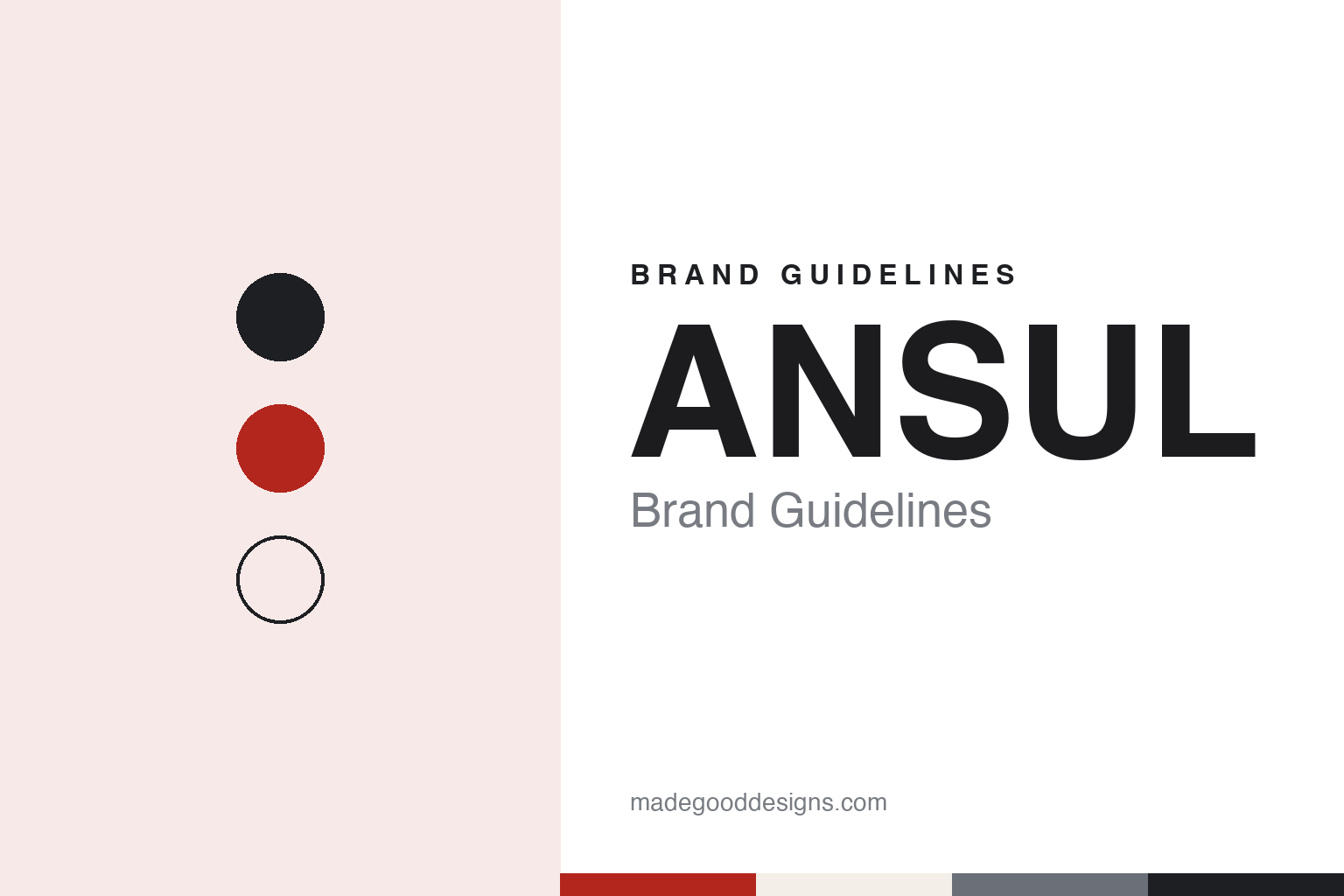
Two constants: an ANSUL red, charcoal and off-white palette and a condensed sans register. Abstract homage — not an ANSUL product or mark; no extinguisher, logo or label is reproduced.
Anhydrous sulfur dioxide
A refrigerant, a feed business and a family firm.
ANSUL takes its name from a chemical, not a person. English Wikipedia says the word joins the first letters of anhydrous sulfur dioxide, which the Marinette, Wisconsin company sold to dye works and fruit preservers and later as a refrigerant. The business was created in 1915 by Francis “Frank” G. Hood out of the bankrupt Bastol Company, a Marinette enterprise started in 1912, and its early activities included cattle feed, refrigerants and specialty chemicals.
Fire chemicals came later. Wikipedia dates the start of its production of fire suppression chemicals to 1934. The refrigeration and air-conditioning products division was sold to Virginia Chemicals in 1967, and by 1983 the company had stopped all its other production at the Marinette plant. The name changed several times but always kept the word Ansul: the Ansul Chemical Company from 1915 to 1963, the Ansul Company from 1963 to 1981, Ansul Fire Protection from 1981 to 1995, and the present form since 1995.
For most of its first sixty years the company was led by the Hood family. Wikipedia’s list of presidents runs from Frank Hood, from 1915 to 1938, to Robert C. Hood, from 1949 to 1974, with Harvey V. Higley and Francis J. Hood in between. It stayed independent until 1978, when the Australian group Wormald International bought it. Tyco International acquired Wormald in 1990, which brought ANSUL into Tyco’s fire protection business.
Colour
Capital letters, product by product.
Today ANSUL is a brand of special-hazard fire suppression equipment rather than a chemical company. Its website, run by Johnson Controls, groups the range under foam concentrates and equipment, industrial systems, gaseous systems using carbon dioxide, halocarbon or inert gas, portable extinguishers and spill-control products, restaurant systems and vehicle systems.
Many products carry their own trade names beside the ANSUL mark, and the company writes them in capitals in the same way. Its website lists RED LINE and SENTRY extinguishers and the R-102 and PIRANHA restaurant systems; English Wikipedia adds the INERGEN clean-agent system, the Checkfire vehicle range and dry-powder agents such as MET-L-X and FORAY. Wikipedia describes ANSUL as the registered trade name used together with these product names, as in ANSUL SENTRY.
The industries named on the website run from restaurants, data centres, education and cultural properties to mining, forestry, metal processing, marine and offshore platforms, aviation and power generation. The same pages list services, distributor search and safety data sheets, the working material of a brand sold through installers and distributors.
The capitalised naming is the most consistent visible thread. The word ANSUL, an acronym in origin, appears in capitals across the company’s own pages, and the product names follow the same pattern, so a catalogue of cylinders, nozzles and agents reads as one family of marks.
Its customers range widely. English Wikipedia says the US government is a major customer, and its list of agents runs from dry chemicals and dry powders such as LITH-X and NA-X to foam concentrates and spill-control products. In Marinette the company also has a 380-acre fire technology center, which Wisconsin Public Radio has also called its fire training center.
Typography
How the category presents itself.
Fire protection makers sell to engineers, contractors, insurers and building owners rather than to shoppers, and their pictures tend to show the product at work in a building. A common image is the sprinkler head in close-up: a small brass or chrome fitting, often with a coloured glass bulb, photographed against a ceiling. Another is the pipework itself, grooved or threaded, running in red-painted lines above warehouse racking or through a plant room.
Suppression systems are shown in the rooms they are designed for. Catalogues and project pages picture rows of gas or water-mist cylinders standing in a side room next to a server hall, a control room or an archive, with pipes leading off to nozzles in the ceiling. Detectors and alarm panels appear in the same matter-of-fact way: a round detector head on a plain ceiling, a call point on a corridor wall, a panel with its status lights in a plant room.
Testing and training make up much of the rest of the imagery. Makers and their distributors publish photographs of test rigs, live-fire demonstrations and installer courses, and many list training centres and technical schools alongside their products. Approvals and listings from testing bodies are usually printed on data sheets and in catalogues.
The trade meets at shows. The NFPA Conference & Expo in the United States and Firex in London are among the events where makers set out sprinklers, valves, cylinders and panels on stands for contractors and engineers. The brands in this guide range from privately held specialists to units of large building-technology groups, and their colours, names and typography are set out here as an unofficial reading of how each presents itself.
Aa
A condensed sans — capitals for every product name. (Specimen set in Archivo Narrow, a sans STAND-IN; NOT the ANSUL logo.)
ANSUL
A Marinette brand inside Johnson Controls.
The parent changed again in 2016. Johnson Controls announced on 25 January 2016 that it would merge with Tyco, and the merger was completed on 9 September 2016, with the combined company named Johnson Controls International plc, according to English Wikipedia. ANSUL now sits among the fire suppression brands of Johnson Controls, alongside Tyco Fire, Chemguard and Skum, the company’s website shows. Marinette remains the base: the US Environmental Protection Agency describes the Ansul site there as an active manufacturing plant on the south shore of the Menominee River, on 63 acres, with a deed restriction that limits future use of the land to industry.
The site carries a long environmental record. English Wikipedia says arsenic compounds were released there from 1957 to 1977 as a result of herbicide manufacture. The EPA says corrective action is being carried out under a 2009 Administrative Order on Consent, and that Tyco removed about 300,000 cubic yards of arsenic-bearing sediment from the Menominee River and built a barrier wall around the facility. In September 2020 The Daily News of Iron Mountain reported that the Lower Menominee River had been removed from the list of Great Lakes Areas of Concern.
A second matter concerns firefighting foam. Wisconsin Public Radio reported in December 2025 that Tyco and its predecessor Ansul used foam containing PFAS at the company’s fire technology center in Marinette from the 1960s until 2017, and that in March 2022 the Wisconsin Department of Justice had sued Johnson Controls and Tyco Fire Products, alleging the company did not promptly report PFAS found in sampling in 2013. In June 2026 the Department of Justice announced a settlement with Tyco Fire Products that includes deep drinking-water wells for properties in an agreed area, continued monitoring and further remediation.
For a design guide, ANSUL shows how a chemical acronym from 1915 became a fire suppression brand whose capitalised product names carry the identity. Compare Tyco Fire Protection and Johnson Controls. For this guide we use a hydrant red, charcoal and warm off-white with a condensed sans, an unofficial interpretation; no product or logo is reproduced.
Explore & save
Keep ANSUL’s identity on hand — save it to a board in the Made Good inspiration library.
ANSUL identity set
Pin the ANSUL red, charcoal and off-white palette and the condensed sans register to your own board.