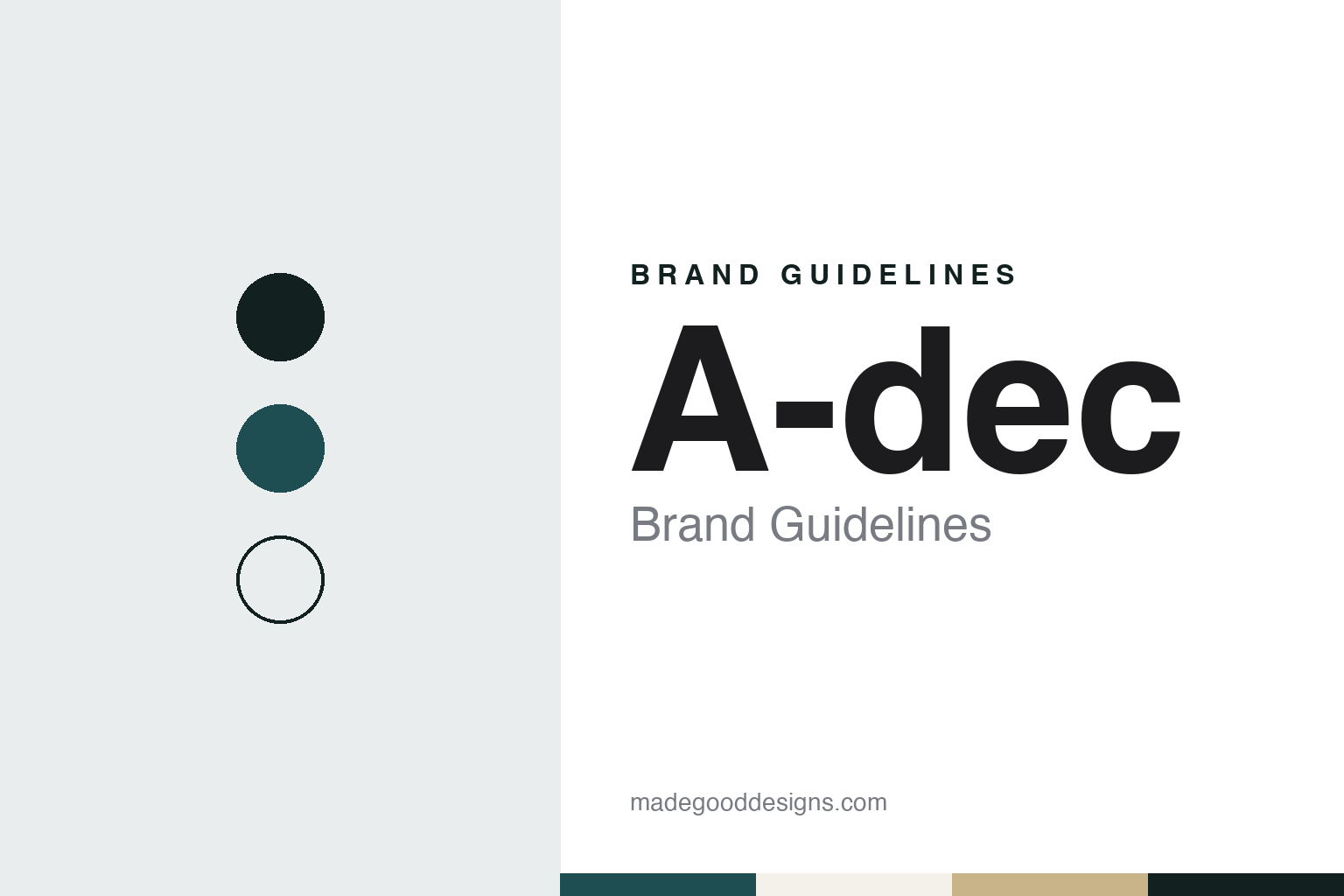
A-dec Brand Guidelines
Ken and Joan Austin’s Newberg dental equipment maker, since 1964.
Aa
Two constants: an A-dec teal, warm white and sand palette and an industrial sans register. Abstract homage — not an A-dec product or mark; no chair, unit, logo or nameplate is reproduced.
Austin Dental Equipment
A couple, an evacuator and a Quonset hut in Newberg.
A-dec takes its name from the Austin Dental Equipment Company, which Ken and Joan Austin founded in 1964 in Newberg, Oregon. Oregon State University’s oral-history project, which interviewed Ken Austin in March 2015, says he grew up on a family farm in Newberg, studied industrial engineering at Oregon State College, served in the Air Force and then worked eight jobs in eight years. One of them was at Densco, a dental equipment supplier in Colorado, and the project says that job gave him the idea for a company of his own. The couple moved back to Newberg to start it.
The first product was small. The oral-history project describes an air-operated saliva evacuator, the Air Vacuum System; English Wikipedia calls it the Air-Venturi System and says it differed from the belt-driven devices then in use. Next came a miniature control unit for sit-down dentistry and a tray cart that gave the dental assistant a mobile work surface. English Wikipedia dates both to 1964 and names the unit the Dec-Et; the Oregon State project dates them to 1965. A three-way syringe, the Tri-Flower, followed, and in 1969, the project says, A-dec put the pieces together and began selling a sit-down dental unit.
English Wikipedia says the company was incorporated in 1966, while it was still housed in a Quonset hut in Newberg, and that in 1971 it built a new plant and offices on the edge of town and expanded its distribution to 23 countries. In 1972 the founders wrote down “the A-dec Way,” a set of 15 operating principles that the company still publishes. The list begins with “concern for people” and runs through “creativity” and “keep things simple & basic” to “conserve resources.” The company’s about page also quotes Joan Austin’s version of the idea: if A-dec takes care of its people, its people will take care of its customers, and the customers will take care of the business.
Colour
From the delivery unit outward.
A-dec’s range grew outward from the delivery unit. English Wikipedia says it offered a full line of instrument delivery systems by 1977 and then added chairs, stools and dental lights, a cabinetry line in 1983, and a self-contained water system that let a practice control the water supplied to handpieces and syringes. In 1985 it began a partnership with W&H, the family-run Austrian maker of rotary dental instruments, which produced an A-dec|W&H co-brand for handpieces. In January 1990 it bought A-dec Diversified, another Newberg company.
The Oregon State oral-history project says A-dec grew to become the largest manufacturer of dental equipment in the United States and the second largest in the world, on the back of equipment built for sit-down dentistry. It also credits the company with the first all-air modular handpiece control system.
The model names the company uses today come from a later period. Wikipedia lists the Cascade and Radius lines of the 1990s; the A-dec 500 of 2004, a chair-mounted delivery system that, it says, brought several technologies together into one integrated system and led A-dec to streamline its production lines; and the A-dec 300 of 2009, a smaller integrated chair and delivery system. The current website organises the range by number: A-dec 500, 400 and 300 chairs, LED operating lights, Inspire cabinets, and QuietCore+ compressors and vacuums for the practice’s mechanical room, alongside parts, software and a service app.
Where the equipment is made is a point the company stresses. Its website says A-dec employs more than 1,300 people worldwide, 87% of them on its Oregon campus, where its team “designs, engineers, and builds” the range. English Wikipedia describes a 40-acre campus in northeast Newberg with 11 buildings, and says most of the equipment is custom ordered by dentists.
Typography
How dental equipment makers present themselves.
Dental equipment makers sell to a narrow audience — dentists, clinic groups, dental schools and the dealers who supply them — and their brands are built around a handful of recurring scenes. The treatment unit is the centrepiece: a patient chair with its instrument delivery, operating light and assistant’s element, usually photographed in a clean, bright surgery, either empty or with a clinician and patient posed mid-appointment.
Imaging has its own visual language. Panoramic and cone-beam CT units are shown in rooms of their own, intraoral X-ray arms are fixed to the wall beside the chair, and sensors and intraoral scanners appear in the hand, often next to the screen that displays the result. Software is shown as screenshots: a 3D skull, an arch of teeth, an implant plan. Handpieces get the close-up treatment of precision tools, while sterilisers and washers belong to the back room, photographed as white boxes on a clean counter.
The trade has its own calendar. The International Dental Show (IDS) in Cologne, held every two years, is where many makers launch products; Planmeca, for one, says it introduced a digital imaging system there in 1995. National dental meetings in North America, Europe and Asia fill the years between, and trade publications such as Dental Tribune report the launches and the takeovers.
Ownership in the sector changes often. Family-owned makers sit alongside listed groups and private-equity-backed companies, and brands move between them: Kodak’s dental business became part of Carestream Health and then Carestream Dental, and KaVo’s treatment unit and instrument business passed from Envista to Planmeca at the start of 2022. This guide sets out what can be checked about each maker — its founding, its owners and its products — and marks clearly what rests on the company’s own word.
Aa
A plain industrial sans. (Specimen set in Work Sans, a sans STAND-IN; NOT the A-dec logo.)
A-dec
Family-owned, two generations on.
A-dec has stayed private and in the family. In 2007, the Oregon State oral-history project says, Ken Austin handed the presidency to his son-in-law, Scott Parrish; English Wikipedia gives the same year. The company website now names Parrish as chairman of the board, describes A-dec as “family-owned and headquartered in Newberg, Oregon,” and says that “two generations later” it still holds to the founders’ aim of making high-quality dental equipment. English Wikipedia adds that employees receive profit sharing.
The company keeps adding to the business around its equipment. In February 2024, Dental Products Report reported the launch of the A-dec Certified Pre-Owned Equipment program and quoted its chief executive, Marv Nelson. Under the program, the magazine said, A-dec refurbishes used A-dec equipment through its own process and sells it through authorised dealers, rather than leaving that trade to unauthorised third parties. The website also lists a buyback scheme, a programme for new dentists, continuing-education courses and a 3D planning tool for practices.
The founders were recognised outside dentistry too. The oral-history project notes that Ken Austin was named Oregon Industries Business Leader of the Year in 1981, and that Ken and Joan Austin were inducted into the Oregon State University College of Business Hall of Fame in 2003; the university’s business school building, Austin Hall, was dedicated in 2014 after a lead gift from the family. The company’s slogan, “Making the best better since 1964,” leans on the same continuity.
For a design guide, A-dec shows how a founding product and a written set of values can carry a brand for six decades. Compare Midmark, an Ohio maker of clinical and dental equipment, and Henry Schein, the dental and medical distributor. For this guide we use a deep teal, a warm white and a muted sand with a sans, an unofficial interpretation; no product or logo is reproduced.
Explore & save
Keep A-dec’s identity on hand — save it to a board in the Made Good inspiration library.
A-dec identity set
Pin the A-dec teal, warm white and sand palette and the industrial sans register to your own board.