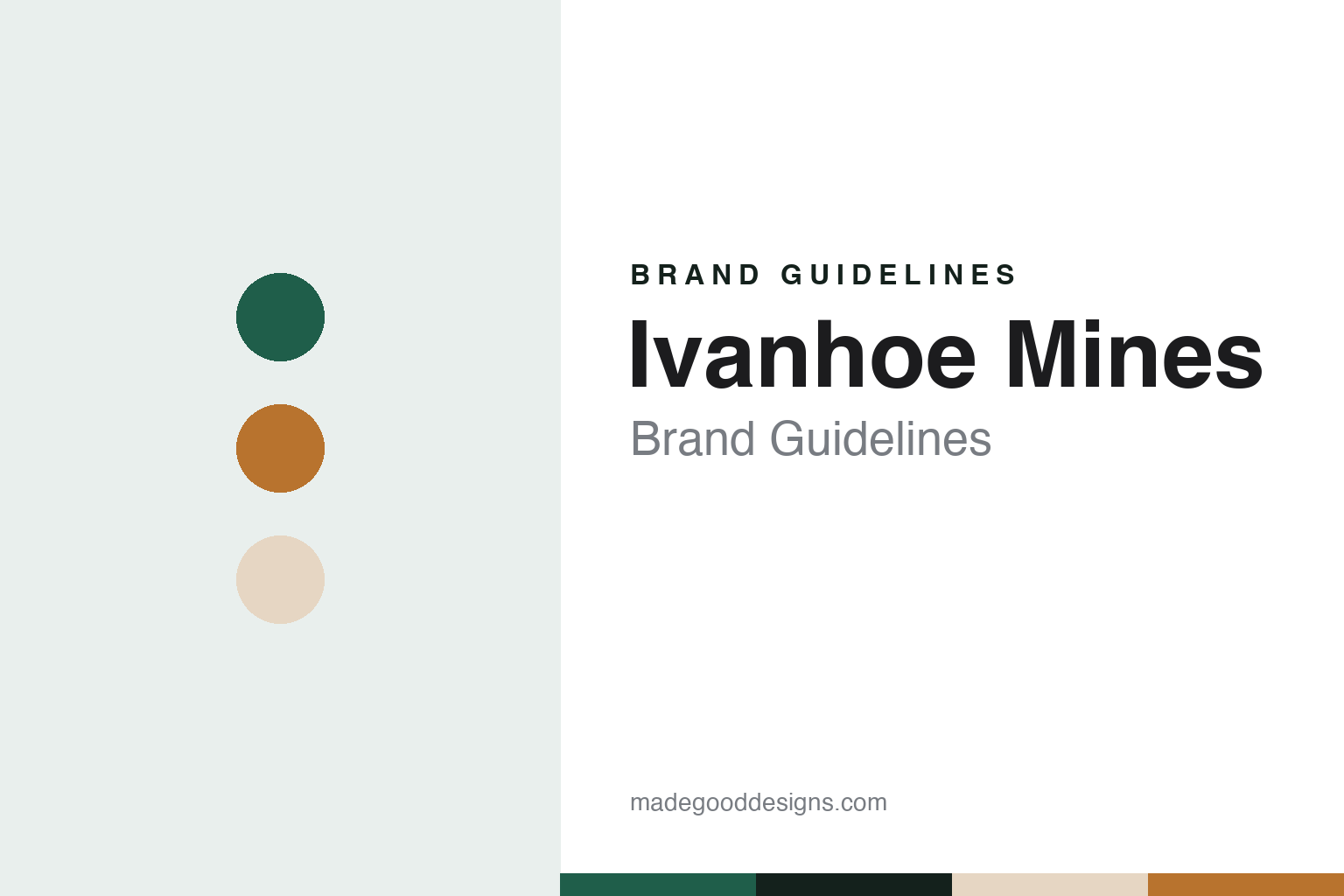
Ivanhoe Mines Brand Guidelines
A Vancouver miner that took back an old name and went to the Copperbelt.
Aa
Two constants: a malachite green, ochre and clay palette and an editorial serif register. Abstract homage — not an Ivanhoe Mines product or mark; no logo is reproduced.
Two Ivanhoes
A platinum company that took back its founder’s name.
There have been two companies called Ivanhoe Mines, and the company itself answers the question on its investor pages. The original Ivanhoe Mines, which discovered and developed the Oyu Tolgoi copper-gold mine in Mongolia, changed its name to Turquoise Hill Resources in August 2012, and Rio Tinto took full ownership of Turquoise Hill in December 2022. English Wikipedia says the mining financier Robert Friedland founded that first company as Indochina Goldfields in 1994.
Today’s Ivanhoe Mines has a different lineage. The company says it was incorporated on 29 April 1993 under the name Ivanhoe Nickel & Platinum Ltd.; English Wikipedia’s article on Friedland says it was launched in 1993 as African Minerals, to pursue mineral interests in southern Africa. Shareholders approved a reorganisation in May 2011, completed in September 2012, and the company became Ivanplats Limited. On 23 October 2012 Ivanplats closed its initial public offering and its shares began trading on the Toronto Stock Exchange under the symbol IVP.
On 28 August 2013 Ivanplats changed its name to Ivanhoe Mines, and its shares moved to the symbol IVN. The company says the new name reflected that it had grown into more than a platinum-group metals business; English Wikipedia adds that it took advantage of Friedland’s right to the name. Friedland is listed on the company website as its founder and executive co-chairman. The company has offices in Vancouver and in Sandton, South Africa, and its shares have also traded on the OTCQX market in the United States since October 2016.
Colour
A copper complex on the Central African Copperbelt.
Ivanhoe’s main copper business is the Kamoa-Kakula Copper Complex in the Democratic Republic of the Congo, about 25 kilometres west of the town of Kolwezi on the Central African Copperbelt. The company describes it as a very large, near-surface, flat-lying copper deposit. In 2015 Ivanhoe sold half of its interest in the Kamoa project to the Chinese miner Zijin Mining, English Wikipedia says. Exploration kept extending the deposit: in April 2017 the company announced the Kakula West discovery, and in January 2019 it reported a high-grade intersection at the Kamoa North Bonanza Zone, according to English Wikipedia. Ivanhoe’s website gives the current ownership as 39.6% Ivanhoe, 39.6% Zijin Mining, 0.8% Crystal River Global and 20% the government of the DRC.
The company dates the first copper concentrate to May 2021 and commercial production to 1 July 2021. Its Phase 3 concentrator produced its first concentrate on 10 June 2024. An on-site direct-to-blister copper smelter, rated by Ivanhoe at 500,000 tonnes a year, began start-up on 21 November 2025 and produced its first anodes on 29 December 2025; the company calls it the largest smelter on the African continent. It reports that Kamoa-Kakula produced 388,838 tonnes of copper in concentrate in 2025.
Ivanhoe describes Kamoa-Kakula as the world’s highest-grade major copper mine and says it runs on hydroelectric power, with on-site solar panels and a battery storage system. It cites the London consultancy Skarn Associates for an estimate that the complex has among the lowest greenhouse-gas intensities per tonne of metal of any major copper mine; those are the company’s claims.
Typography
How copper miners present themselves.
Copper miners sell a raw material, not a consumer product, so their identities are built for investors, governments, employees and the communities near their mines. The pictures tend to repeat across the sector: terraced open-pit benches lit by low desert sun, haul trucks whose wheels stand taller than the workers beside them, the long sheds of a concentrator, and stacks of copper cathode sheets ready for shipment. Copper itself often supplies the colour, in warm orange and brown tones that run through reports and presentations.
Much of the communication is formal. Annual reports, sustainability reports and technical reports on reserves are published on fixed calendars, and quarterly results are written for analysts. Alongside the numbers sit recurring themes: safety, presented as a daily routine rather than a slogan; community programmes in schools, clinics, water and local suppliers; and, increasingly, the place of copper in electricity grids, electric vehicles and renewable energy, framed as the metal of the energy transition.
The sector also has its own meeting places. The PDAC convention in Toronto and the Mining Indaba in Cape Town gather miners, explorers, investors and ministers each year, and company stands, logos and presentation decks are designed for those rooms as much as for the web. Trade titles such as The Northern Miner and Mining Technology report on projects, permits and disputes, which are part of the public record of every large miner.
The companies in this guide differ widely in origin: some began as subsidiaries of older American smelting groups, some as small exploration companies, some as state enterprises. This guide sets out what can be checked about each one — who founded it, who owns it, where it mines and what has been reported about its disputes — and marks clearly what rests only on the company’s own word.
Aa
An editorial serif for a company built on discovery stories. (Specimen set in Newsreader, a serif STAND-IN; NOT the Ivanhoe Mines logo.)
Ivanhoe Mines
Ingenuity, tenacity, compassion.
Kamoa-Kakula has also had setbacks. In May 2025 seismic activity triggered flooding at the Kakula underground mine, and Ivanhoe reported on 20 May that it had suspended underground operations there, Miningmx reported on 30 May 2025. Zijin said there had been a roof collapse; Ivanhoe disputed this, saying there was no evidence of collapsing stopes or structural pillars, and it withdrew its 2025 production guidance for the complex.
Beyond copper, Ivanhoe runs two other mines. Platreef, on the Northern Limb of South Africa’s Bushveld Complex, holds platinum-group metals, nickel, copper and gold; the company says initial production from its first concentrator began on 18 November 2025, and it owns 64%, with Black Economic Empowerment partners holding 26% and a Japanese consortium led by ITOCHU 10%. A third shaft was completed in March 2026, and a second, larger concentrator is under construction with completion targeted for the end of 2027, the company says. Kipushi, a historic zinc-copper mine near Lubumbashi in the DRC that produced between 1924 and 1993, was redeveloped with the state miner Gécamines after Ivanhoe acquired its interest in November 2011; its concentrator started production in June 2024. Ivanhoe now holds 62% and Gécamines 38%, the company says. It also explores on its Western Forelands licences near Kamoa-Kakula.
The company frames its brand in short statements. Its stated purpose is “to discover, develop and produce the critical resources needed for a resilient future,” and its values are listed as three words: Ingenuity. Tenacity. Compassion. Its website is published in English, French, Japanese and Chinese.
For a design guide, Ivanhoe Mines shows how a company can borrow weight from a founder’s earlier name while building a new story around discovery. Compare Zijin Mining, its partner at Kamoa-Kakula, and Codelco, a state-owned copper producer in Chile. For this guide we use a malachite green, a dark ink, an ochre and a pale clay with a serif, an unofficial interpretation; no product or logo is reproduced.
Explore & save
Keep Ivanhoe Mines’s identity on hand — save it to a board in the Made Good inspiration library.
Ivanhoe Mines identity set
Pin the Ivanhoe Mines malachite green, ochre and clay palette and the editorial serif register to your own board.