MMG Brand Guidelines
Three letters for a miner assembled through acquisitions.
Aa
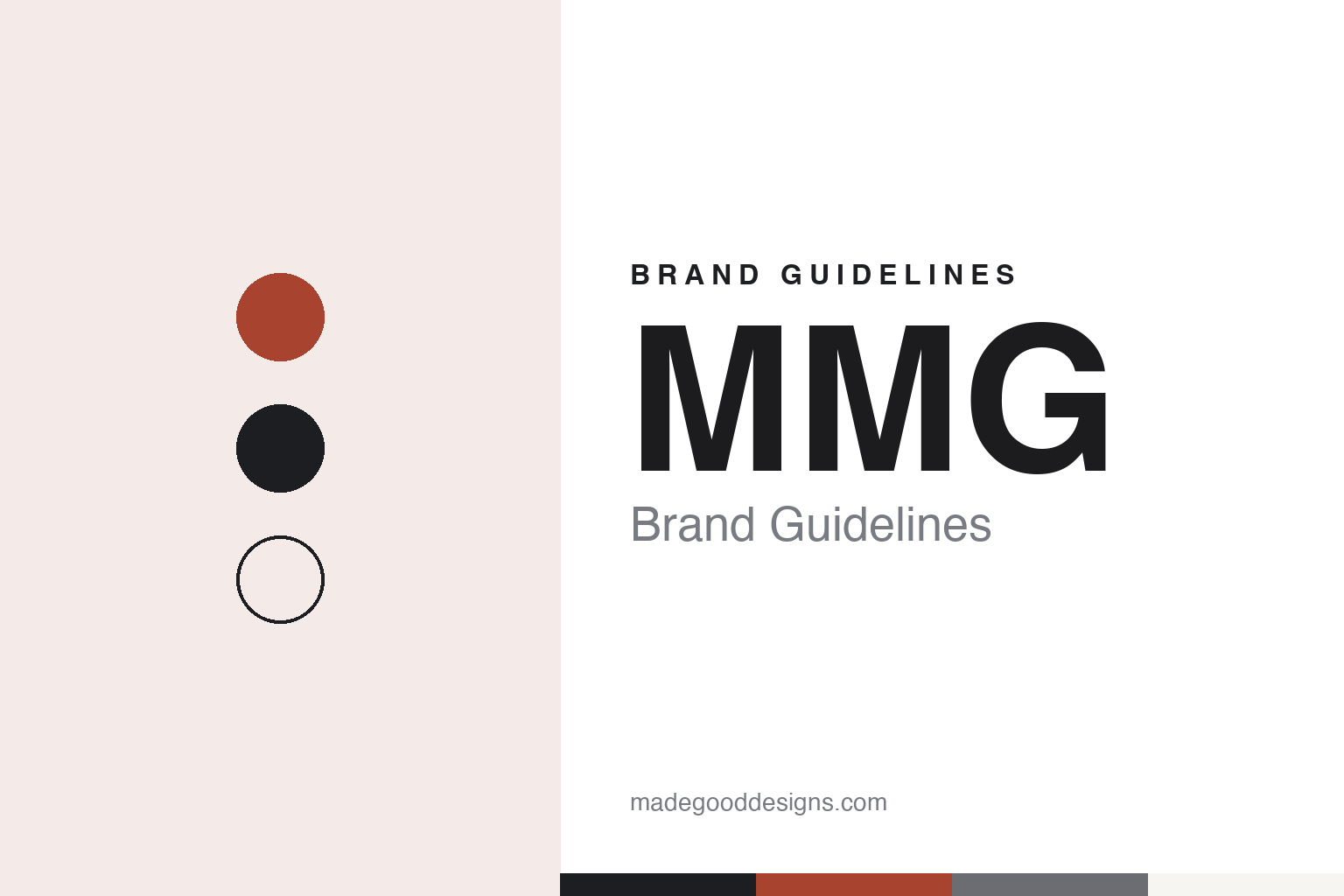
Two constants: a rust red, near-black and grey palette and a corporate sans register. Abstract homage — not an MMG product or mark; no logo or nameplate is reproduced.
Minerals and Metals Group
A 2009 portfolio, a Hong Kong shell and a new name.
MMG is a twenty-first-century company. Its own history says it was established in 2009, originally as Minerals and Metals Group, after China Minmetals Corporation bought a portfolio of base-metals assets from the Australian miner OZ Minerals; English Wikipedia dates the formation to June 2009. China Minmetals, which MMG says was founded in 1950, is one of China’s state-owned enterprises, and the company says it remains MMG’s major shareholder through a Hong Kong subsidiary.
The corporate shape came together in steps. In December 2010, English Wikipedia says, MMG was acquired by Minmetals Resources, a China Minmetals subsidiary listed on the Hong Kong Stock Exchange. In 2011 that company agreed to sell its trading, fabrication and downstream businesses in China to concentrate on mining, the company says, and in September 2012 Minmetals Resources changed its registered English name to MMG Limited, matching the name the operations already used. MMG says its head office is in Melbourne and its registered office in Hong Kong, where its shares trade; it added a secondary listing on the Australian Securities Exchange in December 2015 and left it in 2019.
Former MMG operations include the Century and Golden Grove mines and the Sepon mine, which MMG sold to Chifeng in 2018, English Wikipedia and the company say. Rosebery, in Tasmania, marked its 80th anniversary in 2016, according to MMG. In March 2012 Minmetals Resources acquired Anvil Mining, bringing the Kinsevere mine and the Mutoshi development project in the Democratic Republic of the Congo, the company says.
Colour
Las Bambas, high in the Peruvian Andes.
MMG’s Peruvian operation is Las Bambas. Glencore announced on 1 August 2014 that its sale of the project to a consortium owned 62.5 per cent by MMG, 22.5 per cent by Guoxin International Investment and 15 per cent by CITIC Metal had completed, effective 31 July 2014. Glencore then described Las Bambas, in Cotabambas in the Apurímac region, as a project at an advanced stage of construction. MMG is the operator.
MMG describes Las Bambas as a large open-pit copper mine more than 4,000 metres above sea level near Challhuahuacho, between the provinces of Cotabambas and Grau. Commercial production began in 2016, the company says. The mine produces copper concentrate with molybdenum, gold and silver credits; the concentrate travels by road in closed containers to a transfer station and then by rail to the port of Matarani in Arequipa. English Wikipedia calls the deposit one of the largest in the world.
The mine has a long record of community conflict. To make way for it, English Wikipedia says, the Fuerabamba community was resettled to a new town, Nueva Fuerabamba, built between 2012 and 2014. Large protests took place during construction in 2015, and from July 2021 communities repeatedly blockaded the road used to carry concentrate, saying they saw too little benefit from the mine. Peru’s government announced a deal with protesters from Chumbivilcas province on 5 October 2021; on 3 December 2021 MMG announced it would halt copper production from mid-December because of the blockades; and in July 2022 a truce expired without an extension, according to English Wikipedia. MMG says it keeps information offices in seven communities in the Apurímac and Cusco regions and introduced a social management model called Corazón de Las Bambas in 2024.
Typography
Copper miners and their image.
Copper miners sell a raw material, not a consumer product, so their identities are built for investors, governments, employees and the communities near their mines. The pictures tend to repeat across the sector: terraced open-pit benches lit by low desert sun, haul trucks whose wheels stand taller than the workers beside them, the long sheds of a concentrator, and stacks of copper cathode sheets ready for shipment. Copper itself often supplies the colour, in warm orange and brown tones that run through reports and presentations.
Much of the communication is formal. Annual reports, sustainability reports and technical reports on reserves are published on fixed calendars, and quarterly results are written for analysts. Alongside the numbers sit recurring themes: safety, presented as a daily routine rather than a slogan; community programmes in schools, clinics, water and local suppliers; and, increasingly, the place of copper in electricity grids, electric vehicles and renewable energy, framed as the metal of the energy transition.
The sector also has its own meeting places. The PDAC convention in Toronto and the Mining Indaba in Cape Town gather miners, explorers, investors and ministers each year, and company stands, logos and presentation decks are designed for those rooms as much as for the web. Trade titles such as The Northern Miner and Mining Technology report on projects, permits and disputes, which are part of the public record of every large miner.
The companies in this guide differ widely in origin: some began as subsidiaries of older American smelting groups, some as small exploration companies, some as state enterprises. This guide sets out what can be checked about each one — who founded it, who owns it, where it mines and what has been reported about its disputes — and marks clearly what rests only on the company’s own word.
Aa
A plain corporate sans for three letters. (Specimen set in Barlow, a sans STAND-IN; NOT the MMG logo.)
MMG
Botswana, the Congo, Australia and a deal still open.
MMG’s other operations are spread across three more countries. At Dugald River, near Cloncurry in Queensland, the project was commissioned in 2017 with its first shipment of zinc concentrate, the company says; Rosebery continues in Tasmania; the MMG board approved an expansion of Kinsevere in the Democratic Republic of the Congo in 2022; and in 2024 MMG completed its purchase of the Khoemacau copper mine in Botswana.
One acquisition is still open. On 18 February 2025 MMG announced a conditional agreement to buy Anglo American’s nickel business in Brazil. In a stock-exchange announcement dated 3 November 2026, MMG said all other conditions had been met but the European Commission had opened an in-depth Phase II review, due to finish by 21 December 2026, and that the two companies had extended the deadline for completing the deal to 31 December 2026. The purchase was agreed in February 2025 and had not been completed at the time of writing.
MMG describes itself as a producer of copper, zinc and other base metals for “the transition to a lower-carbon future,” lists five values beginning “We think safety first,” and says it is a member of the International Council on Mining and Metals. Its name has moved from a descriptive phrase to three letters: Minerals and Metals Group became MMG, and the Hong Kong-listed company took that name in 2012.
For a design guide, MMG shows how a set of initials can hold together a company assembled through acquisitions on several continents. Compare Glencore, which sold Las Bambas to the MMG consortium in 2014, and Southern Copper, another copper miner in this series. For this guide we use a rust red, a near-black and a cool grey with a sans, an unofficial interpretation; no product or logo is reproduced.
Explore & save
Keep MMG’s identity on hand — save it to a board in the Made Good inspiration library.
MMG identity set
Pin the MMG rust red, near-black and grey palette and the corporate sans register to your own board.