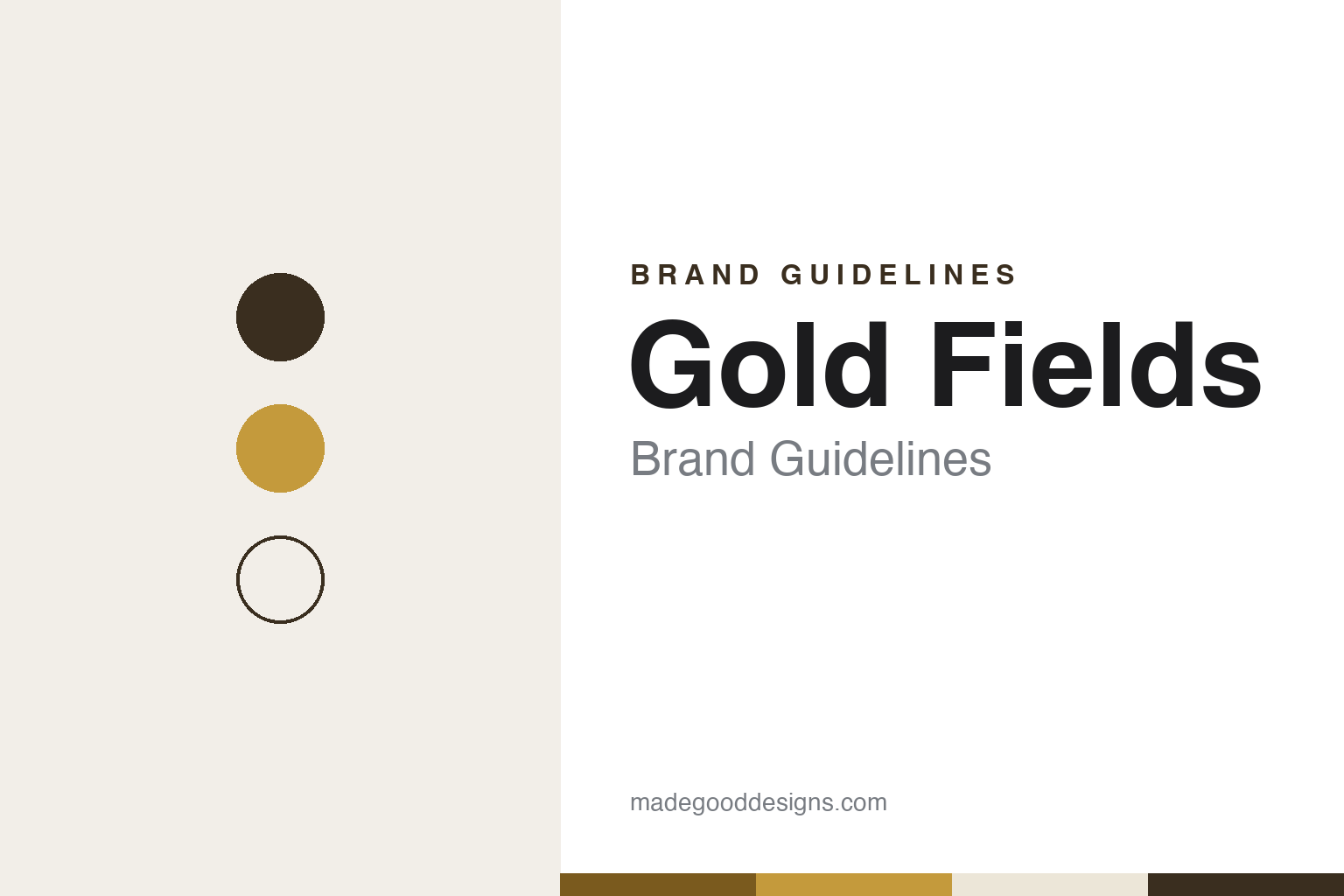
Gold Fields Brand Guidelines
The Johannesburg gold miner with roots in 1887.
Aa
Two constants: an ochre, brown and gold palette and a sober serif register. Abstract homage — not a Gold Fields asset; no logo, mark or product is reproduced.
Rhodes, Rudd and the Rand
An 1887 company for the Witwatersrand.
The company traces its roots to Gold Fields of South Africa Ltd, registered in early 1887 by Cecil Rhodes and Charles Rudd, who were its directors, with Rudd’s brother Thomas as chairman, according to English Wikipedia. Gold had been found on the Witwatersrand the year before. Gold Fields says the company was formed in London and opened an office at Doornfontein in Johannesburg, and that in 1892 it was renamed Consolidated Gold Fields of South Africa, to mine the deep-level deposits of the Witwatersrand.
For most of the next century the business was run from London. English Wikipedia describes Consolidated Gold Fields as a British mining company, listed in London and later part of the FTSE 100, that began to diversify outside South Africa by 1900 and added mines in the United States and Australia after 1945. Gold Fields says that in 1959 and 1960 the name Gold Fields of South Africa was brought back for the London group’s South African operations.
The company’s South African story centres on the West Wits line, west of Johannesburg. Gold Fields says magnetic shales above deep gold deposits there were detected in 1931, leading to the development of the Driefontein and Kloof mines; it dates the start of production at Kloof to 1968. In 1974, English Wikipedia says, Gold Fields of South Africa tried to take over the Union Corporation, and General Mining bought a stake to stop it.
The London parent did not survive the 1980s. In 1988 the mining group Minorco made a hostile bid for Consolidated Gold Fields, which a judge blocked in October 1988, English Wikipedia says, citing The New York Times; Hanson then bought the company. English Wikipedia dates that purchase to 1988 and Gold Fields dates it to 1989. Gold Fields says its South African company then became independent.
Colour
Migrant labour and the mines.
Like the rest of the Witwatersrand gold industry, Gold Fields’ South African mines worked within the migrant labour system. The Truth and Reconciliation Commission, in the business and labour chapter of its 1998 report, found that the mining houses and the Chamber of Mines played a “first-order” role in shaping the migrant labour system. It listed recruiting monopolies, the capping of African wages and divisive practices in managing compounds among the industry’s methods, and found that the Chamber’s opposition to unions for black mine workers had held back their growth until the early 1980s. The report also noted that real African wages on the gold mines were higher in 1915 than in 1970.
Gold Fields’ own history page refers to the National Party’s 1948 election victory as the start of “the iniquities of apartheid.” It says that in 1983 the Chamber of Mines recognised the right of the National Union of Mineworkers to represent black mineworkers, who it says made up the overwhelming majority of the workforce, and it describes the Transkei in 1984 as “a major labour sending area to the mines.”
The legacy reached the courts after apartheid. In December 2012 former gold miners filed a class action in South Africa against 30 gold mining companies, including Gold Fields, alleging that the companies had failed to take adequate measures to protect miners from silica dust, the Business & Human Rights Resource Centre records. The High Court allowed the class action in May 2016. On 3 May 2018 six companies, Gold Fields among them, announced a settlement; Reuters reported that almost all the claimants were black miners from South Africa and neighbouring countries such as Lesotho. The Johannesburg High Court approved the settlement in July 2019.
Typography
Design and documentation.
Gold miners sell a metal that looks the same whoever digs it, so much of their visual identity is borrowed from the work itself. Their reports and websites return to a few images again and again: a doré bar being poured from a furnace, stacked bullion glowing under warm light, a headframe against the sky, and the long terraced walls of an open pit seen from the air.
Each region adds its own scenery. South African producers show the steel headframes of the Witwatersrand and underground stopes lit only by cap lamps; Australian miners show red earth and haul roads in the outback; Canadian companies increasingly show the Arctic, where Agnico Eagle’s Meadowbank mine poured Nunavut’s first gold bar in 2010, according to English Wikipedia, and where B2Gold’s Goose mine reached commercial production in October 2025. West African operations, such as B2Gold’s Fekola mine in Mali, bring savanna landscapes and the paperwork of new national mining codes.
Much of the industry’s printed identity sits in documents rather than products. Annual reports, sustainability reports and technical reports carry the logos, colours and photography; so do the slide decks shown to investors at gatherings such as the Denver Gold Forum in Colorado and Diggers and Dealers in Kalgoorlie, Western Australia. Community programmes, safety campaigns and agreements with Indigenous partners appear prominently in that material, alongside the maps and drill sections that geologists read.
This guide sets out what can be checked about each company — where it began, how its name and ownership changed, and where its mines are — and attributes figures and claims to the sources that give them. The palettes and typefaces shown are our own unofficial interpretations, not the companies’ brand assets.
Aa
A sober serif for a company with roots in 1887. (Specimen set in Source Serif 4, a serif STAND-IN; NOT the Gold Fields logo.)
Gold Fields Limited
From the West Wits to the Atacama.
The present company dates from 1998. Gold Fields says a new company, Goldco, was formed from the gold assets of Gold Fields of South Africa and those of Gencor, and was then renamed Gold Fields Limited; English Wikipedia’s article on Gencor dates the agreement to October 1997. Gold Fields had bought the Tarkwa mine in Ghana in 1993, it says, and in 2001 it added the Agnew and St Ives mines in Western Australia and the Damang mine in Ghana. It listed on the New York Stock Exchange in 2002 and acquired the Cerro Corona deposit in Peru in 2003. A hostile bid by Harmony Gold in 2004 lapsed, Gold Fields says, after a High Court ruling in 2005.
In 2012 Gold Fields unbundled the subsidiary that held its Kloof, Driefontein and Beatrix mines into a new listed company, Sibanye Gold, now Sibanye-Stillwater, English Wikipedia says. The South Deep mine in Gauteng stayed with Gold Fields; in 2018 a strike by the National Union of Mineworkers there lasted 45 days before a settlement. English Wikipedia also records a tailings spill into the Asuman River at Tarkwa in October 2001 and an order from Ghana’s Environmental Protection Agency in July 2012 to halt a gold-recovery plant there because water discharged from the site needed further treatment.
Recent moves are documented in the company’s own releases. Gold Fields completed its purchase of Osisko Mining on 28 October 2024, taking full ownership of the Windfall project in Québec, and on 2 November 2026 it said Québec had issued the certificate of authorization needed to begin building the mine. On 28 October 2025 it inaugurated Salares Norte, its first operation in Chile, at more than 4,000 metres in the Atacama Region. The Damang mine was handed over to the Government of Ghana on 18 April 2026.
For a design guide, Gold Fields shows how a name from 1887 can pass through London, Johannesburg and a 1998 merger and still head a listed miner. Compare Harmony Gold and AngloGold Ashanti, two more gold miners with roots on the Witwatersrand. For this guide we use an ochre, a dark brown and a gold with a serif, an unofficial interpretation; no product or logo is reproduced.
Explore & save
Keep Gold Fields’s identity on hand — save it to a board in the Made Good inspiration library.
Gold Fields identity set
Pin the Gold Fields ochre, brown and gold palette and the sober serif register to your own board.