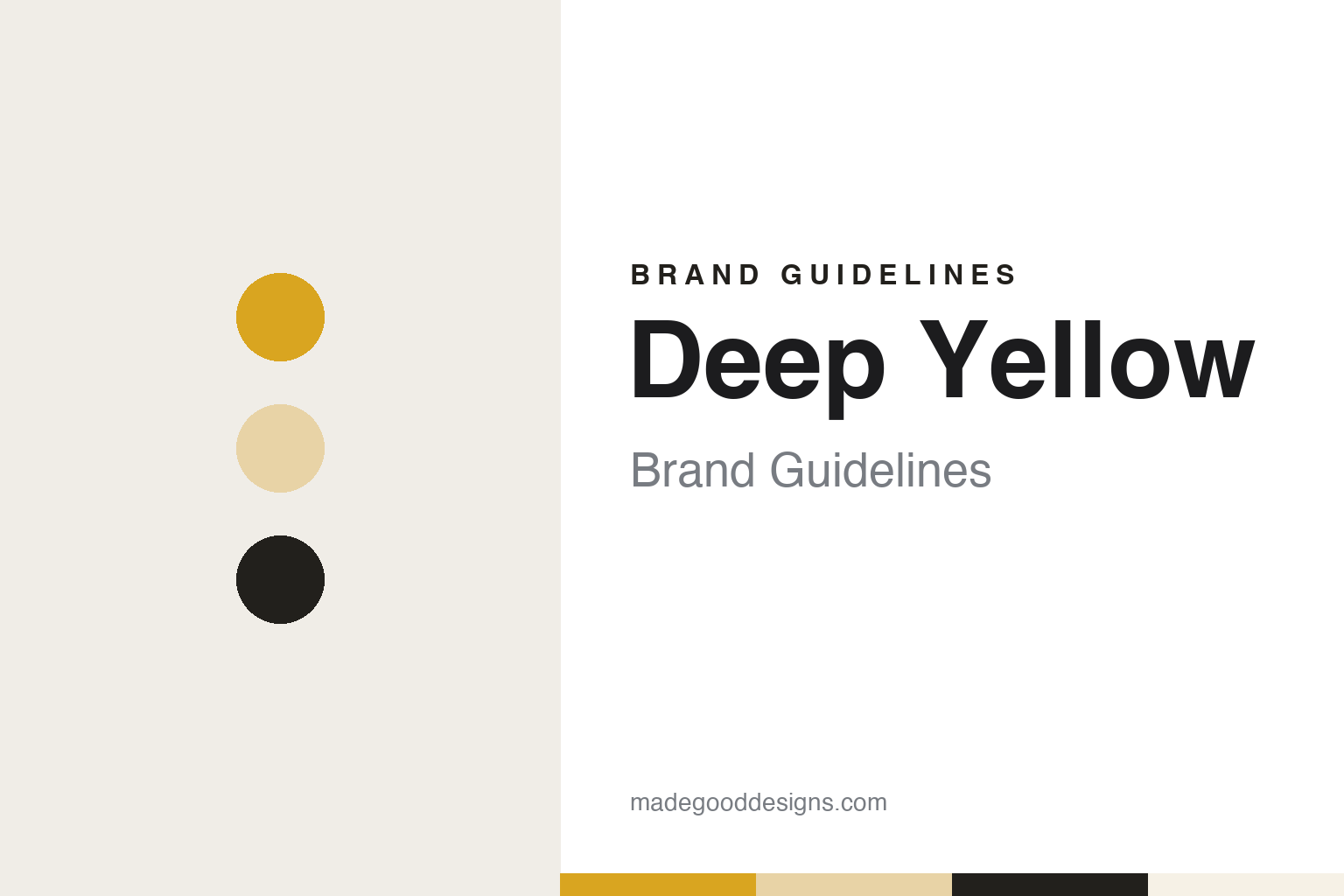
Deep Yellow Brand Guidelines
The Perth uranium developer behind Namibia’s Tumas project.
Aa
Two constants: an ochre, sand and basalt palette and a grotesque sans register. Abstract homage — not a Deep Yellow product or mark; no logo, map or site photograph is reproduced.
Perth and Swakopmund
An Australian company with a Namibian flagship.
Deep Yellow is a uranium developer based in Subiaco, in Perth, Western Australia. Its 2026 annual report describes Deep Yellow Limited as a company incorporated in Perth and listed on the Australian Securities Exchange, where it trades as DYL; the company also lists on the Namibian Stock Exchange and on the US OTCQX market. A company profile on the market-data site StockAnalysis gives its year of incorporation as 1985.
Most of its work is in Namibia, through subsidiaries including Reptile Uranium Namibia and Deep Yellow Namibia, run from Swakopmund. The Namibian Uranium Association describes Deep Yellow Namibia as managing a group of companies that hold a mining licence and exploration licences covering more than 1,100 square kilometres in the Erongo region, among the country’s major uranium mines.
The company’s modern shape owes much to John Borshoff. The annual report says he joined the board in 2016 after more than 50 years in the uranium industry, including more than a decade as a senior geologist and manager of the Australian activities of the German miner Uranerz; in 1993, after Uranerz withdrew from Australia, he founded Paladin Energy, which he left in 2015. The report credits him with turning Deep Yellow from an explorer into a developer with projects in two countries. Deep Yellow announced in October 2025 that he was stepping down as chief executive and managing director, and in December 2025 it named Greg Field, formerly a senior executive at Rio Tinto, to the role.
A second project came by merger. Deep Yellow says Mulga Rock joined the group through its merger with Vimy Resources, completed in August 2022. The project lies in the Great Victoria Desert, 290 kilometres by road east-north-east of Kalgoorlie, and the company says a revised definitive feasibility study is under way that will also assess critical minerals and rare earths alongside uranium.
Colour
Tumas, not yet a mine.
Tumas, in Namibia’s Erongo region, is Deep Yellow’s flagship, and it is not yet in production. The company describes it as a series of palaeochannel and calcrete-type deposits, in which the uranium mineral carnotite sits in river sediments filling narrow, steep-sided ancient channels. It says about 125 kilometres of such channels lie on the project, and that exploration since 2016, chiefly at the Tumas 3 and Tumas 1 East discoveries, has more than quadrupled the palaeochannel resource.
The studies came in steps. The Namibian Uranium Association says a pre-feasibility study was completed in early 2021 and a definitive feasibility study released in February 2023; Deep Yellow says a re-costing of that study, with the engineering firm Ausenco, followed in December 2023. Namibia’s Ministry of Mines and Energy then issued a 20-year mining licence that runs to September 2043, according to the association, which gives the plan as about 1,600 tonnes of uranium oxide a year over a mine life of more than 30 years. Deep Yellow describes Tumas as set to become the fourth uranium mine in Namibia.
The investment decision has moved more than once. Deep Yellow says it first targeted March 2025 and announced a deferral in April 2025. English Wikipedia, in its article on uranium mining in Namibia, says the company then put off building the full-scale process plant until the uranium price improved, while early infrastructure work continued. On 16 October 2026, Small Caps reported that Deep Yellow had withdrawn its target of a final investment decision in the fourth quarter of 2026, citing weak equity markets, and had not named a new date. Civil and concrete works on the processing plant site were continuing, paid for from existing cash, the report said, with two concrete contractors working across the leaching, clarification and beneficiation areas.
Typography
How uranium developers present themselves.
Uranium companies sell a commodity that few of their audiences will ever see, so their visual material leans on the stages around it. Mining reports and investor decks in this sector commonly show drill core laid out in trays, drums of uranium concentrate, the yellowcake of the trade, and the plants where ore is milled. The product itself is a powder; the imagery is of the places and steps that produce it.
Geography does much of the work. In-situ recovery, the method Kazatomprom uses for all of its production in Kazakhstan, pumps solution through wells rather than digging a pit, so its pictures tend to be wellfields of wellheads and pipework laid across open steppe and prairie. In northern Saskatchewan, the Athabasca Basin, where Cameco mines McArthur River and Cigar Lake, appears as lakes, forest and snow, with headframes and camps in winter light.
The fuel story widens the frame. Companies that sell uranium into conversion, enrichment and fuel fabrication often finish their presentations with nuclear power plants, cooling towers and control rooms, and with the language of low-carbon, reliable electricity; when Cameco and Brookfield completed their purchase of Westinghouse in November 2023, World Nuclear News quoted Cameco’s chief executive on demand for nuclear power and energy security.
Much of this material is made for investors and for the industry itself. Producers and developers publish decks and annual reports for listings in markets such as Toronto, New York, London and Astana, and present at industry events, among them those of the World Nuclear Association, whose public information service is World Nuclear News. This guide sets out what can be checked about each company — its origins, owners and mines — and treats its colours and type as an unofficial interpretation.
Aa
A grotesque sans for a developer’s reports and maps. (Specimen set in Archivo, a sans STAND-IN; NOT the Deep Yellow logo.)
Deep Yellow
Two pillars, two deserts.
Deep Yellow describes its plan as a “dual-pillar” strategy, with two advanced projects, Tumas in Namibia and Mulga Rock in Western Australia, and an aim of becoming a multi-mine producer; these are the company’s own descriptions. Its project pages pair maps of the Erongo and Great Victoria Desert ground with resource tables, and in October 2026 it published a flyover video of the civil and concrete works at Tumas.
Exploration ground widens the portfolio. In Namibia it holds the Omahola project, which English Wikipedia describes as a group of magnetite-hosted uranium deposits in the area known as Alaskite Alley, on the same mineralised veins as the Rössing and Husab mines. It also holds the Nova joint venture, where, the 2026 annual report says, Japan’s state minerals agency JOGMEC agreed in May 2025 to withdraw, returning Deep Yellow’s share to 65 per cent. In Australia it has the Alligator River ground in the Northern Territory.
Local ownership is part of the Namibian story. The annual report says that after the end of its June 2026 financial year, the Namibian partner Oponona Investments became a 5 per cent shareholder of Reptile Uranium Namibia, as announced to the ASX on 26 August 2026.
For a design guide, Deep Yellow shows how a company with no mine yet builds its identity from studies, licences and maps of desert ground. Compare Paladin Energy, the company John Borshoff founded in 1993, and Boss Energy, another Perth uranium company. For this guide we use an ochre yellow, a desert sand and a dark basalt with a sans, an unofficial interpretation; no product or logo is reproduced.
Explore & save
Keep Deep Yellow’s identity on hand — save it to a board in the Made Good inspiration library.
Deep Yellow identity set
Pin the Deep Yellow ochre, sand and basalt palette and the grotesque sans register to your own board.