Paladin Energy Brand Guidelines
The Perth uranium company built on a Namibian mine, stopped, restarted and widened.
Aa
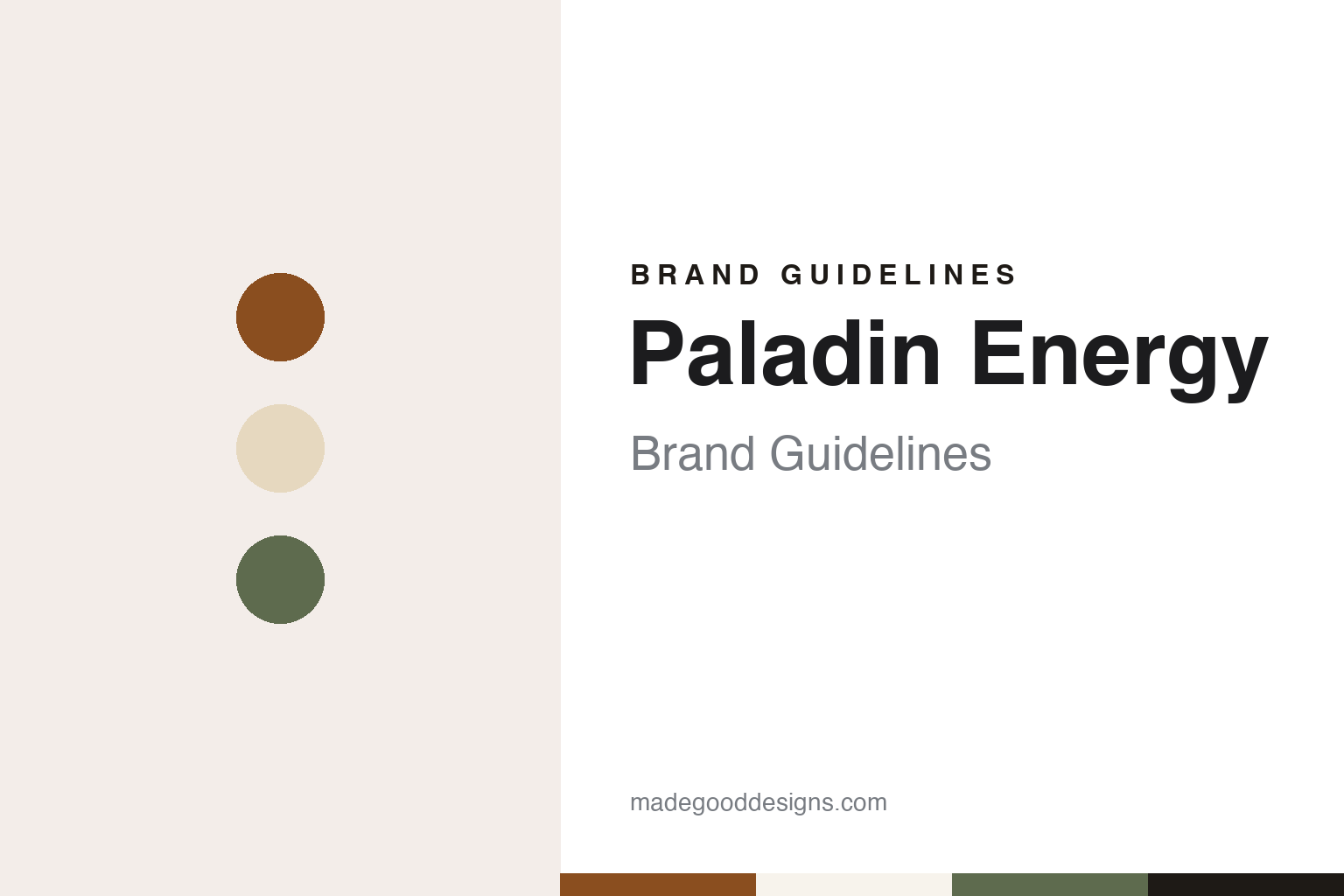
Two constants: a Paladin Energy desert ochre and calcrete sand palette and a Sturdy serif register. Abstract homage — not a Paladin Energy product or mark; no logo or nameplate is reproduced.
Perth
A founder and a Namibian deposit.
Paladin Energy is a uranium company based in Perth, Western Australia. English Wikipedia gives 1993 as its founding year, and the Perth business paper Business News described John Borshoff as the company’s founder when it reported, in August 2015, that he had resigned as managing director of “the Perth-based uranium miner.” Wikipedia records that he had stepped down as chief executive that year. Today the company is listed on the Australian Securities Exchange and the Toronto Stock Exchange, and Wikipedia adds the Namibian Stock Exchange and the over-the-counter market in the United States.
The company’s own history begins in August 2002, when, it says, it bought Langer Heinrich Uranium (Pty) Ltd and its assets from Aztec Resources, formerly Acclaim Uranium NL. English Wikipedia says the Langer Heinrich deposit, in Namibia’s Erongo Region, was discovered in 1973 but had not been mined. Site works began in September 2005, Wikipedia says, and the mine was officially opened by the President of Namibia in March 2007.
Paladin then spread its reach. Wikipedia records that it completed a takeover of Fusion Resources in February 2009, adding deposits near Mount Isa in Queensland, and that it ran a second African mine, Kayelekera in Malawi, where production was suspended in 2014 and which was sold to Lotus Resources in 2020. In 2014 Paladin sold a 25% interest in Langer Heinrich to China National Nuclear Corporation, Wikipedia says; Paladin’s website gives its own share in the mine as 75%.
Colour
Langer Heinrich, stopped and restarted.
Langer Heinrich is an open-pit mine in central western Namibia, about 80 kilometres east of Swakopmund, working a shallow calcrete deposit with an alkaline leach process, the company says. Its timeline gives first production in 2007 at a capacity of 2.7 million pounds of uranium oxide a year, rising to 3.7 million pounds after a second-stage expansion in 2009 and to 5.2 million pounds after a third in 2012.
Low uranium prices then turned against it. English Wikipedia records that Paladin filed for insolvency on 18 August 2017, citing high debt and persistently low uranium prices, and that its shares were delisted from the Toronto Stock Exchange. On 2 February 2018 a debt-for-equity swap transferred 98% of its shares to its creditors, and trading on the Australian Securities Exchange resumed on 16 February 2018, Wikipedia says. Paladin placed Langer Heinrich into care and maintenance in May 2018, citing a sustained low spot price, according to the company.
The restart followed the market’s recovery. Paladin says it decided in 2022 to return the mine to production; Wikipedia dates the announcement to 19 July 2022. First production came on 30 March 2024, from reclaimed ore stockpiles, the company says, and mining itself resumed in 2025. In its 2026 annual report Paladin says the ramp-up to full production was completed during the 2026 financial year, in which the mine produced 4.82 million pounds of uranium oxide. The report says the processing plant treated 4.76 million tonnes of ore that year at an average feed grade of 498 parts per million, with an average recovery rate of 90%.
Typography
Uranium companies and their records.
Uranium companies sell a commodity that few of their audiences will ever see, so their visual material leans on the stages around it. Mining reports and investor decks in this sector commonly show drill core laid out in trays, drums of uranium concentrate, the yellowcake of the trade, and the plants where ore is milled. The product itself is a powder; the imagery is of the places and steps that produce it.
Geography does much of the work. In-situ recovery, the method Kazatomprom uses for all of its production in Kazakhstan, pumps solution through wells rather than digging a pit, so its pictures tend to be wellfields of wellheads and pipework laid across open steppe and prairie. In northern Saskatchewan, the Athabasca Basin, where Cameco mines McArthur River and Cigar Lake, appears as lakes, forest and snow, with headframes and camps in winter light.
The fuel story widens the frame. Companies that sell uranium into conversion, enrichment and fuel fabrication often finish their presentations with nuclear power plants, cooling towers and control rooms, and with the language of low-carbon, reliable electricity; when Cameco and Brookfield completed their purchase of Westinghouse in November 2023, World Nuclear News quoted Cameco’s chief executive on demand for nuclear power and energy security.
Much of this material is made for investors and for the industry itself. Producers and developers publish decks and annual reports for listings in markets such as Toronto, New York, London and Astana, and present at industry events, among them those of the World Nuclear Association, whose public information service is World Nuclear News. This guide sets out what can be checked about each company — its origins, owners and mines — and treats its colours and type as an unofficial interpretation.
Aa
A sturdy serif — integrity, respect, courage, community. (Specimen set in Source Serif 4, a serif STAND-IN; NOT the Paladin Energy logo.)
Paladin Energy
Namibia, then Canada.
The second chapter is Canadian. On 24 June 2024 Paladin announced a deal to buy Fission Uranium Corp., owner of the Patterson Lake South project in Saskatchewan’s Athabasca Basin. Wikipedia records that the Canadian government approved it on 18 December 2024, after a national-security review under the Investment Canada Act, and that the deal was completed on 23 December 2024; Paladin’s annual report cites an ASX release on the clearance dated 19 December. Fission is now Paladin Canada Inc., based in Saskatoon, and Paladin is again listed in Toronto. The undertakings Paladin gave under that act include, its annual report says, that all its senior executives be independent of any state-owned enterprise of the People’s Republic of China.
Patterson Lake South is not yet in production. Paladin describes it as an advanced development project hosting the Triple R deposit, with a proposed mine and mill, and says it received Saskatchewan ministerial approval of its environmental impact statement in February 2026, a step it calls a prerequisite for the permits and licences needed for construction and operation. In February 2025, the company says, it signed mutual benefit agreements with the Clearwater River Dene Nation and the Buffalo River Dene Nation. It also holds the Michelin project in Newfoundland and Labrador and exploration ground in Queensland and Western Australia. Through its Canadian subsidiary, its annual report says, Paladin holds 17 claims covering 31,067 hectares in the basin. After the 2018 restructuring the chief executive’s role passed to Scott Sullivan in 2018 and Ian Purdy in 2020, Wikipedia says; Paul Hemburrow became managing director and chief executive on 1 September 2025.
The brand speaks plainly. Paladin lists four values, integrity, respect, courage and community, and calls itself an independent uranium company with assets in Namibia, Canada and Australia. For a design guide, Paladin Energy shows a brand rebuilt around one restarted mine and widened by a Canadian purchase. Compare Deep Yellow and Boss Energy, two more Australian uranium companies. For this guide we use a desert ochre and a calcrete sand with a serif, an unofficial interpretation; no product or logo is reproduced.
Explore & save
Keep Paladin Energy’s identity on hand — save it to a board in the Made Good inspiration library.
Paladin Energy identity set
Pin the Paladin Energy desert ochre and calcrete sand palette and the Sturdy serif register to your own board.