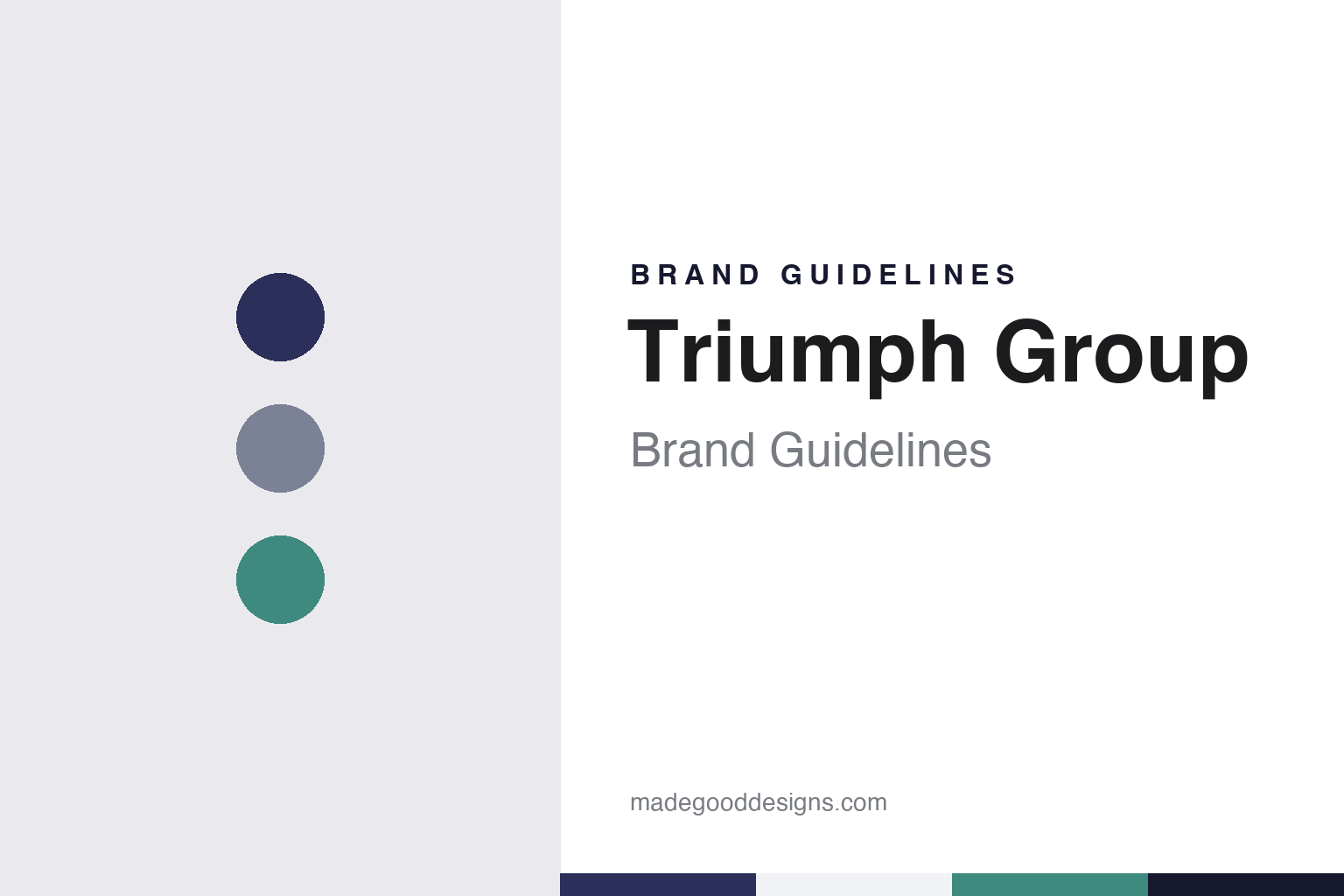
Triumph Group Brand Guidelines
A 1993 buyout that grew into a Pennsylvania aerospace supplier.
Aa
Two constants: an indigo, grey and teal palette and a corporate sans register. Abstract homage — not a Triumph Group product or mark; no component, logo or nameplate is reproduced.
Alco Standard
A group of workshops inside a conglomerate.
Triumph Group began inside another company. English Wikipedia says it was one of the businesses of Alco Standard Corporation, a loose conglomerate whose interests ran from office supplies to food services. By the late 1980s Alco was concentrating on office supplies, paper and food, and in 1986 it was considering selling Triumph, whose companies worked in aerospace and earned a small share of Alco’s revenue.
Alco grouped the eleven Triumph companies, two paper businesses and an aerospace subsidiary into a new unit, Alco Diversified Services, led by Richard Ill, who had run Triumph for several years. In 1992 Alco announced that it wanted to sell the unit, and in 1993 Triumph Group took it over in a leveraged buyout. At that point, English Wikipedia says, the business did aviation repair and overhaul, industrial machining and paper and steel converting, with about 1,450 people at 22 sites in the United States, and aviation was only a little over a quarter of its sales.
The company soon tilted towards aircraft. It sold some non-core units, went public in 1996 and set out to grow by buying aviation companies, among them Air Lab, Teleflex Controls and the Hydro-Mill Company in the mid-1990s and the large-component maker Ralee Engineering in 1998. By early 1999, English Wikipedia says, it had eighteen subsidiaries and more than 2,000 employees, and that year it added six more companies, making flight control surfaces, control systems and metal parts and offering repair and overhaul for most aircraft systems. Its repair arm serviced Boeing 727 and 737 aircraft and auxiliary power units for the US Air Force’s KC-10 tankers.
Colour
From repair shops to aerostructures and back to systems.
The 2000s brought bigger purchases. In 2003 Triumph acquired Boeing’s facility at Spokane, Washington, which became Triumph Composite Systems, and it then bought Parker Hannifin’s United Aircraft Products division and Rolls-Royce Gear Systems, English Wikipedia says. In 2003 it folded its metals business and regrouped its aviation companies into fewer segments.
Its largest step came in June 2010, when it acquired Vought Aircraft Industries, a maker of aerostructures, from the Carlyle Group. English Wikipedia says the deal nearly doubled Triumph’s workforce and turned it into a supplier able to take on large structures for aircraft makers. Further deals followed, including the Canadian gear maker General Donlee in 2013, while in January 2014 Triumph sold Lee Aerospace back to its founder after fourteen years of ownership.
Leadership changed in the 2010s. Richard Ill led the company as chief executive from 1993 to 2012 and returned for a period after his successor resigned; Daniel J. Crowley became chief executive in January 2016. In 2021 Triumph signed a ten-year contract with Rolls-Royce, and in December 2023 it announced the sale of its Product Support business to AAR Corporation, English Wikipedia says. In June 2023 it had also signed a memorandum of understanding with Stirling Dynamics to work together on electro-mechanical actuation.
English Wikipedia now lists Triumph’s operations as actuation products and services, which design and repair hydraulic pumps, actuators and valves; geared solutions, which make gearboxes for aircraft, helicopters and engines; interiors, covering insulation, ducting and floor systems; and systems electronics and controls, which make fuel pumps and engine controls.
Typography
How aerospace suppliers present themselves.
Aerospace suppliers sell to a small number of buyers, and their imagery is built for engineers, airlines and investors rather than for passengers. The product is usually hidden inside someone else’s aircraft, so the pictures tend to show it before it disappears: an engine bolted to a test stand, a single fan blade lit in a studio, a fuselage section on a factory floor, or a cutaway drawing that opens up the layers of a turbofan or a landing-gear leg.
Factories are part of the story. Clean rooms, composite lay-up tables and long assembly halls appear again and again, often with people in them: apprentices, engineers and technicians in overalls, shown at work rather than posing. Many of these companies are joint ventures, partners or subcontractors on the same programmes, so a single engine or wing can carry the work of several firms, each telling its own part of it.
The trade has its own stages. The Paris Air Show at Le Bourget and the Farnborough show in England alternate year by year, and suppliers take chalets and stands there alongside the aircraft makers they serve. Services after delivery are a large part of the business too, and the language of aftermarket support, spare parts and maintenance, repair and overhaul (MRO) runs through their websites and reports.
Corporate reports often put an aircraft on the cover, even when the company makes none of it. Behind that shared look sit very different histories: century-old engine makers, plants sold off by aircraft builders, conglomerate spin-outs and private-equity buyouts. The guides in this series set out what can be checked about each one, and mark clearly what rests on the company’s own word.
Aa
A clean corporate sans for a systems supplier. (Specimen set in Manrope, a sans STAND-IN; NOT the Triumph Group logo.)
Triumph Group
Public from 1996, private again from 2025.
Its final years as a listed company brought new shareholders onto the board: in May 2023, English Wikipedia says, the activist investor Vision One reached a cooperation agreement with Triumph that gave two of its principals board seats. Triumph’s years as a listed company ended in 2025. In February 2025, English Wikipedia says, the private equity firms Warburg Pincus and Berkshire Partners agreed to take the company private. The Pennsylvania Business Report reported on 28 July 2025 that the two firms had completed the acquisition of the Radnor-based company, which would continue as an independent, privately held provider of aerospace systems and components.
The change of owner brought a change of chief executive. Jorge Valladares, formerly chief operating officer of TransDigm, succeeded Daniel Crowley, the Pennsylvania Business Report said, quoting the new chief executive’s aim to strengthen and expand the company’s capabilities for its customers.
Today Triumph Group is headquartered in Radnor, Pennsylvania, and describes its work, in English Wikipedia’s summary, as engineering, designing and making aircraft components, systems and accessories for makers of regional, commercial, military and business aircraft and for airlines and cargo carriers. As a private company it no longer trades on the New York Stock Exchange.
Its history is a run of acquisitions and disposals rather than a single founding product, and its name has stayed constant through all of them, from the Alco years to private equity ownership.
For a design guide, Triumph Group shows how a supplier assembled from many workshops can keep one name over changing owners. Compare Spirit AeroSystems, another structures supplier shaped by sales and buyouts, and Parker Hannifin, whose United Aircraft Products division Triumph bought. For this guide we use an indigo, a gearbox grey and a teal with a sans, an unofficial interpretation; no product or logo is reproduced.
Explore & save
Keep Triumph Group’s identity on hand — save it to a board in the Made Good inspiration library.
Triumph Group identity set
Pin the Triumph Group indigo, grey and teal palette and the corporate sans register to your own board.


