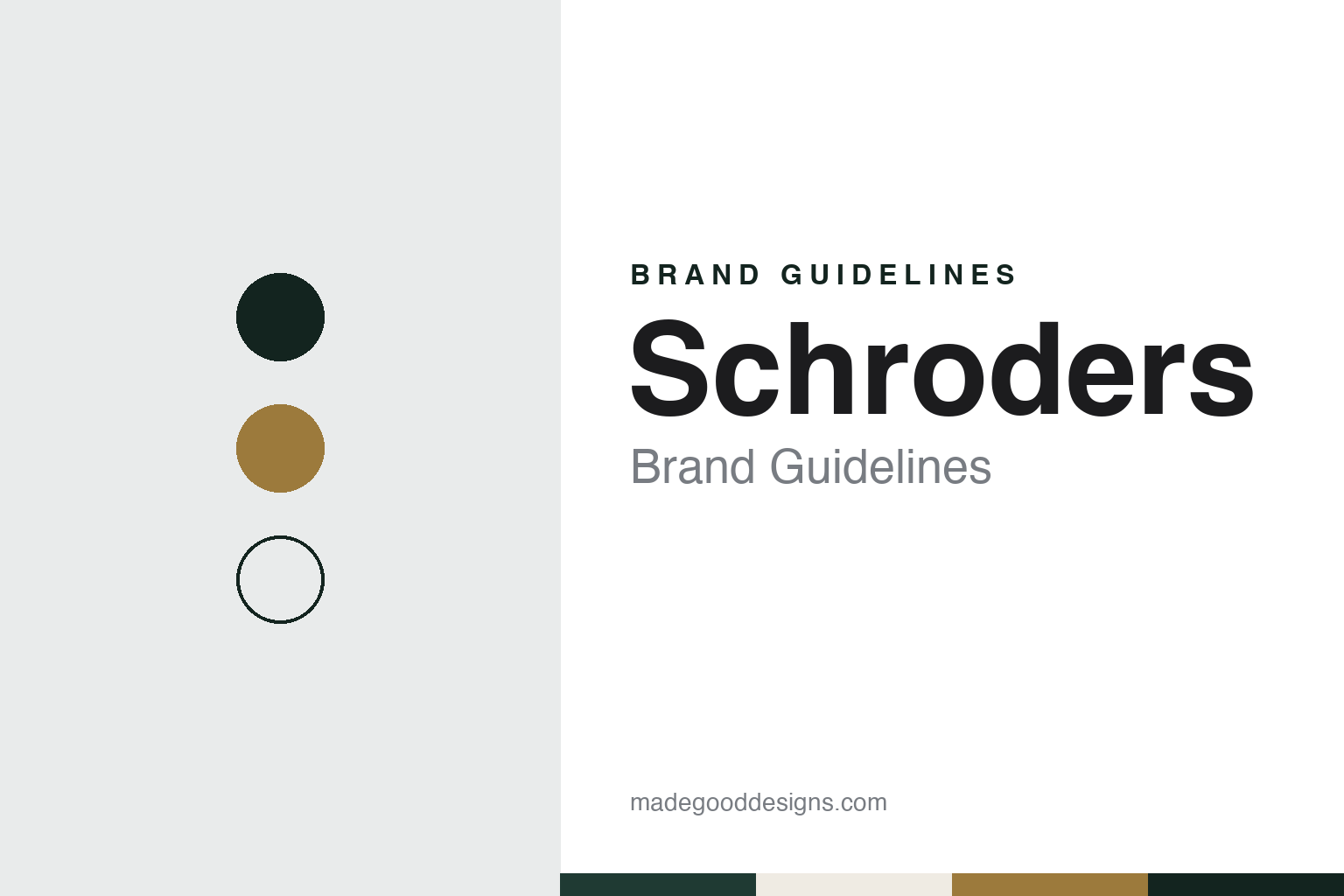
Schroders Brand Guidelines
A Hamburg merchant family’s London house, from bills of trade to funds.
Aa
Two constants: a green, brass and parchment palette and a merchant-bank serif register. Abstract homage — not a Schroders asset; no logo, fund document or mark is reproduced.
Two brothers in London
A Hamburg trading family sets up in the City.
Schroders carries the name of the Schröder family, a Hanseatic merchant family of Hamburg with branches in several cities. The firm dates itself to 1804, when, in its own words, “a young Johann Heinrich Schröder went into partnership in London with his elder brother.” English Wikipedia names the brother as Johann Friedrich, whose London firm, J.F. Schröder & Co, had been founded in 1800, and dates the house of J. Henry Schröder & Co. to 1818.
The business began in trade. German Wikipedia describes dealings in coffee, sugar, cotton and indigo shipped from overseas to central and eastern Europe, with trade finance becoming steadily more important until the firm was in effect a merchant bank. It arranged loans for governments: German Wikipedia says it was the London partner of the French house Erlanger in 1863 for the Confederacy’s only foreign loan of the American Civil War, and in 1870 led Japan’s first foreign loan, which the company says supported the country’s first railway.
By 1913, German Wikipedia says, it was the second-largest bank in the City of London by credit volume, much of it from financing German overseas trade. That business broke down in the First World War. A company profile on Reference for Business says the family members had remained German citizens and the firm was open to seizure by the British government; Bruno Schröder, the senior partner, was naturalised in Britain within days of the declaration of war in 1914.
In 1923 the firm opened a New York bank, the J. Henry Schroder Banking Corporation, known as Schrobanco. In 1924, the company says, it formed its first investment trust, and in 1926 it set up an Investment Department — the beginning of the business Schroders is today.
Colour
Crisis, war and a listing.
The 1930s were hard for the London house. German Wikipedia says the banking crisis of 1931 opened a difficult period from which the firm recovered only in the 1950s. The Reference for Business profile says the collapse of the German economy nearly forced the company out of business, and that the build-up to and outbreak of the Second World War brought new difficulties, with much of its assets frozen for the duration; it quotes the company as calling survival its “foremost achievement in the depression and war years.” During this period, the profile says, the firm concentrated on Schrobanco in New York, which ran as an independent company and was largely shielded from the parent’s troubles. Helmut Schröder, a partner since 1926, became senior partner in 1940 and also headed Schrobanco. The standard history of the firm is Richard Roberts’s Schroders: Merchants & Bankers, published in 1992.
After the war the London firm rebuilt around domestic business and fund management. The company says it won its first UK pension-fund mandate in 1947. In 1957, German Wikipedia says, the partnership became a company and the umlaut was dropped from the name; in 1959 J. Henry Schroder & Co. Ltd listed on the London Stock Exchange, an offering the company says was oversubscribed eighteen times, with the family keeping a large holding. In 1962 it took over the issuing house Helbert, Wagg & Co, and for a time traded as J. Henry Schroder Wagg.
The firm changed shape twice more. In 1986 it sold Schrobanco and bought half of the New York investment bank Wertheim & Co., English Wikipedia says, and in the 1980s it played a leading role in the British government’s privatisations. In 2000 it sold its investment-banking business to Citigroup, whose European investment bank traded as Schroder Salomon Smith Barney until 2003. What remained was an asset manager, and the company says the sale was made “to specialise in asset and wealth management.”
Further purchases followed. In 2013 Schroders bought Cazenove Capital, the wealth manager, and in 2019, the company says, a majority stake in BlueOrchard, a microfinance and impact-investment manager. In June 2021 it grouped its private-markets businesses under the Schroders Capital brand, English Wikipedia says.
Typography
How asset managers present themselves.
Asset managers sell something that cannot be photographed: a promise about money over decades. Their visual language tends to borrow calm from elsewhere. Campaigns favour quiet photography of savers, families and retirees, while corporate pages lean on skyline offices, glass lobbies and the street names of financial districts. The tone is reassurance rather than excitement.
Much of the real design work sits in documents. Fund factsheets, prospectuses and annual reports follow tight templates in which a fund name, a ticker and a chart must sit in the same place on every page, across dozens of languages and jurisdictions. Exchange-traded funds have added their own graphic shorthand: three- and four-letter tickers that work almost as logos, and fund-family names such as SPDR, launched by State Street in 1993, and iShares, which BlackRock acquired with Barclays Global Investors in 2009.
The larger firms also publish a steady stream of thought leadership. Stewardship reports explain how they vote shares on behalf of clients, sustainability reports set out policies, and annual letters from chief executives and market-outlook publications are written to be quoted by the financial press. These pieces are designed as editorial products, with covers, charts and data graphics, and they carry much of a firm’s identity.
Visibility beyond the financial pages usually comes through sponsorship of sports and the arts, and occasionally through public stunts: State Street’s Fearless Girl statue, installed facing Wall Street’s Charging Bull in March 2017, began as a promotion for an index fund. This guide sets out what can be checked about each firm — its founding, its owners and its deals — and keeps colours and typefaces to an unofficial interpretation.
Aa
A bookish serif for a two-century-old house. (Specimen set in Libre Caslon Text, a serif STAND-IN; NOT the Schroders logo.)
Schroders
A family name passes to Nuveen.
For most of its listed life Schroders was a family-controlled company. English Wikipedia says the Schroder family, through trustee companies, individual holdings and charities, held about 44 per cent of the ordinary shares before the takeover, and the company itself says the family holding preserved a long-term outlook and stable ownership.
That ended in 2026. In February 2026 the US asset manager Nuveen agreed to buy Schroders, and the deal closed on 1 October 2026: a release published by Schroders that day said “Nuveen today completed its acquisition of Schroders,” and The TRADE reported the same day that the deal had closed and that the shares had been suspended and delisted from the London Stock Exchange. Nuveen is owned by the US retirement group TIAA, the release says.
The Schroders name continues for now. According to the release, Schroders will operate separately within Nuveen for 12 to 18 months, led by Richard Oldfield, its group chief executive, and London will be the combined firm’s headquarters outside the United States and its largest office; Schroders’ wealth businesses, including Cazenove Capital, are named as central to the combined firm. Private Banker International reported the same arrangements on 5 October 2026. The company’s website now carries the name Schroders Limited.
For a design guide, Schroders shows how a family name from a Hamburg counting house can carry through two centuries of change, from trade bills to funds. Compare Nuveen, its owner since October 2026, and UBS, another European name in wealth and asset management. For this guide we use a deep green, an old brass and parchment with a serif, an unofficial interpretation; no product or logo is reproduced.
Explore & save
Keep Schroders’s identity on hand — save it to a board in the Made Good inspiration library.
Schroders identity set
Pin the Schroders green, brass and parchment palette and the merchant-bank serif register to your own board.