Northern Star Brand Guidelines
An East Kimberley explorer that became the owner of Kalgoorlie’s Super Pit.
Aa
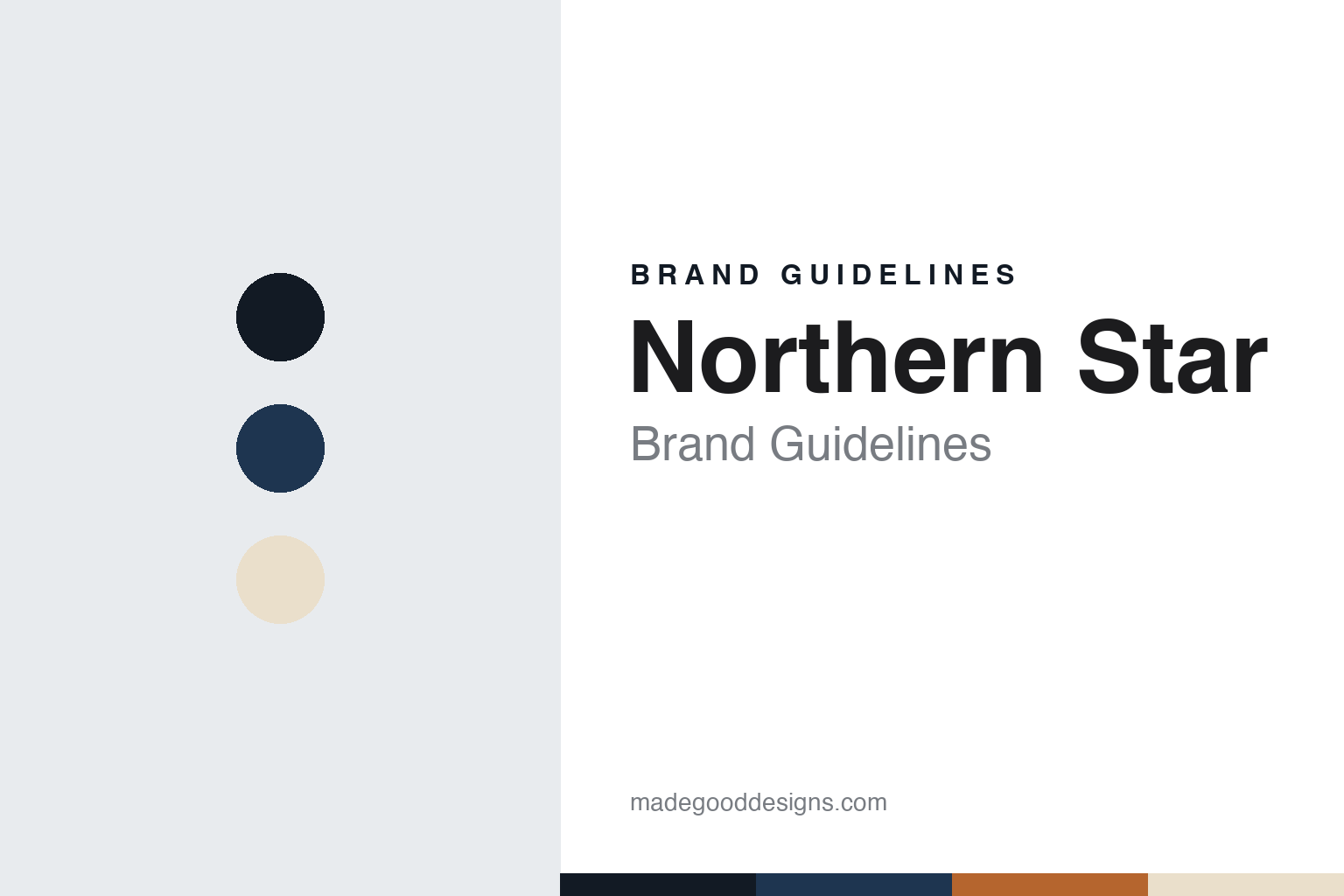
Two constants: a Northern Star navy and ochre palette and a Condensed sans register. Abstract homage — not a Northern Star product or mark; no bar, logo or nameplate is reproduced.
East Kimberley
An explorer that nearly ran out of road.
Northern Star Resources began as a small exploration company. English Wikipedia, citing its 2003 prospectus and the Australian Securities Exchange’s admission notice, says it was set up to search for and develop ore deposits in the East Kimberley region of Western Australia and was listed on the ASX in December 2003, with Jubilee Mines as its cornerstone investor. Its early greenfields exploration near Halls Creek was unsuccessful, and by the time of the global financial crisis the company was “teetering on bankruptcy,” the Australian Financial Review wrote in May 2016, as quoted by Wikipedia.
The turn came with a change of strategy. In 2007 the underground geologist Bill Beament became chief executive and led a recapitalisation; he refocused the company on buying mining assets he saw as undervalued, Wikipedia says, citing the AFR. In 2010 Northern Star bought the Paulsens gold mine from Intrepid Mines, its first major acquisition and the step that made it a producer. In the 2014 financial year it bought four more mines, including Jundee, and the Sydney Morning Herald described it in May 2014 as the country’s second-biggest gold miner after Newcrest Mining, as Wikipedia records.
The company is based in Western Australia: its website gives its head office as Subiaco, in Perth, and it trades on the ASX under the code NST. It describes itself as a gold producer with operating mines and exploration in Western Australia and Alaska.
Colour
The Super Pit, Saracen and Alaska.
Northern Star’s largest asset sits in a famous goldfield. The company says the 1893 gold rush at Kalgoorlie led to the discovery of the Golden Mile, which by 1903 had 49 operating mines and 100 headframes. In the 1980s the businessman Alan Bond began buying up individual leases along the Golden Mile; his company did not complete the takeover, but in 1989 the leases were combined and Kalgoorlie Consolidated Gold Mines, or KCGM, was formed to run them for joint-venture owners, the company says. KCGM’s operations include the Fimiston open pit, known as the Super Pit, and the Mt Charlotte underground mine.
In 2019 Northern Star agreed to buy a half share of the Super Pit from Newmont Goldcorp, Wikipedia says, citing the AFR of December 2019; Saracen Mineral Holdings held the other half. The company says that on 3 January 2020 KCGM became wholly Australian-owned for the first time. A merger between Northern Star and Saracen, its joint-venture partner, was proposed in October 2020 and completed in February 2021, when Saracen was removed from the ASX, according to Wikipedia; from then the Super Pit was controlled by a single company for the first time in its history, Northern Star says.
The company also reshaped its smaller holdings. It sold its share of the Kundana operations to Evolution Mining in July 2021 and the Paulsens mine to Black Cat Syndicate in June 2022, Wikipedia says. Its mines are grouped into three production centres: Kalgoorlie, which includes KCGM and the Carosue Dam operations; Yandal, which includes Jundee, Thunderbox and Bronzewing; and Pogo in Alaska. The company says it acquired the Pogo underground mine, about 145 kilometres southeast of Fairbanks, in 2018; the mine has produced gold since 2006, it says. Pogo lies in the Tintina Gold Province and is worked underground through four portals, according to the company, which describes its mining methods as varying with the thickness and dip of the quartz veins.
Typography
Design and documentation.
Gold miners sell a metal that looks the same whoever digs it, so much of their visual identity is borrowed from the work itself. Their reports and websites return to a few images again and again: a doré bar being poured from a furnace, stacked bullion glowing under warm light, a headframe against the sky, and the long terraced walls of an open pit seen from the air.
Each region adds its own scenery. South African producers show the steel headframes of the Witwatersrand and underground stopes lit only by cap lamps; Australian miners show red earth and haul roads in the outback; Canadian companies increasingly show the Arctic, where Agnico Eagle’s Meadowbank mine poured Nunavut’s first gold bar in 2010, according to English Wikipedia, and where B2Gold’s Goose mine reached commercial production in October 2025. West African operations, such as B2Gold’s Fekola mine in Mali, bring savanna landscapes and the paperwork of new national mining codes.
Much of the industry’s printed identity sits in documents rather than products. Annual reports, sustainability reports and technical reports carry the logos, colours and photography; so do the slide decks shown to investors at gatherings such as the Denver Gold Forum in Colorado and Diggers and Dealers in Kalgoorlie, Western Australia. Community programmes, safety campaigns and agreements with Indigenous partners appear prominently in that material, alongside the maps and drill sections that geologists read.
This guide sets out what can be checked about each company — where it began, how its name and ownership changed, and where its mines are — and attributes figures and claims to the sources that give them. The palettes and typefaces shown are our own unofficial interpretations, not the companies’ brand assets.
Aa
A condensed sans for a name taken from the sky. (Specimen set in Barlow Semi Condensed, a sans STAND-IN; NOT the Northern Star logo.)
Northern Star
A fourth centre in the Pilbara.
The newest part of the business is in the Pilbara. On 2 December 2024 Northern Star agreed to acquire all of De Grey Mining, owner of the Hemi gold project, under a binding scheme implementation deed in which De Grey shareholders would receive Northern Star shares, The Australian Mining Review reported that day, quoting managing director and chief executive Stuart Tonkin. Northern Star says it acquired Hemi through a court-approved scheme of arrangement on 5 May 2025. The project lies about 85 kilometres south of Port Hedland, and the company says it is a development project rather than an operating mine; the company describes Hemi as an intrusion-hosted type of gold mineralisation new to the Pilbara region, and its six main zones are named, in alphabetical order, Aquila, Brolga, Crow, Diucon, Eagle and Falcon.
By March 2026 the company had become, in the words of the Australian Financial Review quoted by Wikipedia, “the country’s largest listed gold producer.” Its own website describes it as a global-scale Australian gold producer and sets out a strategy built on its three large production centres in Western Australia and Alaska, with sustainability, safety and community and Indigenous engagement pages alongside its investor material.
For a design guide, Northern Star shows how a company can grow from a struggling explorer into the owner of a landmark open pit under the name it listed with in 2003. Compare Newmont, which sold Northern Star its half of the Super Pit, and Evolution Mining, another Australian gold miner that bought assets from it. For this guide we use a night-sky navy, a pit ink and a goldfields ochre with a sans, an unofficial interpretation; no product or logo is reproduced.
Explore & save
Keep Northern Star’s identity on hand — save it to a board in the Made Good inspiration library.
Northern Star identity set
Pin the Northern Star navy and ochre palette and the Condensed sans register to your own board.