Zijin Mining Brand Guidelines
From a Fujian gold hill to Kamoa and Bor.
Aa
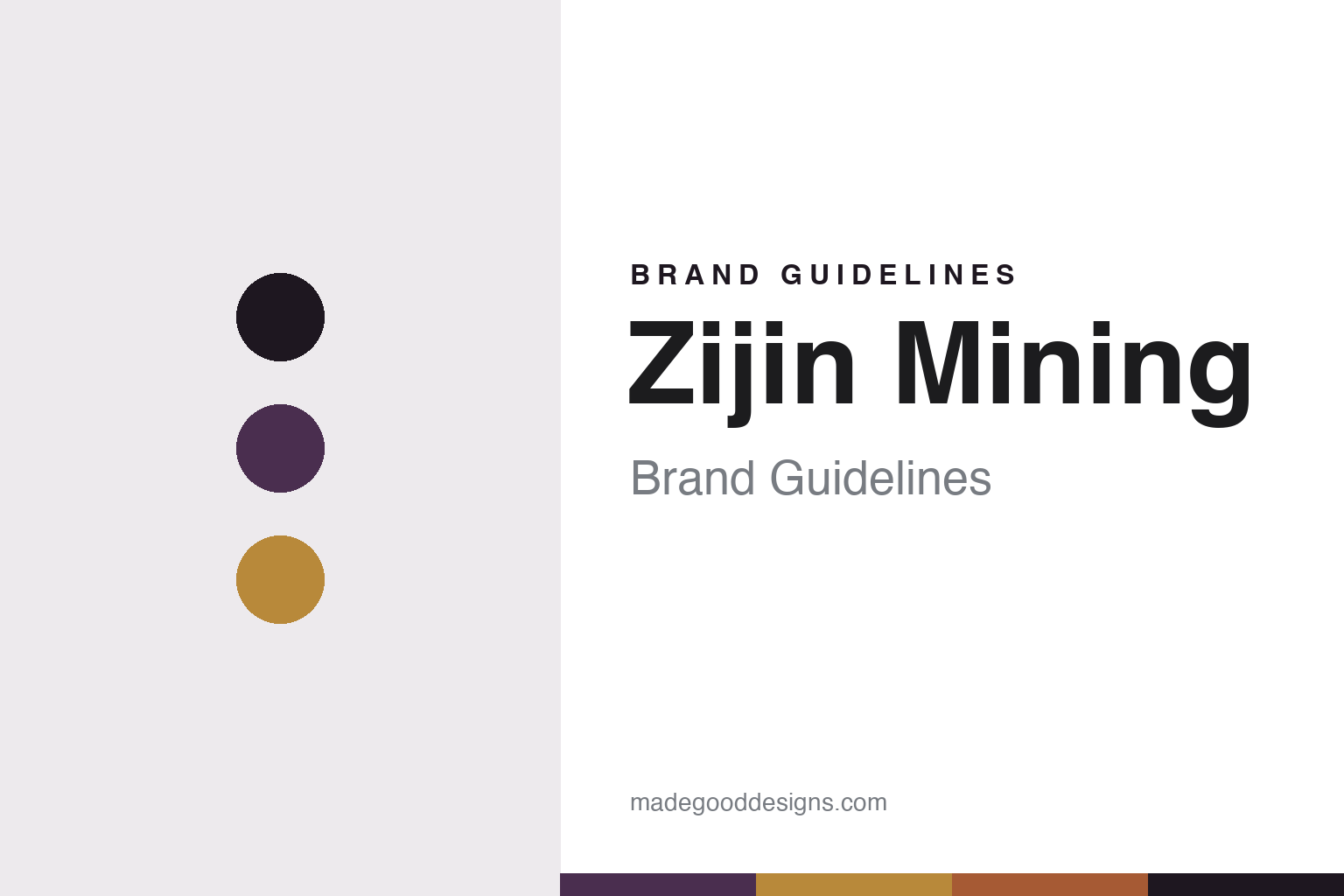
Two constants: a plum, gold and copper palette and a steady serif register. Abstract homage — not a Zijin Mining product or mark; no logo, mine or nameplate is reproduced.
Zijinshan
A county minerals company and one hill in western Fujian.
Zijin Mining starts with a hill. In its own history, the company says the geologist Chen Jinghe worked out in the 1980s that the Zijinshan deposit in Shanghang County, western Fujian, carried gold in its upper zone and copper below, and that the find later won a first prize in China’s State Science and Technology Progress Award. The company dates its predecessor, the Shanghang Minerals Company, to 1986; English Wikipedia gives the same year.
The Zijin name came with a restructuring. In 1993, the company says, it became the Shanghang Zijin Mining Company and began building the Zijinshan Gold Mine; it counts its anniversaries from that year and marked its 30th in 2023. It was renamed Fujian Minxi Zijin Mining Group in 1994, became a limited liability company in 1998 and a joint-stock company, Fujian Zijin Mining, in 2000. Expansion inside China followed: Guizhou Zijin in 2001 and the Ashele copper mine in Xinjiang in 2002.
Two listings turned the county company into a public one. The shares joined the Hong Kong Stock Exchange in 2003 and the Shanghai Stock Exchange in 2008, the company says, and it still trades on both. English Wikipedia describes Zijin as partly state-owned: its largest shareholder, with about a quarter of the shares, is an investment company controlled by the government of Shanghang County. The group’s headquarters remain in Shanghang, in the city of Longyan, with an office in Xiamen on the coast.
The company frames its early decades as a run of stated goals and milestones. It says the Zijinshan mine was officially recognised as the “Largest Gold Mine in China” in 2008, the year of its Shanghai listing. It published its first corporate social responsibility report in 2011 and says it met a second goal, “becoming a leading metals miner in China,” in 2013, before the overseas copper purchases that now define it.
Colour
Copper from Tibet to the Congo.
Zijin began as a gold miner, and in 2005, the company says, it reached its first goal of “becoming a leading gold mining company in China” and began to look abroad. Copper now leads its own list of businesses, ahead of gold, zinc, lead, silver, lithium and molybdenum, and the company says it works in 17 provincial-level regions of China and 15 other countries.
Its copper names span three continents. In China they include the Julong mine in Tibet, in which it took a controlling stake in 2020, the Duobaoshan mine in Heilongjiang, wholly owned since 2017, and Zijinshan itself. In 2015 it bought 49.5% of Kamoa Holding, the company that owns the Kamoa-Kakula copper mine in the Democratic Republic of the Congo, where its partner is Ivanhoe Mines; it also raised its stake in the Kolwezi copper mine to 72% in 2016. In 2018 it acquired 63% of RTB Bor, Serbia’s state copper complex, and in 2019 it secured full ownership of the nearby Timok deposit, now the Čukaru Peki mine.
Gold and new metals kept the list growing. The company records the Buriticá mine in Colombia and Aurora in Guyana in 2020, Rosebel in Suriname in 2022, the La Arena copper-gold mine in Peru in 2024, and, in 2025, the Akyem gold mine in Ghana and the Raygorodok mine in Kazakhstan. It added lithium projects in Argentina, Tibet and Hunan in 2022, and in 2025 floated a gold subsidiary, Zijin Gold International, in Hong Kong. Outside mining itself, it gained control of Fujian Longking, an environmental-protection company, in 2022, and in 2015 it bought a 50% interest in Barrick Niugini, operator of the Porgera gold mine in Papua New Guinea. In 2023 it set out climate goals of a carbon peak by 2029 and carbon neutrality by 2050, it says.
Typography
How copper miners present themselves.
Copper miners sell a raw material, not a consumer product, so their identities are built for investors, governments, employees and the communities near their mines. The pictures tend to repeat across the sector: terraced open-pit benches lit by low desert sun, haul trucks whose wheels stand taller than the workers beside them, the long sheds of a concentrator, and stacks of copper cathode sheets ready for shipment. Copper itself often supplies the colour, in warm orange and brown tones that run through reports and presentations.
Much of the communication is formal. Annual reports, sustainability reports and technical reports on reserves are published on fixed calendars, and quarterly results are written for analysts. Alongside the numbers sit recurring themes: safety, presented as a daily routine rather than a slogan; community programmes in schools, clinics, water and local suppliers; and, increasingly, the place of copper in electricity grids, electric vehicles and renewable energy, framed as the metal of the energy transition.
The sector also has its own meeting places. The PDAC convention in Toronto and the Mining Indaba in Cape Town gather miners, explorers, investors and ministers each year, and company stands, logos and presentation decks are designed for those rooms as much as for the web. Trade titles such as The Northern Miner and Mining Technology report on projects, permits and disputes, which are part of the public record of every large miner.
The companies in this guide differ widely in origin: some began as subsidiaries of older American smelting groups, some as small exploration companies, some as state enterprises. This guide sets out what can be checked about each one — who founded it, who owns it, where it mines and what has been reported about its disputes — and marks clearly what rests only on the company’s own word.
Aa
A steady serif for a long company history. (Specimen set in Noto Serif, a serif STAND-IN; NOT the Zijin Mining logo.)
Zijin Mining
Purpose statements, filings and a public record.
Zijin states its purpose as “Mining for a Better Society” and its goal as becoming “a green, high-tech, leading global mining company.” The record around those words includes events stated in official sources. In July 2010 waste water leaked from the Zijinshan Gold and Copper Mine into the Ting River; on 30 January 2011 a district court in Longyan convicted the mine of a serious pollution offence, the company told the Hong Kong exchange in an announcement the next day, noting losses to fish farmers and a one-day suspension of water supply in parts of Shanghang County.
On 15 January 2025 the United States Department of Homeland Security added Zijin Mining Group and two Xinjiang subsidiaries, Xinjiang Zijin Nonferrous Metals and Xinjiang Zijin Zinc Industry, to its Uyghur Forced Labor Prevention Act Entity List, the department’s published list shows.
For a design guide, Zijin Mining shows how a company born around a single mountain deposit carries that origin into a global portfolio: the hill gives the name, and the timeline of listings and acquisitions does the rest of the storytelling. Compare it with Ivanhoe Mines, its partner at Kamoa-Kakula, and MMG, another copper miner with roots in China. For this guide we use a plum, ore gold, copper and near-black palette with a serif, an unofficial interpretation; no product or logo is reproduced.
Explore & save
Keep Zijin Mining’s identity on hand — save it to a board in the Made Good inspiration library.
Zijin Mining identity set
Pin the Zijin Mining plum, gold and copper palette and the steady serif register to your own board.