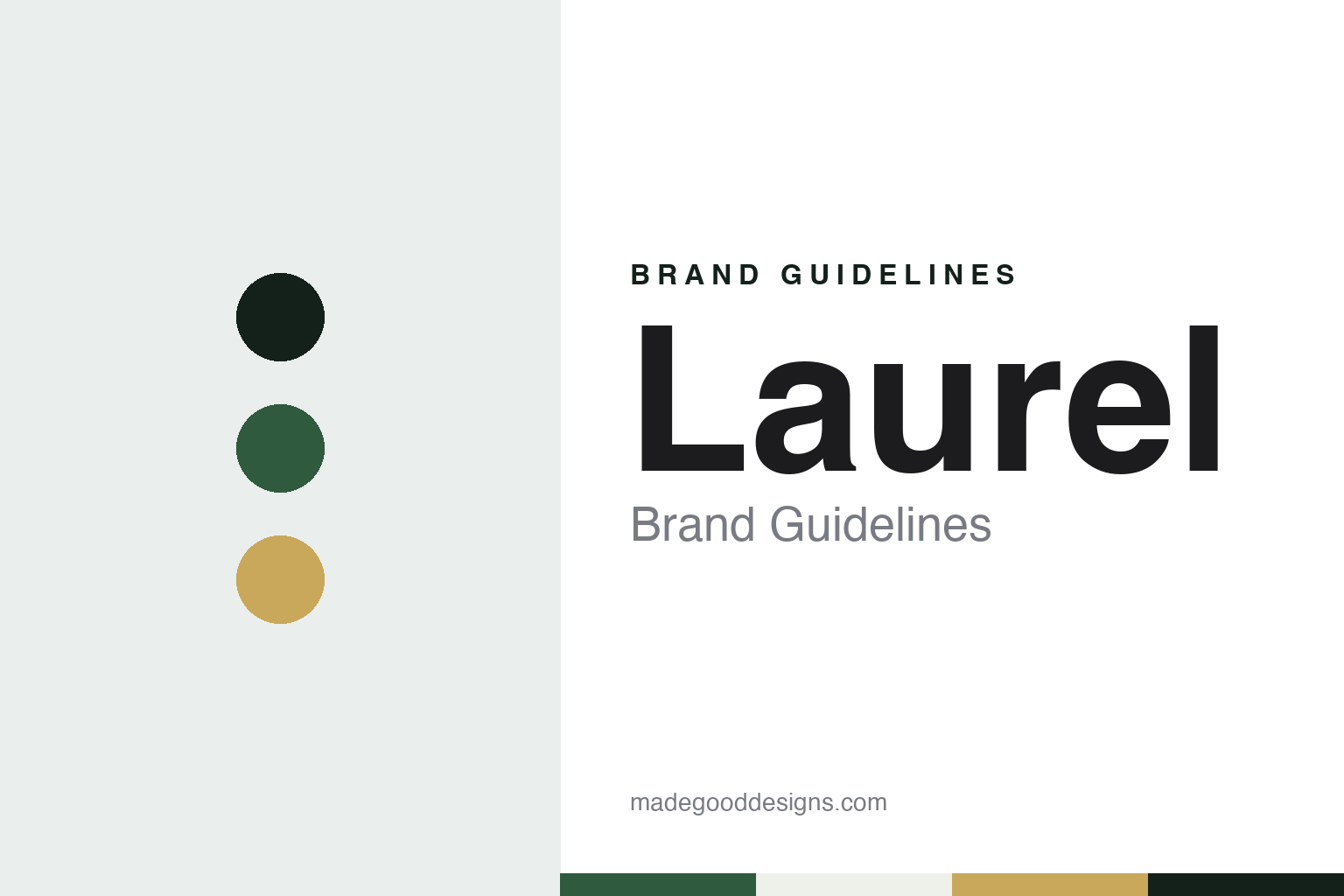
Laurel Brand Guidelines
The Osaka coin-counter maker that became Laurel Bank Machines.
Aa
Two constants: a laurel green, gold and paper palette and a Mincho serif register. Abstract homage — not a Laurel product or mark; no machine, logo or nameplate is reproduced.
Tenshin
A post-war trading company in Osaka.
Laurel dates its founding to 15 January 1946. The company says its founder, Iwao Ikebe, set up a firm called Tenwa Kogyo that year and in 1947 founded Tenshin Shoji in Osaka; Japanese Wikipedia gives 1946 for Tenshin Shoji. Its present operating company, Laurel Bank Machines, was incorporated in 1959, the company says, and in January 2026 it marked eighty years since the founding.
The business turned to money early. In 1954 a Tenshin company began making and selling a coin counter, the TZ, according to the company’s history, and in 1957 it developed a banknote counter, the PV-1, at the request of the Bank of Japan — a date Japanese Wikipedia also gives. A coin-wrapping machine, the LAC-2, followed in 1963, and in 1966 a coin wrapper became the company’s first export, to the United States.
The Laurel name arrived in stages. In 1970 the company set up Laurel Seiki to run a factory in Tokyo, and in 1973 the main company changed its name from Tenshin to Laurel Bank Machines, with its sister companies renamed Laurel Seiki and Laurel Shoji at the same time, the company says. The headquarters is now in Toranomon, in Tokyo’s Minato ward, with an Osaka head office alongside it.
Colour
From coin rolls to the teller’s counter.
Laurel makes machines for handling money in bulk. Japanese Wikipedia describes it as a maker of coin counters, banknote counters and the larger machines and processing lines that count, sort and pay in money, supplying financial institutions in Japan and abroad, including the Bank of Japan and the Japan Post group. It also lists automatic change machines and cash deposit machines for shops, and queuing systems and information screens for bank branches.
The company’s history is a run of firsts it claims for itself. It says that in 1970 it developed a new technique for wrapping coins in transparent film, which it patented; that in 1971 it built a note-dispensing unit for online cash dispensers; that in 1981 it completed Japan’s first teller system for paying in and paying out cash at the counter; and that in 1982 it made Japan’s first compact banknote sorter, the BS series. In 1983, it says, the TDS-03 combined coin and note deposits in one machine for the first time in Japan, and in 1987 it developed an unattended cashier system, the OACS, for bank back offices. Later product lines carry names such as ACTUS, AXis and LADY, and in 2024 the company announced the DRZ, a note and coin deposit and withdrawal machine.
Design recognition came in 1992, when its battery-powered handheld note counter, the HBC-10, received a Good Design Award, according to the company and Japanese Wikipedia.
The machines are made in Japan, at factories in Tokyo and Osaka. In 2025, the company says, the two factory companies, Laurel Seiki and Laurel Kikai, merged as Laurel Precision, which runs both sites.
The range has moved beyond counting. The company’s history records key-management cabinets in 2008, a bank reception machine that gained colour universal design certification in 2010, a licence in 2018 to issue prepaid payment instruments for a cashless payment business, and, in 2021, the purchase of an AI text-recognition product from the Japanese firm Asilla. Its 2025 profile describes the business as the development, manufacture, sale and maintenance of currency-processing machines and systems, financial online terminals and cashless payments.
Typography
Cash handling, behind the counter.
Cash-handling makers sell machines that most people meet without ever choosing them. Their products appear in bank lobbies and in the walls of branches, behind teller counters as cash recyclers, beside supermarket tills as coin counters, and in the printing halls where banknotes are made. The maker’s name is often a small plate on a large machine, so the brand does much of its work in brochures, trade stands and service contracts rather than on the street.
The machines themselves come in families. NCR’s first serious ATM generation, the 5070 of 1983, was developed at its Dundee plant in Scotland and came in lobby and through-the-wall versions, with modules that could be taken out for repair or refilling, according to English Wikipedia. That modular build lends itself to cutaway diagrams, which trace the path a note takes through a machine from cassette to dispenser.
Trade fairs and bank technology conferences are where new machines are shown. Diebold demonstrated a cash machine prototype at the American Bankers Association’s annual meeting in 1966, and in October 2015 showed two ATM concepts at the Money20/20 show in Las Vegas, English Wikipedia says. The ATM Industry Association gives its own awards, which makers list on their websites.
Ownership in this sector changes often. Diebold took over Germany’s Wincor Nixdorf in 2016, NCR split off its ATM business as NCR Atleos in 2023, and in February 2026 the cash carrier Brink’s agreed to acquire NCR Atleos, ATM Marketplace reported. This guide sets out what can be checked about each brand — who founded it, who owns it and where its machines are made — and marks clearly what rests on the company’s own word.
Aa
A Mincho serif for a Japanese machine-maker. (Specimen set in Shippori Mincho, a serif STAND-IN; NOT the Laurel logo.)
Laurel
A group with a founder’s motto.
Laurel went abroad through partners and its own companies. In 1970, the company says, it began exporting coin counters and spindle-type note counters to Europe with the British firm De La Rue as its agent, and from 1975 it set up agents across Europe, extending its network in 1978 to Southeast Asia, the Middle East, Africa and Latin America. It opened a representative office in Los Angeles in 1986, formed a joint venture in France in 1995 and another in Shenyang, China, in 1996, which became a wholly owned subsidiary in 2009, and set up LBM Italia as a joint venture in 2013.
Its machines appear in official records outside Japan. The European Central Bank’s list of banknote authentication devices tested with a positive result, dated 3 December 2021, included a Laurel J-923 currency counter, tested in November 2021 and listed under the company’s Tokyo address.
The company profile lists Laurel Holdings, Laurel Precision, Laurel Shoji and the Chinese and Italian companies as the Laurel group, which it says employed 1,292 people in March 2025, with about ninety locations across Japan. Its president and chief executive is Tadashi Ikebe, and the company describes its motto, chūjo, as “sincerity and consideration,” a principle it attributes to the founder.
For a design guide, Laurel shows how a specialist maker can carry a name adopted in 1973 across decades of machines. Compare SCAN COIN, a coin machine maker founded twenty years later in Sweden, and De La Rue, its early European agent. For this guide we use a laurel green, a soft gold and a paper white with a serif, an unofficial interpretation; no product or logo is reproduced.
Explore & save
Keep Laurel’s identity on hand — save it to a board in the Made Good inspiration library.
Laurel identity set
Pin the Laurel green, gold and paper palette and the Mincho serif register to your own board.


