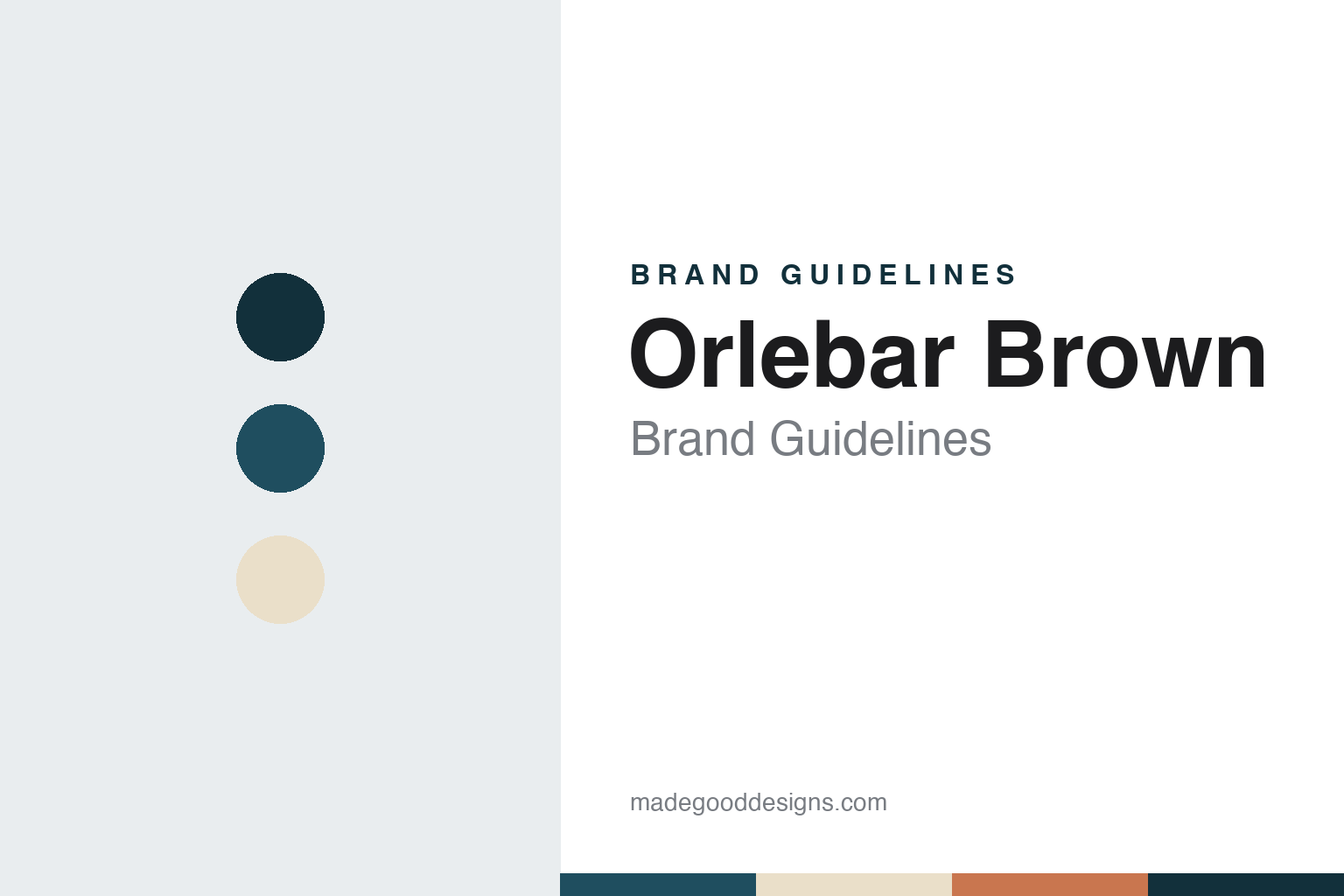
Orlebar Brown Brand Guidelines
The London label built on a short you can swim in.
Aa
Two constants: an Orlebar Brown deep pool and warm sand palette and a Tailored sans register. Abstract homage — not an Orlebar Brown product or mark; no garment, print or logo is reproduced.
A Short You Can Swim In
A lunch, a dress code and a pattern for trousers.
Orlebar Brown started with a change of clothes. Adam Brown, who had worked in the voluntary sector and then in portrait photography, was invited to a friend’s 40th birthday in Rajasthan. He dated the trip to February 2005 in a 2017 interview with The Moodie Davitt Report, and the Evening Standard in 2014 and The Independent in August 2026 also give 2005; English Wikipedia gives the summer of 2006. When the group went from the pool to lunch, Brown was told to change out of his swimming shorts to meet the restaurant’s dress code. Afterwards, he told The Independent, he thought: “I don’t want a swim short, I want a short that I can swim in.”
He had no background in clothing. The Standard reported that he took a three-day Start Your Own Fashion Business session at the Portobello Business Centre and a summer course at St Martins to learn to draw. He then teamed up with an old college friend, Julia Simpson-Orlebar. Piper, the investor that later backed the business, and the corporate adviser Oaklins both describe the company as founded in 2007 by the two of them. English Wikipedia says the website went live in March of that year. Simpson-Orlebar left amicably in 2008, the Standard reported, and in a 2015 interview with City AM Brown called her “instrumental” at the research, development and launch stage.
The first run was small. The company says it launched with one style in four lengths and five colours, and the Standard and The Independent put the first order at about 1,000 pairs. Brown ran the business from a spare room and a storage unit, and told the Standard that the first pairs sold in about three and a half months. He told City AM that it was two “pretty tough years” before he hired his first employee.
Finding a maker took longer than the idea. Brown told The Moodie Davitt Report that he tried factories around the world before settling on a small one in North London.
Colour
Side fasteners, photographs and a Bond film.
The product is a piece of tailoring in swimming fabric. Brown has described the first design as “based on the traditional pattern of a man’s pair of trousers, with side fasteners to adjust, and a tailored waistband.” English Wikipedia, citing a 2015 Esquire article, calls it a 17-piece pattern with a four-part shaped waistband; Brown told TheIndustry.fashion in 2021 that over 60 elements go into each pair. The company calls the side fasteners its hallmark, says its Classic swim shorts remain its best-selling product, and says they are made from recycled plastic and guaranteed for five years. Its website sorts swim shorts into styles with names including Bulldog, Setter, Dane and Springer.
Pictures became the second signature. Signé magazine reported in December 2018 that Brown had drawn on his interest in photography for the brand’s photographic prints, using images from Getty Images on its swim shorts, then extended the idea so that customers could have their own photographs printed on a pair. English Wikipedia describes an app, #SnapShorts, for the same purpose. Photographic is still one of the pattern filters on the company’s website, alongside solid, print and striped.
The range widened in 2010, with the first T-shirts, polos and shirts, Brown told TheIndustry.fashion; W magazine dated the move to a full resort line to the same year. Brown said in 2021: “We did the first three years with just the shorts.” The Standard reported that the venture capital firm Venrex became its first angel investor in 2010. The first shop followed in 2011, on Ledbury Road in Notting Hill.
Then came a film. In the 2012 James Bond picture Skyfall, Daniel Craig wore a pair of Orlebar Brown’s Setter shorts. Brown told The Independent that the company did not know until the film came out, that “somehow we appeared on a sample rail,” and that the moment “made a fundamental difference to our brand.” He called it “a seminal moment” in 2021. His first moodboards, he said, included Sean Connery in Dr. No, along with Steve McQueen, and David Bowie and Bryan Ferry on holiday in the 1970s. The company has since made collections with the Bond franchise, and its website still lists a James Bond 007 collection.
Typography
How swim labels present themselves.
Swimwear and resort labels sell a place as much as a garment, so their visual identity tends to start with the setting. Seafolly’s website speaks of Bondi Beach and the Australian beach lifestyle; Vilebrequin’s speaks of Saint-Tropez in 1971. For a designer, the useful question is how that place is carried through photographs, shop interiors and the small printed items around a sale.
The printed fabric is the first thing to study. In this category a swatch can work like a logo: Vilebrequin’s chief executive told The Week in 2017 that it made a sea-turtle print every year in a different colour, and its website describes lining up a back pocket by hand so the pattern runs across it. A print archive, where a label keeps one, gives it a repeatable source of colour and motif from year to year.
Lookbooks then supply the setting. Beach huts, pool edges, towels and harbour walls appear often in this kind of photography, and they do the job a product shot cannot, by showing the clothes in the place they are meant for. Collection names often work the same way: Ragtrader’s report on Seafolly’s summer 2020 range lists names such as Summer Memoirs and Check In, each tied to a print.
Boutique displays and packaging finish the picture. A stack of folded prints reads as a colour field; a swing tag, box or pouch carries the mark away from the shop. Each brand in this guide sets out who founded it, who owns it now and what it says about where its goods are made, and marks what rests on the company’s own word. The palettes here are our own interpretations, not official colours.
Aa
A tailored sans — “Holiday Better.” (Specimen set in Jost, a sans STAND-IN; NOT the Orlebar Brown logo.)
Orlebar Brown
From a storage unit to Chanel.
Outside money arrived in stages. In August 2013 the private-equity firm Piper took what it called a significant minority stake, and in September 2018 it announced its exit to Chanel SA, with terms undisclosed. W reported on 28 September 2018 that Chanel had bought the label from a group of owners that included Brown, and that he would stay as creative director. Oaklins Cavendish, which advised the shareholders, said the company then employed over 100 people worldwide. Brown told The Independent in 2026 that Chanel provides “high level professional guidance” rather than involvement in “day to day operational things.”
The company’s website says it has been part of Chanel since 2018 and counts more than 50 direct stores and over 250 additional locations, naming places such as London, Paris, Miami, St. Tropez, Phuket and Mykonos. Brown had put the store count at 35 in 2021. The choice of towns follows the theme: he said the company picks “the places where either our customers live, or where they choose to go on holiday.” English Wikipedia places its headquarters in West London.
On manufacturing, English Wikipedia, citing the 2015 Esquire piece, says the swim shorts are made in Portugal by the factory Petratex. The company’s own current statement is broader: it says 96 percent of its products are made in Europe. It also says it has backed projects including a watershed project in Cambodia and kelp-forest restoration at Cascais in Portugal, and that it aims to increase its use of recycled and plant-based fibres. Those are the company’s claims.
The brand’s language stays close to the first idea. Its strapline is “Holiday Better,” which Brown has said also covers encouraging people to holiday in a different way. Its range has grown to polos, linen shirts, trousers, outerwear and footwear, and Brown told The Independent that everything must relate to “the tailored aesthetic of the original shorts,” or “the brand fundamentally gets pulled out of joint.” Collaborations have included Automobili Lamborghini, which has its own collection on the website, and a 2020 special edition with the watchmaker IWC, which Brown discussed in an interview with WATCH I LOVE. Its clothes also appeared in the third season of HBO’s The White Lotus, The Independent reported.
With a 20th anniversary approaching, Brown’s claim for the label is about a category rather than a garment. “I love the fact that we’ve created a category within menswear which wasn’t there before,” he told The Independent.
For a design guide, Orlebar Brown shows how one idea, stated in a single sentence, can direct a whole range. Compare Vilebrequin, another label known for men’s swim shorts, and Speedo, a swimwear brand that began at a Sydney mill. For this guide we use a deep pool blue, warm sand and terracotta with a sans, an unofficial interpretation; no product or logo is reproduced.
Explore & save
Keep Orlebar Brown’s identity on hand — save it to a board in the Made Good inspiration library.
Orlebar Brown identity set
Pin the Orlebar Brown deep pool and warm sand palette and the Tailored sans register to your own board.