POSTEK Brand Guidelines
The Shenzhen barcode and RFID printer maker founded in 1998.
Aa
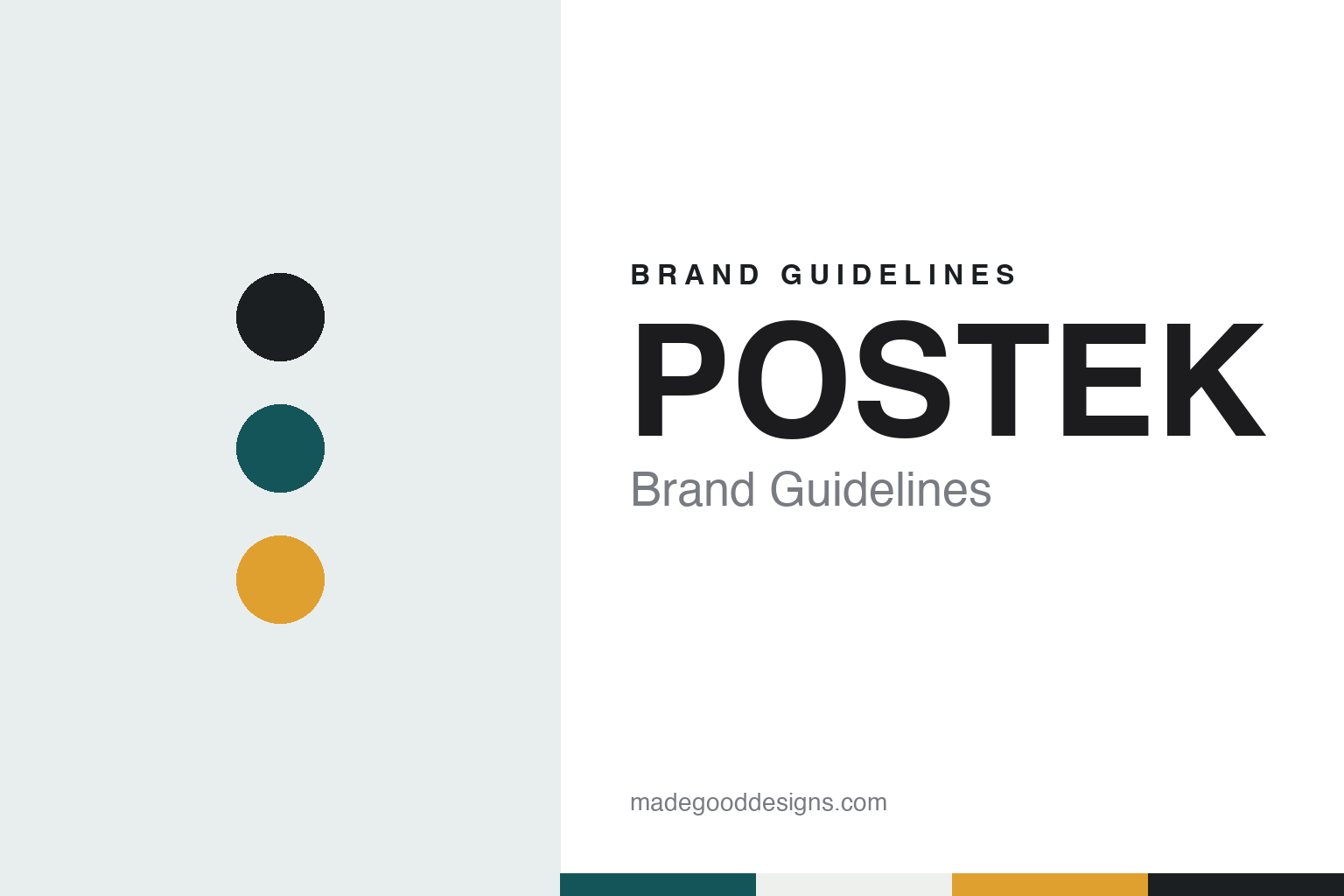
Two constants: a graphite, deep teal and amber palette and an engineered sans register. Abstract homage — not a POSTEK product or mark; no printer, logo or nameplate is reproduced.
Shenzhen, 1998
A label-printer maker from southern China.
POSTEK is a maker of barcode and RFID label printers based in Shenzhen, in southern China. Its Chinese name is 博思得, and the company behind it is Shenzhen POSTEK Technology Development Co., Ltd., according to its website; an exhibitor listing at China’s IOTE Internet of Things exhibition uses the English name Postek Electronics Co., Ltd. The company says it was founded in 1998, and the Russian trade site Idexpert, reporting in December 2019, gave the same year and city.
The company’s own timeline, published in Chinese on its website, sets out the early years. It describes 1999 to 2002 as a period of research and development; in 2003 it set up a production base and introduced an ISO 9001:2000 quality management system; and in 2004 it launched the G series of barcode label printers, which it says used its own national patents and won a product award from AIM China that year. The company says the G series was named a national key new product by China’s Ministry of Science and Technology in 2005.
The range grew from there, by the company’s account: the C168 commercial printers in 2007, the TX industrial series in 2008, and in 2010 the V6, which it calls the first portable thermal transfer printer from a Chinese brand, together with an I series of industrial printers. The company says the compact Q8 series followed in 2011, aimed at medical and office users. The company says it was recognised as a national high-tech enterprise in 2009, moved into a new office building in 2012, and saw the POSTEK name listed as a Guangdong famous trademark and a Shenzhen well-known brand in 2013. In 2014, it says, it received four national patents related to RFID label printers, and its printers won an excellent-product award at the China Hi-Tech Fair in Shenzhen.
Idexpert described the company in 2019 as holding several dozen national patents and running its own research and development department. The company’s English about page gives a figure of more than 60 patents, while its Chinese page gives more than a hundred; neither figure is dated.
Colour
From barcode to RFID.
RFID has moved to the centre of POSTEK’s story. The company says its TXr industrial RFID label printer series launched in 2013 and won RFID product awards in 2016 and in later years, including awards from the Shenzhen Internet of Things Association, which POSTEK says it joined as a vice-president member in 2020. Its Chinese website now describes the company as an Internet of Things technology business whose work has grown from automatic identification into RFID, and on into automatic labelling machines and labelling robots. The company says its 2021 launches included the OX series, the MX print-and-apply series and the GX compact industrial series, and that the Shenzhen Internet of Things Association named it enterprise of the year and the OX its RFID printer of the year.
The current range, as listed on the company’s English website, runs from industrial to commercial models. The industrial lines are the OX series, which the company dates to 2021, the TX Exp series and the smaller GX and G/Ge series; the commercial lines include the E/Ei, C168, Q8 and iQ series. Most print by both direct thermal and thermal transfer, with resolutions up to 600 dpi on the industrial models, according to the company’s specifications. The MX series is a print-and-apply unit, and Robo-Touch is an applicator that the company says connects directly to the printer without an external PLC or air compressor.
POSTEK sells abroad through its own offices and through distributors. The company says it set up an American subsidiary in Orlando, Florida, in 2010. In December 2019 Idexpert reported that OKTRON, a Russian distributor of automatic identification and data capture products, had signed a distribution agreement for Postek’s barcode and RFID printers, to be offered alongside Chainway mobile computers. In its IOTE exhibitor listing, the company names manufacturing, logistics and warehousing, retail, healthcare, fixed-asset management and traceability among the uses for its RFID and barcode printers; its English text there adds government users such as postal services and libraries.
Typography
Labels, receipts and ribbons.
Label and receipt printers are rarely noticed by the people who use their output. A shipping label on a parcel, a price tag on a shelf, a wristband, a till receipt or a ticket from a self-checkout machine all come from small thermal printers that sit out of sight, and the companies that make them present themselves less as consumer brands than as suppliers to warehouses, shops, hospitals and factories.
Their catalogues follow the places where the printers work. Desktop label printers sit on packing benches and in back offices; larger industrial models run around the clock on distribution lines and print-and-apply systems; receipt printers sit at shop counters and inside kiosks; and handheld printers hang from belts and shoulder straps in delivery vans and store aisles. Alongside the machines, most makers sell the consumables that keep them running, from label rolls and wristbands to thermal transfer ribbons, as well as software for managing whole fleets of printers.
The trade meets at fairs rather than in shop windows. Makers show new models at events such as LogiMAT in Stuttgart for warehousing and logistics, the NRF retail show in New York, and EuroShop in Düsseldorf for retail equipment, where printers appear alongside scanners, mobile computers and RFID readers. Product names are mostly codes of letters and numbers, as in the ranges described in this guide.
Many of the makers have changed hands, merged or grown out of larger electronics groups, so their names often carry traces of earlier owners. This guide sets out what can be checked about each brand — where it began, who owns it now and what it makes — and marks clearly what rests only on the company’s own word.
Aa
An engineered sans for an all-capitals name. (Specimen set in Barlow, a sans STAND-IN; NOT the POSTEK logo.)
POSTEK
“Rugged Parts, Durable Machines.”
The company’s brand line in Chinese is 设计精湛,好用耐用 — roughly “refined design, easy to use and durable” — and its English website uses “Rugged Parts, Durable Machines.” Its English about page quotes the saying, attributed to Leonardo da Vinci, that simplicity is the ultimate sophistication, and argues that label printing need not be treated as a field reserved for technical specialists. The company writes its name in capitals throughout its own pages. On its Chinese website several series carry names built on 犇, a character made of three repetitions of 牛, “ox”: the OX series is 犇博, the GX series 犇跃 and the MX series 犇元.
Where the printers are made rests on the company’s own account. It describes building a production base in 2003, and its IOTE exhibitor listing says it carries out research and development, production and sales of its printers itself. The same listing places its headquarters in Shenzhen’s Nanshan district.
For a design guide, POSTEK shows a Chinese industrial brand that presents its machines through series names and a plain promise of durability. Compare HPRT, another Chinese printer maker, and Datamax-O’Neil, whose Orlando home is also where POSTEK says it opened its American office. For this guide we use graphite, a deep teal and an amber with a sans, an unofficial interpretation; no product or logo is reproduced.
Explore & save
Keep POSTEK’s identity on hand — save it to a board in the Made Good inspiration library.
POSTEK identity set
Pin the POSTEK graphite, deep teal and amber palette and the engineered sans register to your own board.