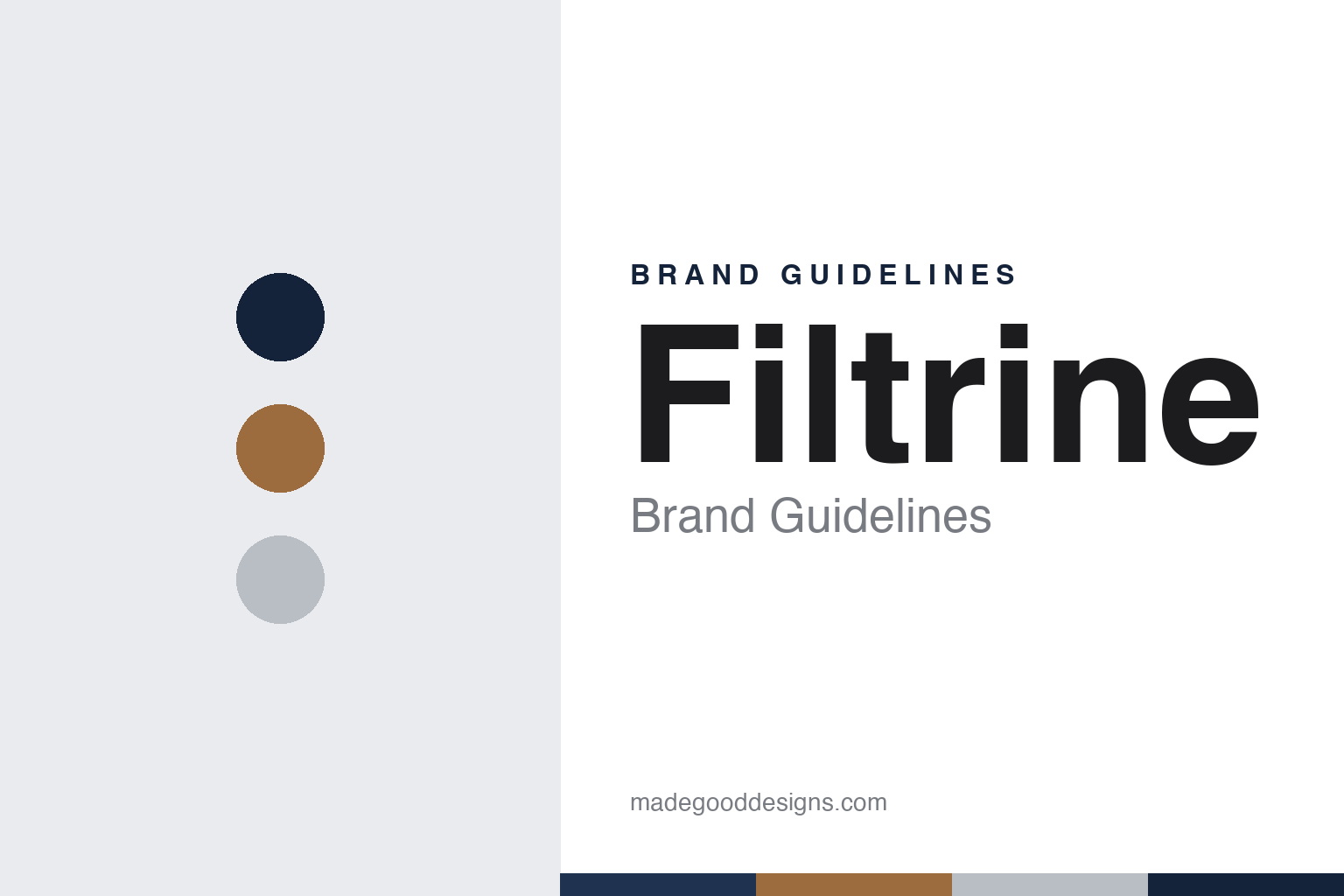
Filtrine Brand Guidelines
A Brooklyn filter of 1901, the Hansel family and Keene, NH.
Aa
Two constants: a navy, bronze and stainless grey palette and an engineering serif register. Abstract homage — not a Filtrine product or mark; no fountain, chiller or logo is reproduced.
A filter called Filtrine
An inventor in Brooklyn and an engineer who bought him out.
Filtrine began with a material. In 1901, the company’s history says, the inventor George Kneuper patented a filter medium that used molecular attraction to remove microscopic particles from water, named it “Filtrine,” and founded the Filtrine Manufacturing Company in a small brick building in Brooklyn, New York. The company says his filters were soon installed in many of the new high-rise office buildings going up in Manhattan. Business NH Magazine gave the same founding year and founder in August 2018.
In 1918 Kneuper sold the company to Charles Hansel, a New York civil engineer, and the Hansel family has owned it ever since. The company president, Peter Hansel, told Business NH Magazine in 2018 that Charles Hansel had seen an opportunity in the volume of new construction and high-rises in New York, and the magazine reported that a fifth generation of the family had joined the business. The company’s website describes it as family owned for over 100 years.
Cooling came next. Under Charles F. Hansel, the buyer’s son, the company says Filtrine produced one of the first electric water coolers in 1925 and introduced the storage-type cooling tank that is still part of all its chillers; it adds that compressor makers such as Carrier, York and Frigidaire specified its cooling tanks with their condensing units. In the 1930s and 1940s it moved into process cooling, with packaged units for film processing and dough making, and during the Second World War, the company says, it worked with U.S. Army engineers on a batch-type ingredient-water chiller for government bakeries, a type of machine it still sells to food processors.
Colour
Stainless fountains, then New Hampshire.
The drinking-fountain side of the business took shape after the war. In the 1950s, the company says, the next generation of the family, John P. and Charles F. Hansel Jr., moved it to larger premises in Waldwick, New Jersey, where it introduced the first stainless steel drinking fountains; Business NH Magazine put it as “among the first.” The company credits one model, the 107-16, to a collaboration with the architect Minoru Yamasaki, who asked for a fountain shaped like Aladdin’s lamp. Filtrine later outgrew plants in Waldwick and in Harrisville, New Hampshire, and it now works from a facility of about 100,000 square feet in Keene, New Hampshire.
Its range today runs from drinking fountains and bottle filling stations to drinking-water chillers, filters, purifiers and ultraviolet sterilizers; Business NH Magazine reported that Filtrine was among the first to use ultraviolet light in water sterilization, in the 1960s. Business NH Magazine described bronze, wood and marble fountains, a fountain built into public art in a park, and “heavy duty vandal-proof” electric water coolers; the company sells those coolers under its INDESTRUCT name and says they are approved by the Federal Bureau of Prisons. The company says it works with architects, engineers and builders on fountains in materials outside the usual range, and that its fountains have been installed in the White House, the United Nations building and the National Gallery of Art, a list the 2018 article repeated.
Drinking water is only part of the business: Peter Hansel told the magazine in 2018 that it made up less than half. The rest is process water — chillers that deliver consistently cold water to bakery dough mixers, and chillers that cool medical equipment such as MRI and CT scanners and linear accelerators, a line the company dates to the 1970s. The company says its OSP chiller models have been pre-approved for special seismic certification by the State of California. Most of its sales are in the United States, the magazine reported, but it was finding customers abroad, particularly in the Middle East, where water drawn from the ground can be too hot to drink. Its trademarks include Filtrine, Taste Master, Steri Flo and LARCO. The company says its products are built in the United States, and its pages carry the line “Proudly manufactured in the U.S.A.” The magazine reported 95 employees in 2018.
Typography
Water at work.
Water dispenser makers sell into rooms that most people pass through without noticing: the office kitchen, the staff room, the school corridor, the gym lobby and the hotel back-of-house. Their brands have to work for two audiences at once. One is the person who fills a glass or a bottle several times a day; the other is the facilities manager, architect or procurement team who chooses the equipment, signs a rental or service contract and answers for it afterwards.
The product types shape how these companies present themselves. A freestanding or countertop cooler fed from the mains is usually shown as a tidy appliance in a bright workspace, often next to a choice of still, sparkling, hot or chilled water. An under-sink system is a different kind of sell: the boiler, chiller and filter sit out of sight in the cabinet, so the visible part of the brand is a slim tap on the bench, and the photographs tend to concentrate on its finish and profile.
Bottle-filling stations and drinking fountains bring the category into schools, universities, gyms and public spaces, where the language turns to refills, durability and easy cleaning. Here the brand appears on a sturdy wall unit rather than a kitchen fitting, and the messaging is aimed as much at the people who maintain it as at the people who use it.
Much of the selling still happens in person, at facility-management, building and hospitality trade fairs, in showrooms and through dealer and distributor networks. Many of the names in this field have also changed hands through mergers and acquisitions, so a brand’s history often runs through several owners, and its identity has to stay recognisable across catalogues, service vans and installer manuals in many countries.
Aa
A sober serif for a century-old engineering firm. (Specimen set in Libre Caslon Text, a serif STAND-IN; NOT the Filtrine logo.)
Filtrine
A family firm on a solar roof.
In Keene, Filtrine has become part of the city’s own sustainability story. In September 2019 the City of Keene reported that the company would install 2,225 solar panels on its 100,000-square-foot roof, an array by ReVision Energy that the city said would be the largest in Keene, and noted that Filtrine had added a wood-chip boiler for heating in 2017. The company says it received the City of Keene’s first Green Business of the Year Award in 2010 and, in 2021, a Large Business Energy Champion Award at the New Hampshire Energy Week awards for powering its operation with solar energy. It also lists the Greater Keene Chamber of Commerce’s 2016 Business of the Year award and a place among Forbes’s Small Giants of 2019.
For a design guide, Filtrine shows how a maker that sells to engineers and specifiers can still carry design weight through materials: stainless steel, bronze and stone fountains alongside chillers built for bakeries and medical equipment. Compare Elkay, the Chicago sink maker, and Oasis, another American water-cooler maker. For this guide we use a deep navy, a bronze and a stainless grey with a serif, an unofficial interpretation; no product or logo is reproduced.
Explore & save
Keep Filtrine’s identity on hand — save it to a board in the Made Good inspiration library.
Filtrine identity set
Pin the Filtrine navy, bronze and stainless grey palette and the engineering serif register to your own board.


