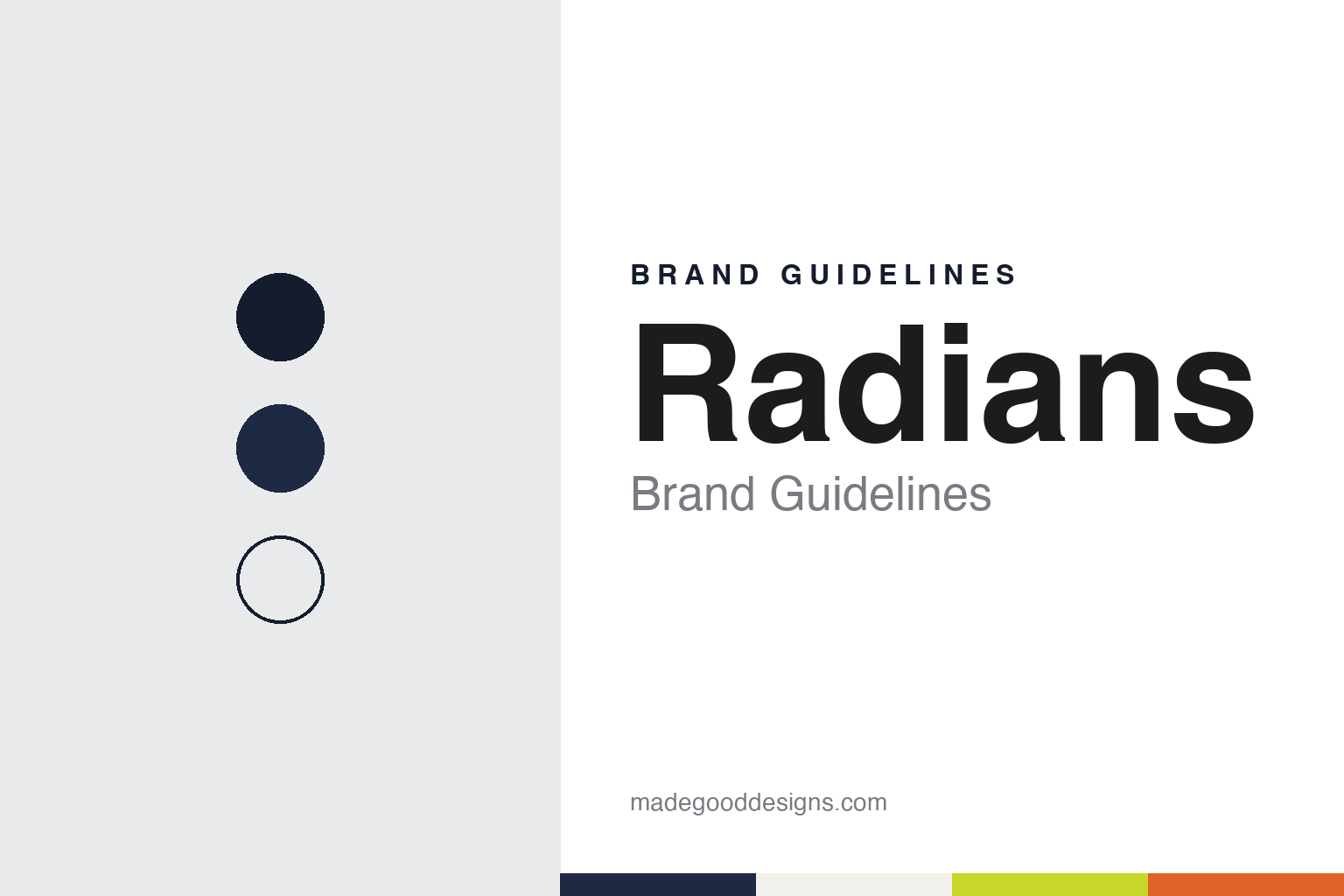
Radians Brand Guidelines
The Memphis PPE maker built on one audio-visual product.
Aa
Two constants: a navy, lime and orange palette and a grotesque sans register. Abstract homage — not a Radians product or mark; no vest, glasses, logo or label is reproduced.
The AV
One combination product, Memphis, 1997.
Radians was founded in Memphis, Tennessee, in 1997, according to the company’s own history, and started on the strength of a single product: the AV, which combined hearing (“audio”) and eyewear (“visual”) protection. A US patent for the Radians AV followed in July 1998, the company says. Its early focus was safety eyewear and hearing protection sold through the sporting goods channel; in 1999 it launched products into industrial safety and joined the National Safety Council, and in 2004 it moved into the hardware channel.
Licensing shaped the business early. In 2003, by the company’s account, Radians signed a global licensing agreement with DEWALT, partnered with the camouflage brands Mossy Oak and Realtree, bought Techna International Safety Products of Grand Rapids, Michigan, and rebranded with a new logo. Agreements with Remington in 2004, Black & Decker in 2007 and Smith & Wesson in 2012 followed. In 2005 it bought SSI Footwear and launched a DEWALT footwear line, expanded into Australia and started a hard-hat division.
Acquisitions continued through the 2010s, the company says: Carolina Safety Sport in 2011; Crossfire Safety Eyewear in 2013; VisionAid of Massachusetts, a maker of lens-cleaning and eyewash products, in 2015; and in 2018 both Bellingham Glove, bought from LFS, Inc., and Neese Industries, which added rainwear and flame-resistant clothing. Radians opened a Radians Europe office in London in 2012 and was named the exclusive source of DEWALT heated gear in 2015. Its chief executive is Mike Tutor, as Textile World named him in September 2022.
Colour
RadWear, Crossfire and licensed tool names.
Radians’ catalogue now spans safety glasses, hearing protection, gloves, hard hats, hi-vis apparel, rainwear, flame-resistant workwear, heated jackets and cooling gear, according to its website. The company names four markets it sells to: industrial workplace safety, sporting goods, hardware and DIY, and law enforcement and public safety. The product menus also run to disposable clothing, eyewash stations and respirators; the company says it entered the N95 particulate respirator market in 2018, and that in 2016 it entered the women’s hi-vis market with the SVL1 vest, which has an adjustable waist, and opened a training center in Memphis to teach customers about ANSI standards, PPE use and OSHA requirements.
Its own ranges include RadWear high-visibility vests, which the company says it launched in 2008; Arctic Radwear cooling products, introduced in 2014; the VolCore line of arc-rated and flame-resistant workwear, from 2018; and the Nordic Blaze warming gear. In eyewear it sells Crossfire, which it describes as “a premier line” of safety glasses, and the THRAXUS glasses; it introduced an anti-fog coating called IQuity in 2017 and the Granite and Quartz vented hard hats in 2019. Licensed lines under the DEWALT, Black+Decker and STANLEY names sit alongside its own, and the company has a partnership with the conservation group Ducks Unlimited for eye and hearing gear for waterfowl hunters.
Radians lists a run of trade awards on its history page: ISHN Readers’ Choice awards in 2015, 2016 and 2021, among them one for the SV55 two-tone engineer vest; a 2016 attendee choice award at the ASSE Safety show for its slim vertical foam-plug dispensers; a 2020 Big Rock Sports show award for the Vertex Nano; and, in 2023, an Occupational Health & Safety New Product of the Year award for THRAXUS Elite glasses in the vision category. It also lists supplier awards from buying groups such as the Safety Marketing Group and Sphere 1.
Typography
How safety makers present themselves.
Personal protective equipment is sold on sight as much as on specification, and the makers in this guide present themselves in a shared visual language. The strongest signal is colour: fluorescent yellow and orange, the tones of high-visibility vests, jackets and rainwear, appear across catalogues, packaging and trade-show stands, usually set against a dark navy, charcoal or black.
Photography does much of the work. Catalogues and websites show safety glasses, earmuffs and hard hats on workers rather than on a white background alone: a welder behind a visor, a road crew in reflective stripes, a warehouse picker in cut-resistant gloves. Construction sites, factory floors and utility work are the usual settings, and many makers add a second, outdoor register for shooters, hunters and anglers, with camouflage, sunglasses styling and range photography.
Product pages lean on order. Gloves are shown in grids by coating, cuff and size; glasses in rows by lens tint; earplugs and earmuffs by type. Standards and ratings are printed as part of the design, in badges and code numbers, and ranges are often organised by the hazard or the trade they are sold for rather than by style alone.
The trade meets at fairs. A+A in Düsseldorf, the international trade fair for safety and health at work, gathers makers and distributors from around the world, and in the United States the National Safety Council’s Safety Congress & Expo serves a similar role. Many makers also sell through distributor networks and buying groups, so brochures, counter displays and sell sheets carry as much of the identity as the logo itself. This guide sets out what can be checked about each brand — who founded it, who owns it and where it is based — and attributes claims to the company where they rest on its own word.
Aa
A grotesque sans for a hi-vis register. (Specimen set in Archivo, a sans STAND-IN; NOT the Radians logo.)
Radians
An eight-acre Memphis campus.
Making things in Memphis is part of how Radians tells its story. The company says it opened a manufacturing site in Dallas in 2011 and moved its made-in-USA foam earplug production from there to its Memphis headquarters in 2014, and that its My-Viz service makes custom high-visibility apparel in the United States. A 2019 corporate profile of the company in Safety+Health said its products were made in ISO-certified factories, that the acoustical testing laboratory at its Memphis headquarters was accredited under the National Voluntary Laboratory Accreditation Program, and named custom hi-vis vests, foam earplugs and lens-cleaning products as its American-made lines.
The Memphis site has grown in stages. Radians moved into a new headquarters in December 2011, broke ground on a larger complex in 2015 and moved into its new warehouse and offices in 2016, the company says; it had also opened a western warehouse, RadWest, in Nevada in 2006, moving it to Reno in 2014. In September 2022 Textile World reported that Radians was expanding its Memphis campus with a new building, to add warehouse space, hold more inventory in-house and process orders for some big-box retailers, and quoted Tutor that the campus would reach about eight acres under roof. Radians says it holds ISO 9001 certification through Intertek and sells in 48 countries on six continents.
For a design guide, Radians shows how a maker can carry its own names and licensed tool brands side by side across hi-vis, eyewear and gloves. Compare Pyramex, another west Tennessee maker of safety glasses and hi-vis, and MCR Safety. For this guide we use a navy, a vest lime and a signal orange with a grotesque sans, an unofficial interpretation; no product or logo is reproduced.
Explore & save
Keep Radians’s identity on hand — save it to a board in the Made Good inspiration library.
Radians identity set
Pin the Radians navy, lime and orange palette and the grotesque sans register to your own board.