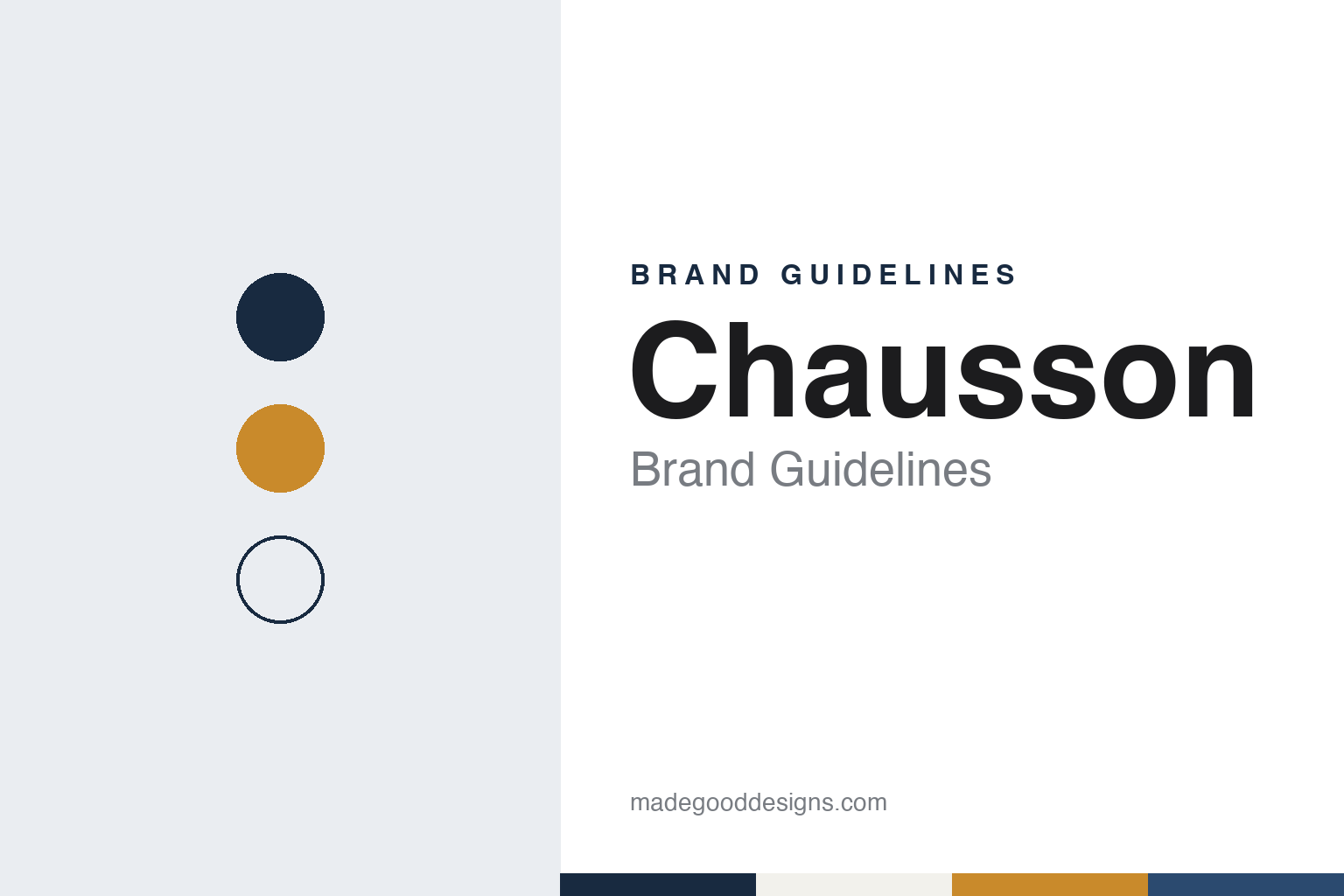
Chausson Brand Guidelines
A radiator maker’s name, a run of buses and a motorhome painted white.
Aa
Two constants: a Chausson Rhône blue, white and ochre palette and a Coachbuilt sans register. Abstract homage — not a Chausson product or mark; no vehicle, logo or nameplate is reproduced.
Radiators and Buses
A car-parts firm from the Paris suburbs.
Chausson is two stories under one name, and the first has nothing to do with holidays. The city of Asnières-sur-Seine’s heritage page says the factory was founded there in 1907 by Jules and Gaston Chausson as Ateliers Chausson Frères, making radiators for car engines, and became the Société anonyme des usines Chausson in 1924. A French Senate question published in September 1993 gives the date as 6 June 1907, and French Wikipedia adds a third brother, Paul. The motorhome brand’s own timeline gives a different year: it opens with 1903.
The firm grew with the French car industry. English Wikipedia says it added steel car bodies after the 1930s. It also says that in 1940 Chausson was making parts for the Dewoitine D.520 fighter, and that a planned production line for a related aircraft was dropped because of the Armistice and the occupation. Autocars Chausson was set up in 1942, under the occupation, and the brand dates its bus production from 1942 to 1959. Early models carried the nickname “hog nose” for their front end. The brand says most French schoolchildren rode in Chausson buses after the Second World War. In April 1959 the coach business went to SAVIEM, now part of Renault Trucks, French Wikipedia says.
After that Chausson worked mainly for others. French Wikipedia describes it as a subcontractor to its two main shareholders, Peugeot and Renault, assembling light commercial vehicles including the Peugeot J7 and the Renault Estafette and Trafic. English Wikipedia puts employment at about 15,000 at the peak in the 1970s.
That industrial company came to an end in the 1990s. The government’s reply to the Senate question records a court ruling of 13 September 1993 placing the business, then held equally by Renault and PSA Peugeot-Citroën, in receivership. French Wikipedia says three redundancy plans between 1993 and 1995 led to 2,549 job losses and the closure of plants around Paris. The last site, Gennevilliers, became a Renault subsidiary in 1995 and closed in 2000.
Colour
From the Odyssée 4000 to the Acapulco.
The second story began while the first was still running. In 1980, Chausson’s 2027 catalogue says, the brand showed its first fitted van, the Odyssée 4000, at the Paris motor show. Motorhomes followed in 1984 with the Acapulco 44 and 56 overcabs. Trigano’s own timeline lists the same year as its first motorhomes, “under the Chausson brand,” with its Challenger brand launched a year later.
White became the signature. The brand says Chausson was the first maker to “dare” white bodywork and that success was immediate. Camprest, a motorhome rental firm, repeats that account in its history of the brand and says the vehicles could be recognised by colour alone.
Ownership settled in the 1990s. The brand’s timeline records the founding of the Camping-cars Chausson company in 1990, and Camprest says Trigano took 49 percent of it at the start. In 1994, the year after the old Usines Chausson entered receivership, Trigano acquired all of it. The new owner introduced what the brand calls a “right price” approach, favouring usefulness over excess.
That approach shaped the products. The Welcome overcabs arrived in 1995 as a limited series, followed in 1997 by the Welcome 70 low-profile, which the brand says was a best seller for many years. At the other end, the Allegro of 1998 had a double-layered polyester roof, and the brand says it received an award from the Observatoire du Design in 2002. The brand also lists a European Design Award for the Sweet in 2010, and says the Flash range’s 610 was named motorhome of the year in the UK in December 2014.
Layouts are where the brand has put most of its effort since. Its timeline runs as a list of inventions: a “panoramic” side opening on the Sweet in 2012, an A-class at a more affordable level the same year, and in 2016 the 630, with twin beds that lift to the roof. In January 2021 it launched the X550, which it calls neither a van nor a traditional motorhome. Camping-car.com reported in September 2023 that orders had surged and that shortages of Fiat chassis had then held it back; an X650 followed in 2024.
Typography
How the category presents itself.
Motorhome makers tend to sell a picture before they sell a vehicle: a white van on a pitch by the sea, doors open, with the road implied behind it. The colour itself has a history in the category. Chausson says it was the first maker to “dare” white bodywork, on its 1984 overcabs.
The second image is more technical. Layout is what buyers compare, so makers lean on plans, cut-away views and model numbers that stand for a floor plan. Chausson’s 2027 catalogue, for instance, explains a lounge feature by listing the numbered models that have it, and Rapido’s vans run from V55 to V68. Rapido’s website offers a comparison tool and 360-degree views of its models, and Chausson’s invites buyers to compare its ranges by the way they want to travel.
The third setting is the dealer forecourt. Chausson says it reaches more than 15 European countries through specialist distributors, and Trigano, its parent, created the Libertium dealership network in 2023 and says it has 70 sales outlets. Rapido’s history shows how early this mattered: Le Journal des Entreprises counts ten dealers in the brand’s first years of rigid caravans.
The category’s annual stage is the Caravan Salon in Düsseldorf. The fair calls itself the world’s leading trade fair for mobile travel, and reports 259,000 visitors in 2026, with 834 exhibitors from 41 countries in 15 halls and on the outdoor grounds. It says those visitors covered more than 250,000 square metres of motorhomes, caravans, roof-top tents and equipment, which puts whole vehicles, not just pictures of them, in front of the public. The next edition runs from 27 August to 5 September 2027.
Aa
A straight, slightly industrial sans for a name that began on radiators. (Specimen set in Barlow, a sans STAND-IN; NOT the Chausson logo.)
Chausson
A Trigano brand, built on the Rhône.
Chausson today is a brand of Trigano, the French leisure-vehicle group that describes itself as the European leader in its sector. Chausson is not a stand-alone company: its website says overcabs and low-profiles are designed and built by Trigano VDL at Tournon-sur-Rhône, in Ardèche, “in the heart of the Rhône Valley vineyards.” The brand puts output there at about 7,000 motorhomes a year, on a site it compares to 33 football pitches. Vans come from a separate dedicated plant, it says. The brand says it sells in more than 15 European countries through a dealer network.
The Tournon plant is shared. Camping-car.com reported in December 2015 that Trigano VDL was opening a third assembly line there, 210 metres long, from January 2016, aiming for 6,200 Chausson and Challenger motorhomes for the season, and that the site also made Caravelair and Sterckeman caravans. The magazine’s factory film shows both motorhome brands being built there, and the same publication calls Challenger Chausson’s “sister” brand. Its website shows a digital machining centre for body panels at the site.
The current range is sorted by lines and numbers. The website groups vehicles into low-profiles, overcabs, A-class models, vans and the X models, with lines such as First Line and Titanium Line. Camping-car.com reported the arrival of a slim S range on the Renault Master for 2024, describing the previous season’s catalogue as sharply reduced. The 2027 catalogue promotes a body structure called IRP 360, with polyester inside and outside, and in 2025 the brand unveiled the ElectriX, which it calls the first dual-mode electric motorhome, combining electric and combustion drive.
The old name carries its own marks. Camprest says stork wings were added to the original firm’s trademark after work with the aviation industry in the First World War. The brand’s English history calls Chausson “a century-old brand,” reaching past the motorhomes to the radiators and buses.
For a design guide, Chausson shows how a brand can carry a long industrial name and still be recognised for one plain decision, a white body. Compare Challenger, the sister brand built on the same site, and Adria, the Slovenian maker Trigano acquired in 2017. For this guide we use a Rhône blue, a van white and an ochre with a sans, an unofficial interpretation; no product or logo is reproduced.
Explore & save
Keep Chausson’s identity on hand — save it to a board in the Made Good inspiration library.
Chausson identity set
Pin the Chausson Rhône blue, white and ochre palette and the Coachbuilt sans register to your own board.