Babcock & Wilcox Brand Guidelines
The 1867 water-tube boiler and an Akron ampersand.
Aa
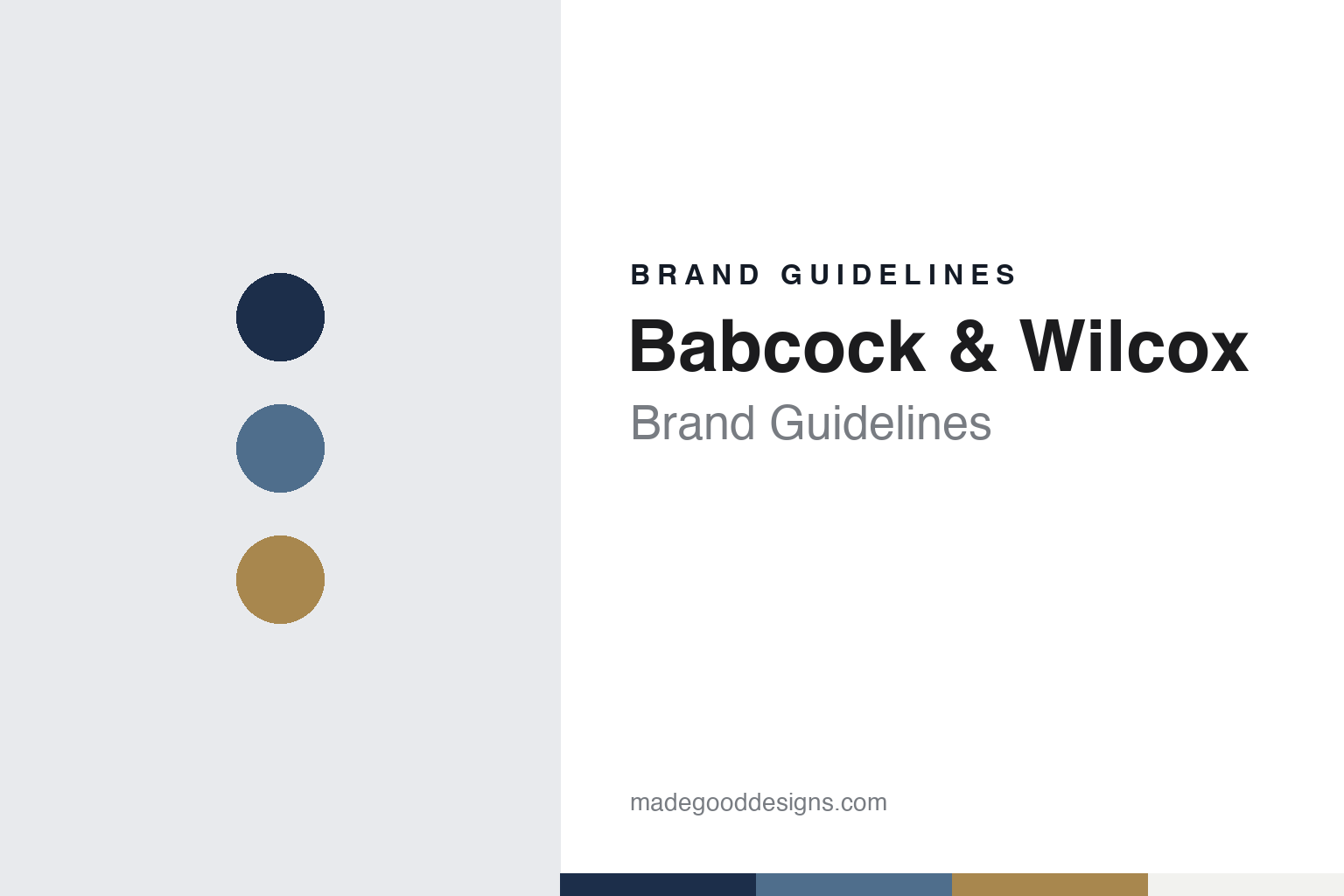
Two constants: a navy, steel blue and brass palette and an engineering serif register. Abstract homage — not a Babcock & Wilcox product or mark; no boiler, logo or nameplate is reproduced.
The water-tube boiler
Two partners and a patent in Providence.
Babcock & Wilcox was founded in 1867 in Providence, Rhode Island, by Stephen Wilcox and George Babcock, English Wikipedia says, to make and market Wilcox’s patented water-tube boiler. The company’s own history page names a third partner, Joseph P. Manton, who it says withdrew in 1870, and traces the design back to a patent of 1856. The idea behind the 1867 patent, titled “Improvements in Steam Generators,” was to spread the water through many small tubes instead of holding it in one large shell, and Wikipedia notes that the design could raise steam at higher pressure than the shell boilers of the day.
The company grew with the electrical age. Wikipedia says Thomas Edison bought B&W boiler No. 92 for his Menlo Park laboratory in 1878, and that B&W boilers powered New York City’s first subway line in 1902. The company says it published the first edition of its book Steam/its generation and use in 1875 and was incorporated in New Jersey as The Babcock & Wilcox Company in 1881. Business outside the United States went to a separate British company, Babcock & Wilcox Ltd, formed in 1891; Wikipedia says the long-term agreements with that firm ended in 1975, after which it was renamed Babcock International Group. The main works moved to Barberton, Ohio, after the company bought a plant there in 1906, its timeline says.
The company’s timeline also records the milestones it chose to remember. In 1875, it says, Babcock and Wilcox published Requirements of a Perfect Steam Boiler, a 12-point set of guidelines, and in 1876 they won a gold medal for a 150-horsepower boiler shown at the Centennial Exhibition in Philadelphia. It says George Babcock was a founding member of the American Society of Mechanical Engineers, set up in New York City in 1880, and that four B&W boilers ran Edison’s Pearl Street station in New York in 1882. In 1904 it bought the Pittsburgh Seamless Tube Company of Beaver Falls, Pennsylvania, to make its own steel tubes, and in the 1930s it built the penstocks, the giant water pipes, for the Hoover Dam, putting up a fabricating plant near the site because the sections were too big to ship by rail.
Both world wars were dominated by marine work. Between 1941 and 1945, Wikipedia says, B&W designed and delivered 4,100 marine boilers for combat and merchant ships, and between 1943 and 1945 it supplied components, materials and process development for the Manhattan Project; the company’s timeline lists a containment vessel known as “Jumbo” built for that programme in 1945. After the war it supplied the eight boilers of the liner SS United States and components for USS Nautilus, the first nuclear-powered submarine, and in 1949 it introduced what it calls its first Package boiler, a self-contained unit delivered ready for use.
Colour
McDermott, Chapter 11 and a split in two.
In 1978 the offshore contractor J. Ray McDermott, later McDermott International, bought B&W, the company says. On February 22, 2000, B&W filed for Chapter 11 bankruptcy protection, in part because of thousands of personal-injury claims linked to asbestos, Wikipedia says; the company describes the filing as a voluntary petition to resolve asbestos liability claims and says it emerged from the process in 2006. As a condition of emerging, Wikipedia adds, it set up a trust fund to compensate claimants.
B&W was spun off from McDermott in 2010 and began trading on the New York Stock Exchange that August, Wikipedia says. Five years later it split in two. The company’s board approved the separation on June 8, 2015: the power generation business became Babcock & Wilcox Enterprises, Inc., operating under the Babcock & Wilcox name, while the remaining company, with the nuclear business, was renamed BWX Technologies and based in Lynchburg, Virginia. Atomic Insights reported on July 1, 2015 that the separation was complete, and Wikipedia says Babcock & Wilcox Enterprises was listed on the NYSE under the ticker BW from that day. In September 2018 the company announced that it would move its headquarters from Charlotte, North Carolina, to Akron, Ohio, where it settled at the turn of 2020.
Typography
Plant rooms, shells and pipework.
Industrial boiler makers sell equipment that most people never see. A steam boiler sits in a plant room behind a hospital, a brewery, a laundry or a paper mill, and the people who buy one are engineers, facility managers and contractors. So the visual language of the category is built for a technical reader: catalogues, data sheets, project case studies and trade-show stands rather than shop windows.
The most common image is the boiler itself in a clean plant room. A packaged fire-tube boiler is usually shown as a long horizontal shell, painted and insulated, with its burner on the front, a control panel at eye level and the flue rising behind it. Around it run steam headers, valves and lagged pipework, photographed under even light so that every joint reads clearly. Cutaway drawings do the explaining: a shell opened along its length to show the furnace tube and the passes of smaller tubes, or a water-tube unit drawn with its drums and banks of tubes exposed.
The second register is the factory. Makers show shells being rolled from steel plate, welders at work on tube sheets, finished units on low-loader trailers and large boilers lifted by crane on site. These pictures stress scale and fabrication skill. Many firms in the category are old, and their histories lean on heritage photographs: riveted boilers, steam-era works yards, early advertisements and the first catalogues.
The customers appear too, usually as settings rather than people: a utility’s turbine hall, a food plant with stainless pipework, a district-heating station, a hospital service yard. Colour is mostly restrained, with greys, navy, white and one strong corporate accent, and type is set in plain sans or engineering-style faces chosen to sit comfortably beside drawings and specification tables.
Aa
A sturdy engineering serif with the weight of a nineteenth-century catalogue. (Specimen set in Source Serif 4, a serif STAND-IN; NOT the Babcock & Wilcox logo.)
Babcock & Wilcox
Utility boilers, package boilers and a crowded name.
Today B&W’s website lists utility-scale boilers, industrial water-tube package boilers, heat-recovery steam generators and circulating and bubbling fluidized-bed boilers, alongside environmental equipment, parts and site services. It also promotes BrightLoop, a chemical-looping process it is developing for steam, hydrogen and syngas production. In 2010, the company says, it formed a joint venture with Thermax of India to serve the Indian utility boiler market.
The name is easy to confuse. Babcock & Wilcox Enterprises in Akron is a separate company from BWX Technologies, from the British Babcock International Group and from Babcock Wanson, the French boiler maker.
For a design guide, Babcock & Wilcox shows how two surnames and an ampersand can carry more than 150 years of industrial history. Compare Cleaver-Brooks, another American boiler name built on two founders, and Spirax Sarco, a steam-system specialist. For this guide we use a navy ink, steel blue and brass on a pale paper with a serif, an unofficial interpretation; no product or logo is reproduced.
Explore & save
Keep Babcock & Wilcox’s identity on hand — save it to a board in the Made Good inspiration library.
Babcock & Wilcox identity set
Pin the navy, steel blue and brass palette and the engineering serif register to your own board.