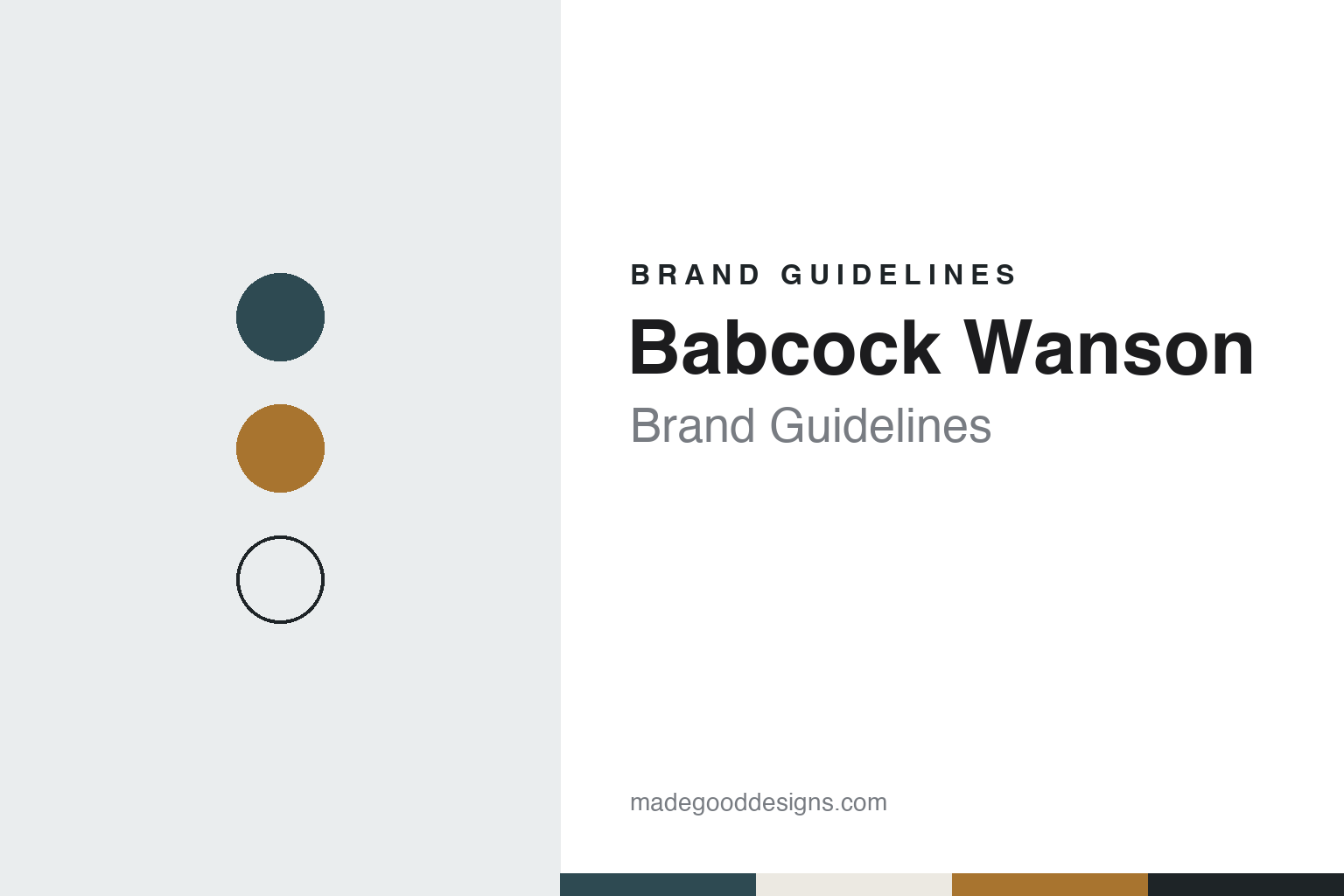
Babcock Wanson Brand Guidelines
A bison emblem, a Nérac boiler works and a European group.
Aa
Two constants: a slate, limestone and ochre palette and an engineering serif register. Abstract homage — not a Babcock Wanson product or mark; no boiler, bison emblem or logo is reproduced.
Two industrial ventures
A French Babcock offshoot and Léon Wanson’s company.
Babcock Wanson is a French company with two roots, and its name records both. The company’s history says the first is the French construction company of Babcock & Wilcox, founded in 1898 and formed from the American boiler maker of that name. It should not be confused with today’s Babcock & Wilcox of Akron, Ohio: the two are separate companies, and Babcock Wanson descends from the French offshoot, not from the American business.
The second root is Léon Wanson’s company. French Wikipedia and the company both say he founded it on 24 January 1929, at first under the name C.M.T., short for Construction de Matériel Thermique. French Wikipedia adds that in the same year he launched a review, La Chaufferie, which became the Bulletin Wanson after the war. The company describes Wanson as a specialist in low- and medium-output industrial boilers and an early name in packaged boilers, water treatment equipment and industrial air heaters.
The brand’s animal dates from 1931. French Wikipedia, drawing on Léon Wanson’s memoir Au fil de la plume, says his lifelong friend Alfred Parent suggested the firm find an emblem, and that Wanson chose a bison after a friend compared him to one for his build and energy — an animal the memoir calls powerful and quick to charge ahead. The company tells the same story, saying the bison was chosen to reflect the stature and energy of the business.
Colour
Parent, Nérac and the CNIM years.
Alfred Parent became a manufacturer in his own right. In 1951 he founded the Parent company, with its head office at Nérac, in Lot-et-Garonne in south-west France, the company says. Wanson opened a British company in 1956, later Babcock Wanson UK, and in 1987 Parent joined the Wanson group, bringing Nérac with it.
The Babcock side was reorganised at the same time. In 1988 the boiler division of the French Babcock & Wilcox merged with Lardet Babcock to form Babcock Entreprise, which in 1989 became a wholly owned subsidiary of the French engineering group CNIM. In 1990 CNIM acquired Wanson and combined it with the Babcock business, creating Babcock Wanson, according to both the company and French Wikipedia. Expansion followed under CNIM: in 1992 it bought the Italian firm Italwanson, which became Babcock Wanson Italiana; in 1998 it set up a Central European subsidiary that later became Babcock Wanson Polska; and in 2008 CYP Babcock Wanson in Spain became Babcock Wanson España.
Over the decades the business absorbed a long list of older names. The company lists Parent, Babcock, Bloctherm, Duquenne, Fluidothermus, Seum, Lardet, Goemine, Cobra, Vapor and Safmat among the brands folded into it — a reminder that much of French industrial-boiler history now sits inside one company.
The range today reaches well beyond the boiler shell. On its website Babcock Wanson groups fire-tube steam boilers such as the BWD and BWR series, coil-type steam generators in the VAP family, electric and electrode boilers including the E-Pack, thermal fluid heaters, industrial air heaters, burners, water treatment and thermal oxidisers for treating volatile organic compounds. Its customers, as it lists them, run from dairies, beverage makers and food plants to chemicals, pharmaceuticals, textiles, laundries, printing and marine work.
Typography
Design and documentation.
Industrial boiler makers sell equipment that most people never see. A steam boiler sits in a plant room behind a hospital, a brewery, a laundry or a paper mill, and the people who buy one are engineers, facility managers and contractors. So the visual language of the category is built for a technical reader: catalogues, data sheets, project case studies and trade-show stands rather than shop windows.
The most common image is the boiler itself in a clean plant room. A packaged fire-tube boiler is usually shown as a long horizontal shell, painted and insulated, with its burner on the front, a control panel at eye level and the flue rising behind it. Around it run steam headers, valves and lagged pipework, photographed under even light so that every joint reads clearly. Cutaway drawings do the explaining: a shell opened along its length to show the furnace tube and the passes of smaller tubes, or a water-tube unit drawn with its drums and banks of tubes exposed.
The second register is the factory. Makers show shells being rolled from steel plate, welders at work on tube sheets, finished units on low-loader trailers and large boilers lifted by crane on site. These pictures stress scale and fabrication skill. Many firms in the category are old, and their histories lean on heritage photographs: riveted boilers, steam-era works yards, early advertisements and the first catalogues.
The customers appear too, usually as settings rather than people: a utility’s turbine hall, a food plant with stainless pipework, a district-heating station, a hospital service yard. Colour is mostly restrained, with greys, navy, white and one strong corporate accent, and type is set in plain sans or engineering-style faces chosen to sit comfortably beside drawings and specification tables.
Aa
A sturdy engineering serif for a century-old boiler name. (Specimen set in Source Serif 4, a serif STAND-IN; NOT the Babcock Wanson logo.)
Babcock Wanson
From CNIM subsidiary to European group.
Babcock Wanson left CNIM in 2016. French Wikipedia says that on 20 July 2016 the Fonds de Consolidation et de Développement des Entreprises, or FCDE, a French fund backed by Bpifrance, banks and insurers, acquired the business, with the management team investing alongside it; the company says it rebranded with a more international focus at the same time. In 2021 the investment firm Kartesia replaced the FCDE as majority shareholder, the company says, and Le Journal des Entreprises described Kartesia in April 2024 as majority owner since 2021.
Acquisitions came quickly. The company lists Reputabel Warmtetechniek in the Netherlands in 2017, Maes in Belgium in 2020, and Thermigas in France, Steam Plant Engineering in Britain and Standard Fasel in the Netherlands in 2021. In 2022 it formed the Babcock Wanson Group, organised into five divisions — boilers and burners, air treatment, water treatment, environmental solutions and services — and added Donau Carbon Technologies in Italy and Parat, the Norwegian electrode-boiler maker; the company dates Parat to 2022 and Le Journal des Entreprises to 2023. PBS Power Equipements of the Czech Republic followed in 2023. In February 2024, Le Journal des Entreprises reported, the group completed its purchase of the German maker VKK, which builds high-output boilers, giving it a base in Germany.
Ownership changed again that year. On 2 July 2024 France’s Autorité de la concurrence authorised the investment firm Ambienta to take exclusive control of Babcock Wanson Group, which the decision describes as active in industrial boilers, industrial burners, air-conditioning products, thermal oxidisers and boiler water treatment.
Nérac remains the centre of the French business. Le Journal des Entreprises reported in April 2024 that the Nérac site employed about 160 people and turned out 130 to 150 boilers a year, that the group made between 400 and 500 boilers a year across all its models and sites, and that its supervisory board had approved a new factory on the Agrinove technology park near Nérac in October 2023, due in 2026, partly to build larger electric boilers. The company describes itself as having more than 600 staff and two main manufacturing sites in Europe; French Wikipedia names them as Nérac and Cavenago in Italy.
For a design guide, Babcock Wanson shows how a merged industrial name can keep an emblem from 1931 at its heart while its group grows across Europe. Compare Babcock & Wilcox, the separate American company, and Viessmann, another European heating name. For this guide we use a slate blue-green, a limestone grey and an ochre accent with a serif, an unofficial interpretation; no product or logo is reproduced.
Explore & save
Keep Babcock Wanson’s identity on hand — save it to a board in the Made Good inspiration library.
Babcock Wanson identity set
Pin the Babcock Wanson slate, limestone and ochre palette and the engineering serif register to your own board.