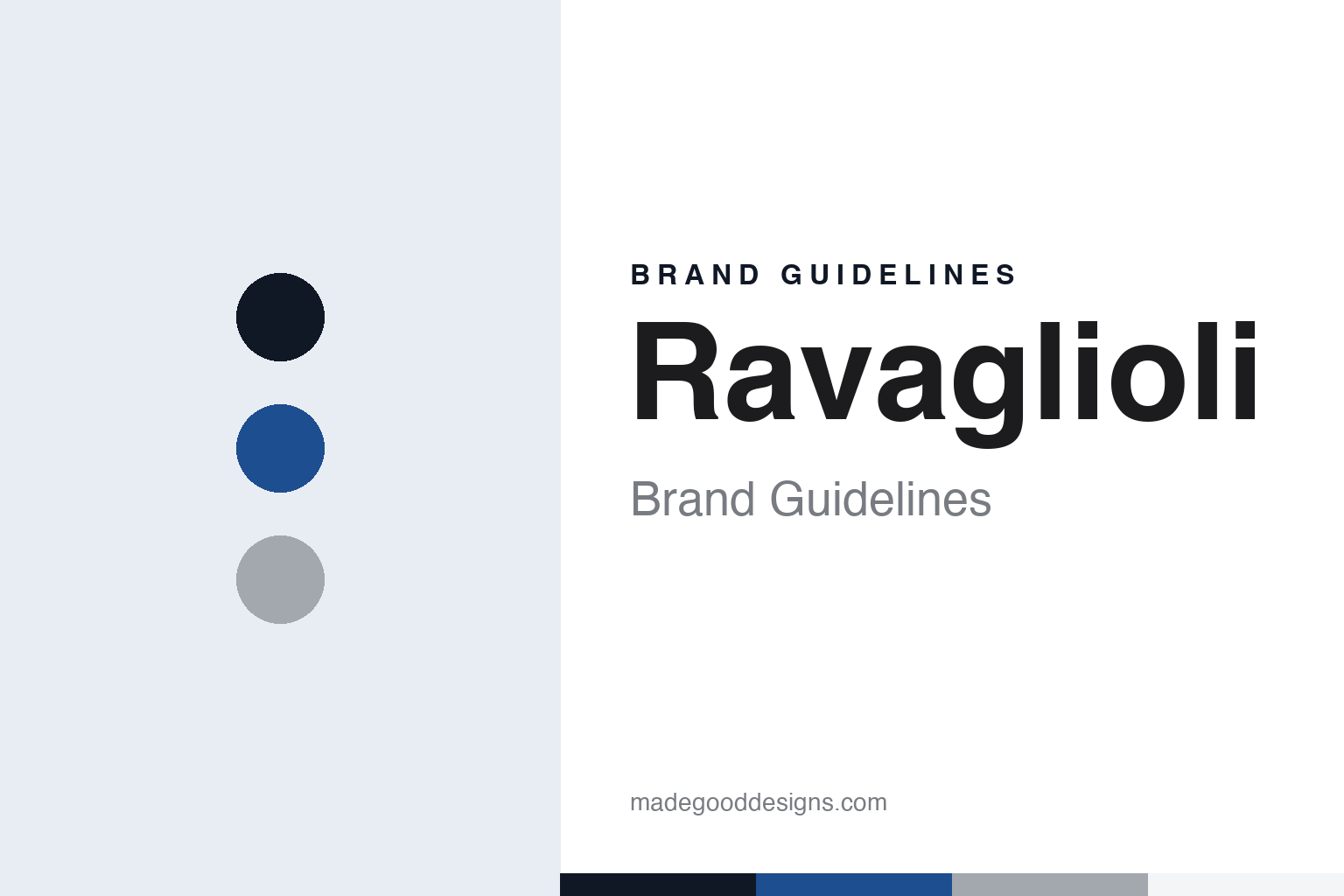
Ravaglioli Brand Guidelines
A Bologna workshop bench that grew into lifts and tyre changers.
Aa
Two constants: a blue, night and grey palette and a workshop sans register. Abstract homage — not a Ravaglioli product or mark; no machine, logo or nameplate is reproduced.
The rotating bench
A Bologna entrepreneur and his workshop tools.
Ravaglioli was founded in Bologna in 1958 by the local entrepreneur Damiano Ravaglioli, English Wikipedia and the company agree, with the aim of designing equipment for repair workshops. The company says its first product was a rotating bench for engines and transmissions, followed by hydraulic cranes, presses and transmission jacks. Its attention then turned to tyres: a mechanical tyre changer, and a system for taking tyres off Trilex rims, rims used on heavy commercial vehicles. Wikipedia sums up the early years the same way, as workbenches and lifting equipment followed by equipment for Trilex tyres.
The company dates its first product catalogue to 1964. Through the 1970s, by its own account, the range grew to cover most of a modern garage: hydraulic four-post and two-post lifts, electromechanical two-post lifts, mobile column lifts and four-post lifts for industrial vehicles, electropneumatic tyre changers and electrohydraulic changers for lorries, and both optical and electronic wheel aligners. That spread, from lifting to wheel service to diagnostics, is still how Ravaglioli divides its catalogue today.
In 1981 the headquarters moved from Bologna to Pontecchio Marconi, in the province of Bologna, where the company says it brought administration, sales and production together. It is still based there. The company says the site was modernised and enlarged in 2009 with a new building for management, technical and administrative offices, a showroom, and rooms for meetings and training courses.
Colour
Lifts, wheel service and diagnostics.
Ravaglioli’s catalogue today falls into three families. Under lifts it lists two-post, four-post, mid-rise, scissor, double scissor, in-ground, mobile column and pit lifts, as well as jacking beams and lifting tables. Under wheel service come tyre changers, wheel balancers and tyre inflation equipment. Under diagnostics it lists wheel aligners, brake testers and test lanes, headlight beam testers and tread depth measuring systems. When Dover’s Vehicle Service Group bought the company, Modern Tire Dealer described it in October 2016 as a Bologna-based maker of lifts, wheel service equipment and diagnostic equipment for cars, trucks, commercial vehicles and motorbikes.
Production is spread across several sites in northern Italy, the company says. Alongside the headquarters it names three production units. The Sirio plant at Ostellato, in the province of Ferrara, makes the main components of Ravaglioli products, and in 2021 it added the Sirio Academy, a training centre for manual and robotic welding. The Space plant at Trana, near Turin, focuses on electronic diagnostic equipment such as wheel aligners and test lines. The Butler plant at Rolo, in the province of Reggio Emilia, was set up in 1988 to design and make tyre service equipment.
The company dates its push abroad to 1985, when it says it developed new production systems for exporting; it publishes its catalogues in five languages, and has branches and sales teams across Europe, with branches in Italy, France, Germany and the United Kingdom. It says its quality system was certified to ISO 9001 in 2000. Ravaglioli also points visitors to Bologna’s Museo del Patrimonio Industriale, the city’s museum of industrial heritage, where it says its history is displayed.
Typography
How workshop equipment makers present themselves.
Garage equipment is sold to people who already know what a lift or a tyre changer should do, so the makers’ own material tends to show the machines at work. The usual picture is a two-post lift with a car raised to head height in a clean, well-lit workshop, the columns and arms set against pale floors and painted walls, with a technician underneath for scale.
Wheel-service equipment has its own look. Tyre changers and wheel balancers are typically shown as compact cabinets in strong body colours — reds, blues and greys recur across the trade — with a wheel mounted and the controls in view. Alignment systems are often shown through their targets or sensors clamped to the wheels and a screen nearby, and brake testers through rollers set into the workshop floor.
Much of the selling happens face to face. Makers present their ranges at trade fairs such as Automechanika in Frankfurt and at national shows, and most sell through dealer and installer networks rather than directly, so dealer locators, installer programmes and training centres feature prominently on their websites. Certification marks and named standards also appear often; Rotary Lift, for example, says many of its lifts carry the certification mark of the Automotive Lift Institute, a trade body formed in 1945.
The makers in this guide include family firms, private companies and brands held inside larger industrial groups. This guide sets out what can be checked about each — who founded it, who owns it and what it says about where its products are made — and marks clearly what rests only on the company’s own word.
Aa
A workshop sans for a Bologna lift maker. (Specimen set in Barlow, a sans STAND-IN; NOT the Ravaglioli logo.)
Ravaglioli
A blue brand inside an American group.
In 2016 Ravaglioli was bought by Vehicle Service Group (VSG), part of the American industrial group Dover. Modern Tire Dealer reported on 3 October 2016 that VSG, based in Illinois, had acquired the Ravaglioli S.p.A. Group, giving it an entry into wheel and tyre service equipment; VSG then sat in Dover’s Engineered Systems segment and grouped nine lifting and collision repair brands, among them Rotary Lift and Chief. VSG’s president told the magazine that Ravaglioli’s products and record of innovation would let the group widen its capabilities, reach and range, and VSG said it would announce plans for the enlarged portfolio in the following weeks. English Wikipedia gives the same year for the sale. Ravaglioli says it became the flagship brand of VSG’s European, Middle East and Africa division.
VSG still owns it. VSG’s website, which traces the group back to 1925, describes the business as part of Dover’s Engineered Products segment and as the holding company for Rotary Solutions, Ravaglioli and Warn Automotive. In 2022, Ravaglioli says, VSG chose it as one of its two main brands for those regions, alongside its German sister company Rotary, under a brand strategy called Rpower. Recent launches include the Legend Series lifts, which the company presents as a lifting concept that pays attention to the look of workshop tools as well as their performance.
Colour is the one identity fact the company spells out. Ravaglioli says that in 2021 it made its look more modern and cleaner by intensifying the shade of what it calls its iconic blue. It gives no further detail of its logo or typeface.
For a design guide, Ravaglioli shows how a founder’s name and its blue can carry on as the lead brand inside a larger group. Compare Rotary Lift, its sister brand in the same group, and Corghi, another workshop equipment maker from Emilia-Romagna. For this guide we use a strong blue, a night navy and a workshop grey with a sans, an unofficial interpretation; no product or logo is reproduced.
Explore & save
Keep Ravaglioli’s identity on hand — save it to a board in the Made Good inspiration library.
Ravaglioli identity set
Pin the blue, night and grey palette and the workshop sans register to your own board.