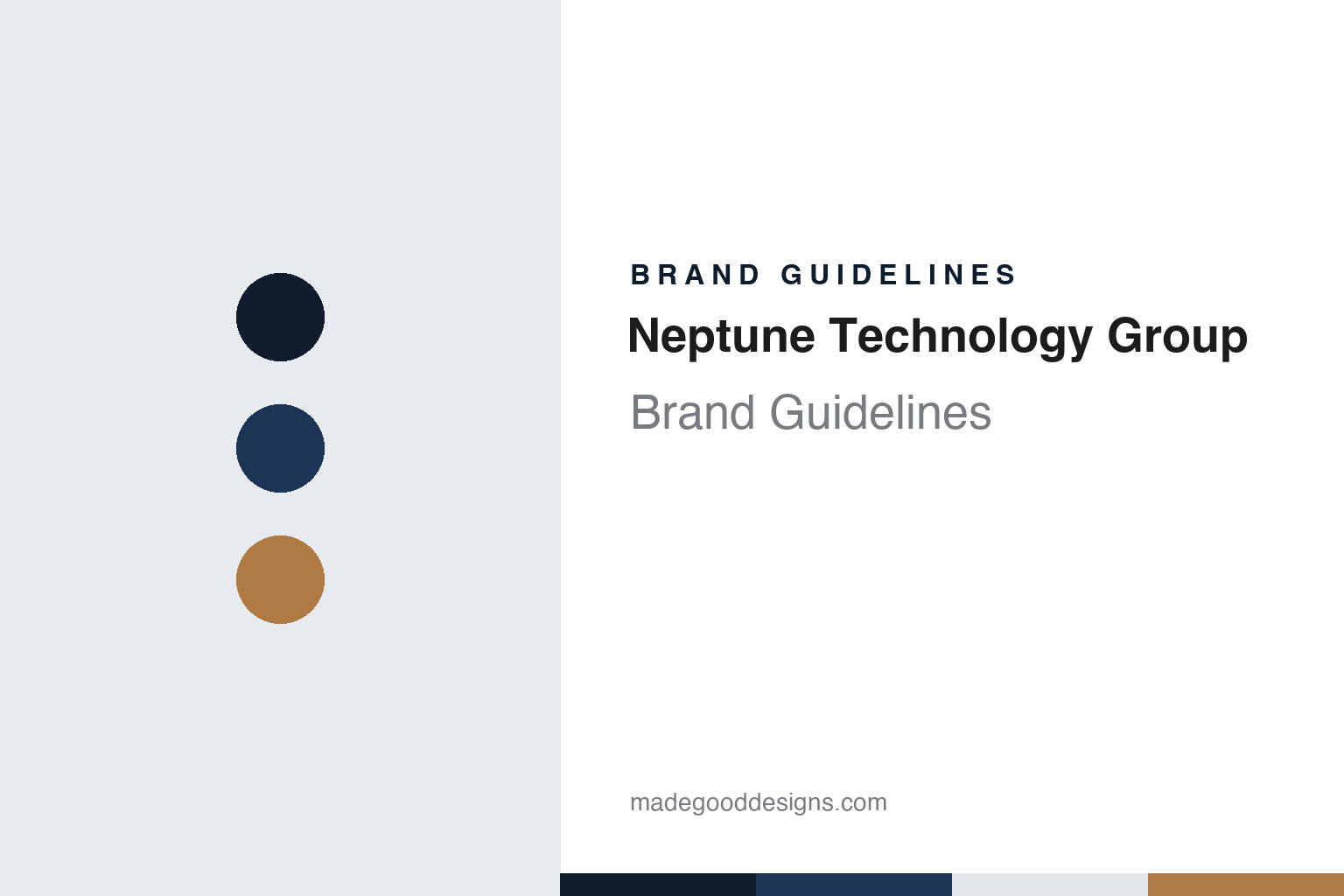
Neptune Technology Group Brand Guidelines
An 1892 water-meter name, carried from Queens to Tallassee.
Aa
Two constants: a navy, bronze and pale grey palette and a utility sans register. Abstract homage — not a Neptune product or mark; no meter, logo or nameplate is reproduced.
Thomson Meter
A Long Island City water-meter works.
Neptune Technology Group traces its roots to New York. An Investcorp announcement carried by WaterWorld in November 2001 says the business was founded in 1886 as the Thomson Meter Company and renamed the Neptune Meter Company in 1892. The company itself dates its story to 1892, the year it says it produced its first Trident water meter, and a 2009 company release says it began making water meters in Long Island City, New York.
Neptune’s own account of its early decades is told through products. In a release marking its 120th anniversary in June 2012, it named a compound meter in 1909, the PROTECTUS fire-service meter in 1915, an absolute encoder register in 1964 and, four years later, the original Automatic Reading and Billing system, ARB. The company describes several of these as industry firsts — its claims.
In 1972 Neptune moved its headquarters from Long Island City to Tallassee, Alabama. The 2012 release calls it one of the first large-scale manufacturing operations to relocate to Alabama, and says a foundry was added the following year. Over the next decades, the company says, it moved from mechanical water meters to automatic meter reading and to radio-based advanced metering systems, training a local workforce of mechanical, electrical and software engineers.
By 2001 the business belonged to Schlumberger. In November 2001 an affiliate of Schlumberger sold its North American water-meter business to the company’s senior management and an affiliate of Investcorp, the investment group with offices in New York, London and Bahrain, according to releases carried by Water & Wastes Digest and WaterWorld. The new standalone company took the name Neptune Technology Group and kept its headquarters and principal factory in Tallassee. In a related deal, Investcorp’s affiliate took Schlumberger Canada’s one-third interest in DAP Technologies, a maker of rugged handheld computers used for meter reading.
Colour
Investcorp, Roper and the radio meter.
Investcorp did not hold Neptune for long. On 22 October 2003, in a release dated from Tallassee and carried by WaterWorld, Neptune announced that Investcorp had signed a definitive agreement to sell it to Roper Industries, the diversified industrial group, and Reuters also reported the deal. The release described Neptune as a provider of water measurement products and automatic meter reading equipment for North American water utilities, with two subsidiaries: DB Microware, which wrote meter-reading and service-order software for water, gas and electric utilities, and DAP Technologies. The deal was expected to close by early 2004, subject to regulatory approvals.
Roper, which now trades as Roper Technologies, still owns the business. A Zacks analysis published in December 2025 placed Neptune within Roper’s Technology Enabled Products segment, pointing to demand for its ultrasonic meters and its cloud-based data and billing software.
Neptune has kept investing in Tallassee. In March 2009 it broke ground on a new research and development centre there, next to its existing engineering building and planned to house up to 90 engineering staff, according to a company release carried by WaterWorld. That release said all Neptune meters and automated meter reading systems were designed and manufactured in Tallassee, and described plastic components made on high-speed injection-moulding equipment — the company’s account at the time.
The product line moved from mechanical registers to radio. The 2012 anniversary release named the E-Coder, a solid-state absolute encoder introduced in 2003, and the E-Coder)R900i, an integrated meter-reading unit, in 2008. Today Neptune lists meters including the MACH 10 ultrasonic meter, the T-10, the TRU/FLO compound meter and the HP PROTECTUS III fire-service meter, and runs Neptune 360, which it describes as a cloud-based meter data management platform for water utilities, covering everything from mobile meter reading to an AMI network.
The company says it serves more than 4,000 water utilities across North America, and it runs a Canadian business, Neptune Canada.
Typography
Meters and the grid.
Utility meters are everywhere and rarely looked at. They sit in cupboards and basements, in pits under the pavement and in boxes on outside walls, and today they are read far more often by machines than by people. The makers in this guide build electricity, water, gas and heat meters, and increasingly the radio networks and software that collect and manage their readings.
Their imagery follows that shift. Factory photographs show rows of grey and white meters clamped into test rigs, brass water-meter bodies waiting for assembly and the dials of mechanical registers. Newer material shows small digital displays and communication modules, and control-room screens where a utility follows consumption, outages and the state of its network across a town or a region. Product shots tend to sit on plain light backgrounds, close in spirit to the technical drawings of a catalogue.
People appear mostly as installers and operators: field engineers beside liveried utility vans, technicians opening a meter cabinet or lifting the lid of a water-meter pit, staff in front of dashboards. Trade fairs such as Enlit, where the power industry meets, and national utility shows are where these companies present themselves to their customers, and their stands lean on the same mix of hardware, maps and screens.
Ownership in the sector has changed often, with listed groups, private equity investors and family firms buying and selling meter businesses across borders. This guide sets out what can be checked about each brand — who founded it, who owns it now and where its products are made — and marks clearly what rests only on the company’s own word.
Aa
A utility sans for a water-meter maker. (Specimen set in Barlow, a sans STAND-IN; NOT the Neptune logo.)
Neptune
A sea god’s name on a water meter.
The Neptune name has lasted more than 130 years through several owners. It is the name of the Roman god of the sea, whose emblem is the trident, and the company’s first meter in 1892 was the Trident; the PROTECTUS name followed in 1915. Product names set in capitals and carrying registered marks — MACH 10, TRU/FLO, PROTECTUS — run through its current catalogue.
The company trades as Neptune Technology Group Inc., the name it took in 2001, and presents itself simply as Neptune. Its website uses the line “Every Drop Matters” and describes a community programme it calls Neptune CONNECT. It describes its aim as being its customers’ “most valued partner,” a phrase that also appeared in its 2003 release on the Roper deal.
Where the meters are made is documented mainly by the company. Releases from 2001 and 2009, carried by trade magazines, put its headquarters and principal manufacturing in Tallassee, and the 2009 release said all its meters and meter-reading systems were designed and made there.
For a design guide, Neptune Technology Group shows how a nineteenth-century product name can be carried through changes of owner into connected metering. Compare Badger Meter and Sensus. For this guide we use a deep navy, a bronze and a pale grey with a sans, an unofficial interpretation; no product or logo is reproduced.
Explore & save
Keep Neptune Technology Group’s identity on hand — save it to a board in the Made Good inspiration library.
Neptune identity set
Pin the Neptune navy, bronze and pale grey palette and the utility sans register to your own board.