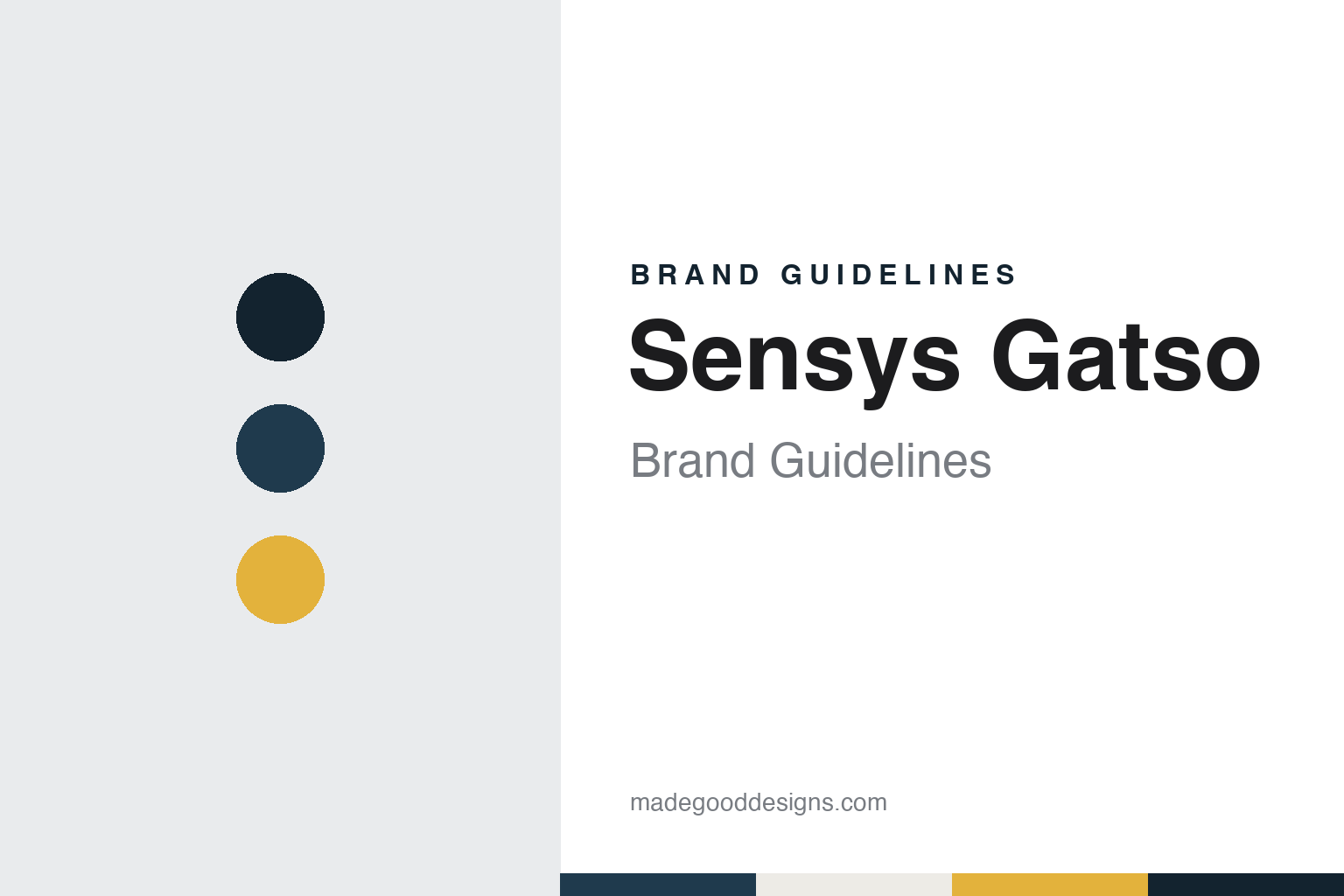
Sensys Gatso Brand Guidelines
A rally driver’s Gatsometer, Jönköping radar and a 2015 merger.
Aa
Two constants: a slate, amber and grey palette and a grotesque sans register. Abstract homage — not a Sensys Gatso product or mark; no camera, logo or nameplate is reproduced.
Gatsometer
A rally driver’s timing device becomes a police tool.
The Gatso half of the name comes from Maurice “Maus” Gatsonides, a Dutch racing and rally driver. Country Life, in a 2020 history of the speed camera, says he began rallying in the 1930s and that his greatest result was victory in the 1953 Monte Carlo Rally in a Ford Zephyr. He was also an engineer who wanted to measure his own driving: in 1938, the magazine says, he built a device linked to the speedometer to help him hold a set average speed, and later a pulse-counting machine that worked out a car’s speed between two rubber tubes laid across the road.
Before cameras there were cars. Dutch Wikipedia describes a short-lived Gatso sports-car marque built at his garage in Heemstede after the Second World War: a prototype first called Gatford, shown at the RAI motor show in Amsterdam in 1948 and renamed Gatso under pressure from Ford, then nine examples of the V8 Gatso 4000 and a single low-slung 1500 prototype of 1949 nicknamed “Platje.” The Dutch edition of TopGear reported in 2024 that the car business collapsed in 1950, short of money and parts.
The timing device found a second life. By 1958, Country Life says, Gatsonides had stopped competing and formed Gatsometer B.V., demonstrating the speed-recording device to Dutch police forces; TopGear says he sold the rubber tubes to the police in Zandvoort that year, with the system now triggering a camera rather than a clock. The Netherlands was the first country to adopt it, according to Country Life. The company dates its first speed-enforcement camera to 1964 and its first red-light camera to 1966, and TopGear places the first Dutch red-light camera in Delft that year.
The name travelled. English Wikipedia says the Gatsometer 24 was sold so widely in Britain and parts of Europe that “Gatso” came to be used as a general word for a speed camera there. In Britain, Country Life reports, the first Gatso speed camera went into service in 1992 on the A316 at Twickenham Bridge in west London, under a Metropolitan Police traffic sergeant.
Colour
A Swedish radar developer and a Dutch camera maker.
The Sensys half began in Sweden. The company says Sensys was founded in 1982 as a development company working on its first 10 GHz radar, and that it grew in 1987 when it won a Swedish police procurement with the RC100 tracking-radar sensor; it has supplied the Swedish Transport Administration since, it says. Swedish Wikipedia gives the head office as Jönköping and says the shares have been listed on the Stockholm exchange, now Nasdaq Stockholm, since 2001, the year the company says it began selling outside Sweden, with a first contract in Dubai.
Gatso, meanwhile, stayed in the Netherlands, with an office in Haarlem, and in the founder’s family; English Wikipedia describes it as largely a family concern. Gatso’s own list of firsts, as the group gives it, includes radar speed measurement in 1970, mobile radar control in 1980, what it calls the first section-control system in 1994, average-speed enforcement over a stretch of road, and a first digital red-light camera in 1997. Country Life dates the radar to 1971 and calls the claim to be first disputed. In the United States, English Wikipedia says, Gatso long worked through agents and system integrators before setting up a subsidiary, GATSO-USA.
The two came together in 2015. On 23 June that year Sensys Traffic AB announced its intention to buy the Dutch holding company Gatso Beheer B.V.; shareholders approved the deal at an extraordinary meeting on 24 July, and the purchase was completed on 31 July 2015, according to the company’s regulatory press release of that date. Payment was made partly in new Sensys shares, and the release said the combined business would operate as Sensys Gatso Group AB. Swedish Wikipedia gives the same 2015 date for the start of the group.
The merger joined a radar specialist with a camera maker, and Swedish Wikipedia describes the group’s largest product categories as automatic speed and red-light enforcement systems, built around its own tracking radars, which it says can measure speed and distance, identify lanes and classify vehicles.
Typography
Cameras, gantries and control rooms.
Traffic system makers sell to road authorities, cities and motorway operators rather than to the public, yet their work is some of the most visible equipment in any town. The signal heads at a junction, the gantries that span a motorway, the cameras mounted on poles and the white and yellow lines painted on the road surface all come from a small group of specialist companies, and most drivers pass their products without ever seeing a brand name.
That makes the way these companies present themselves unusual. Their brochures and websites tend to show the infrastructure in use: a junction at dusk with the signals lit, a motorway gantry carrying message signs, a tunnel portal, or a road-marking crew laying fresh lines at night while traffic is diverted. The other recurring picture is the control room, where operators sit in front of a wall of screens and maps showing the road network in real time.
Much of the business is built on long contracts, technical standards and acquisitions. Many of today’s groups were assembled by buying smaller signal makers, detection specialists and software companies, so one group may carry several older brand names in different countries, and a product range may run from glass beads and road paint to controllers, sensors and traffic management software.
The industry meets at trade fairs. Intertraffic, held in Amsterdam, with related events in the Americas, Asia and China, is one of the places where makers set out stands of signals, cameras and control-room displays for road authorities and contractors. This guide sets out what can be checked about each brand: who founded it, who owns it today and what it says about where its products are made, marking clearly what rests only on the company’s own word.
Aa
A grotesque sans for a name built from two companies. (Specimen set in Archivo, a sans STAND-IN; NOT the Sensys Gatso logo.)
Sensys Gatso
A Swedish listed group with a Dutch name in the middle.
Today the group is Sensys Gatso Group AB, headquartered in Jönköping, with Gatso’s office still in Haarlem. Swedish Wikipedia lists subsidiaries in Australia, Costa Rica, Germany, the Netherlands, Saudi Arabia, Sweden and the United States, plus a branch in the United Arab Emirates. The company’s website named Lewis Miller as chief executive in an interview it posted in September 2026.
Its range now runs from hardware to services. The website groups its work under speed enforcement, red-light enforcement, section control, school zones, vehicle access control and back-office software, and offers managed services that it calls traffic enforcement as a service, or TRaaS. The company lists the T-Series enforcement platform, introduced by Gatso in 2012 and updated in 2015, and FLUX, a software platform launched in 2018. It says it won a Swedish national speed-enforcement contract in 2022, covering equipment and TRaaS, and that in 2026 it launched Motiva, a mobile automated-enforcement product. Its case studies include section control on motorways, red-light enforcement in Hong Kong and the low-emission zone in Amsterdam.
The name carries its own history. Gatso, a name first used on a rally driver’s sports cars in the late 1940s, became a camera brand and then, in English usage recorded by Wikipedia, almost a common noun in Britain; Sensys, the Swedish radar developer, put its own name first when it bought the company in 2015. The joined name keeps both halves visible.
For a design guide, Sensys Gatso shows a merger that kept a founder’s surname inside a listed group’s name. Compare Verra Mobility, an American camera-programme operator that grew by acquisition, and Redflex, the Melbourne enforcement-camera maker. For this guide we use a deep slate, an amber and a road grey with a sans, an unofficial interpretation; no product or logo is reproduced.
Explore & save
Keep Sensys Gatso’s identity on hand — save it to a board in the Made Good inspiration library.
Sensys Gatso identity set
Pin the Sensys Gatso slate, amber and grey palette and the grotesque sans register to your own board.