Byworth Brand Guidelines
A Keighley boiler works started by a glasshouse grower in 1968.
Aa
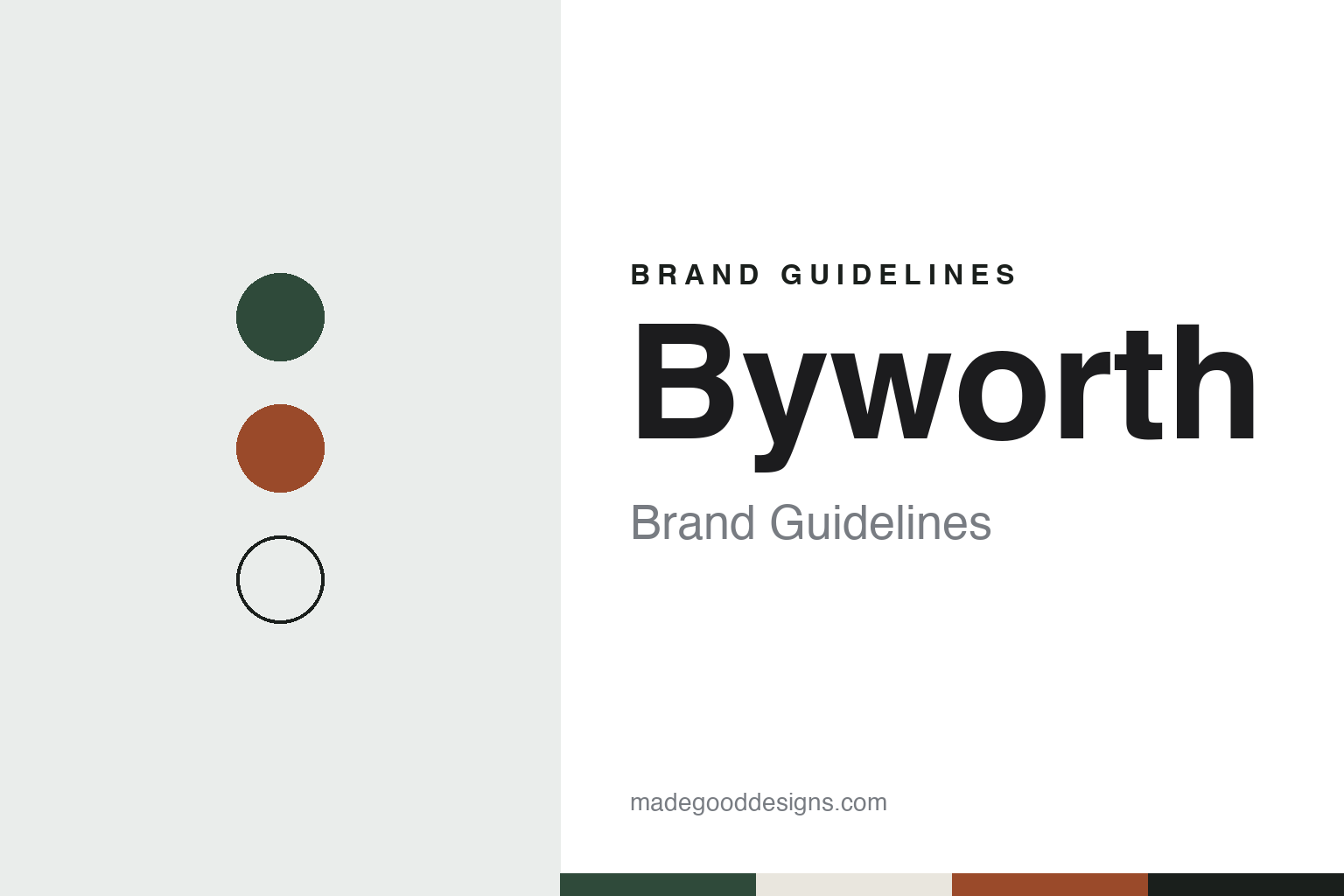
Two constants: a moorland green, millstone and rust palette and a workshop sans register. Abstract homage — not a Byworth product or mark; no boiler, logo or nameplate is reproduced.
Dennis Baldwin and Sons
A grower who built his own boilers.
Byworth began with a grower who was unhappy with his boilers. The company’s own history says its founder, Dennis Baldwin, ran a chrysanthemum and tomato business on three sites around Yorkshire and heated about three acres of glasshouses with steam. He wanted better boilers than he could buy, so he designed and installed his own, and other horticultural businesses soon asked him to build boilers for them.
With two sons who were more interested in engineering than growing, Baldwin sold the horticultural company and put the money into land for a factory. The business was first called Dennis Baldwin & Sons Boiler Manufacturers, and the company gives 1968 as its founding year; it later took the name Byworth Boilers. The early years, as the company tells them, were a story of cranes and sheds: a portal-frame building and a mobile cabin for an office after two years, a first articulated lorry and a five-tonne crane in 1972, with the crane-track foundations dug by hand.
The step into shell boilers came in 1973, when the company says it bought a two-pass dry-back boiler design from the long-established firm of Coltman’s. Submerged-arc welding and ex-shipyard rollers followed in 1974, and the first half of a boiler shop went up in 1975. The company is candid that the mid-1970s nearly closed it: with political unrest in Britain, customers cancelled orders, and work only picked up again in 1976. In the early 1980s Byworth says it designed and built its first three-pass wet-back steam boilers, all coal-fired, made its own coal stokers and began exporting more boilers.
Colour
From coal stokers to a trailer full of steam.
The middle of the 1980s brought heavier work. Byworth says that in 1984–85 it bought its first new plate rollers, which let it make high-pressure boilers, together with a 50-tonne overhead crane, and that by 1986 it was exporting to countries including Egypt, China, Sri Lanka, Cyprus and Ireland. As the market moved from coal to oil and gas firing, the range moved with it, and in 1987 the boiler shop gained a 150-foot extension for larger shells.
The idea the company tells most proudly came in 1988. After a customer’s boiler broke down unexpectedly, Dennis Baldwin’s son Peter Baldwin asked why a boiler maker could not offer a boiler for hire straight away. The answer was a complete packaged boiler house built into an articulated trailer, with its fuel tank and ancillaries, ready to be driven to a site. The first mobile steam boiler went out on hire to a timber merchant that year, and the hire business became a subsidiary, Byworth Transportable Boiler Hire.
The company says it won a contract for four new steam boilers for the Royal Albert Hall in 1991. Peter Baldwin became managing director in 1993, a yard at Thwaites was bought in the mid-1990s for the growing hire fleet, and a service division followed at the end of the decade. In 2004 Byworth began a two-year project with the University of Leeds on the performance of shell-and-tube boilers, and the company says its research engineer received the Combustion Engineering Association’s Derek Ezra Prize in 2007 for that work.
Today’s range, as the company lists it, splits into steam and hot water. The steam side includes the Yorkshireman, the Yorkshireman 2, the M-Series and the vertical Peaksman; the hot-water side includes the PHW range, the Fellsman and the Dalesman. Alongside them the company offers heat-recovery boilers, packaged boiler houses, servicing, hire and City & Guilds-assured training courses.
Typography
Design and documentation.
Industrial boiler makers sell equipment that most people never see. A steam boiler sits in a plant room behind a hospital, a brewery, a laundry or a paper mill, and the people who buy one are engineers, facility managers and contractors. So the visual language of the category is built for a technical reader: catalogues, data sheets, project case studies and trade-show stands rather than shop windows.
The most common image is the boiler itself in a clean plant room. A packaged fire-tube boiler is usually shown as a long horizontal shell, painted and insulated, with its burner on the front, a control panel at eye level and the flue rising behind it. Around it run steam headers, valves and lagged pipework, photographed under even light so that every joint reads clearly. Cutaway drawings do the explaining: a shell opened along its length to show the furnace tube and the passes of smaller tubes, or a water-tube unit drawn with its drums and banks of tubes exposed.
The second register is the factory. Makers show shells being rolled from steel plate, welders at work on tube sheets, finished units on low-loader trailers and large boilers lifted by crane on site. These pictures stress scale and fabrication skill. Many firms in the category are old, and their histories lean on heritage photographs: riveted boilers, steam-era works yards, early advertisements and the first catalogues.
The customers appear too, usually as settings rather than people: a utility’s turbine hall, a food plant with stainless pipework, a district-heating station, a hospital service yard. Colour is mostly restrained, with greys, navy, white and one strong corporate accent, and type is set in plain sans or engineering-style faces chosen to sit comfortably beside drawings and specification tables.
Aa
A plain workshop sans for a family boiler works. (Specimen set in Archivo, a sans STAND-IN; NOT the Byworth logo.)
Byworth
A family works with a Queen’s Award.
Byworth’s most prominent honour is digital rather than mechanical. Work on Unity, its boiler-house control system, began in spring 2013 and the first system was sold that autumn, the company says. On 22 April 2016 the London Gazette listed Byworth Boilers Ltd of Keighley among the winners of the Queen’s Awards for Enterprise: Innovation, for the “control and management of steam boiler house plant and machinery.” In an announcement published by the Combustion Engineering Association that April, the company said the idea had first been put to existing controls makers in 2007 before Byworth built its own team and spent two years developing it.
The business has stayed with the family. The company says the board was made up of the Baldwin family, that Rob Baldwin, Peter’s son, joined as an apprentice boilermaker in 2003 and became production director in 2010, and that a projects director joined the board in 2016. Companies House lists the present company, Byworth Boilers Ltd, as incorporated in October 2010 with its registered office at Parkwood Boiler Works in Keighley, and records Dennis Baldwin Industries Ltd as its controlling shareholder since January 2019.
The works itself has kept growing. The company says plans to double the boiler shop were passed in 2017, and an extension of 135 metres, with a customer centre and training rooms, was finished in early 2021 and opened with a factory launch event that October. It describes the site as one of the few places in Britain where an industrial boiler can be seen made from flat plate to finished shell under one roof. In July 2025 Bradford Means Business reported that the Parkwood Street company had been supplying Heathrow Airport with equipment and training for more than two years, had trained more than 30 airport staff and employed more than 100 people, after Heathrow and the manufacturers’ body Make UK showcased suppliers at an event in London.
For a design guide, Byworth shows how a regional boiler maker can keep a founder’s story and its own Yorkshire works at the centre of its brand. Compare Cochran, another British shell-boiler maker, and Spirax Sarco, the British steam-system specialist. For this guide we use a moorland green, a warm millstone grey and a rust accent with a sans, an unofficial interpretation; no product or logo is reproduced.
Explore & save
Keep Byworth’s identity on hand — save it to a board in the Made Good inspiration library.
Byworth identity set
Pin the Byworth moorland green, millstone and rust palette and the workshop sans register to your own board.