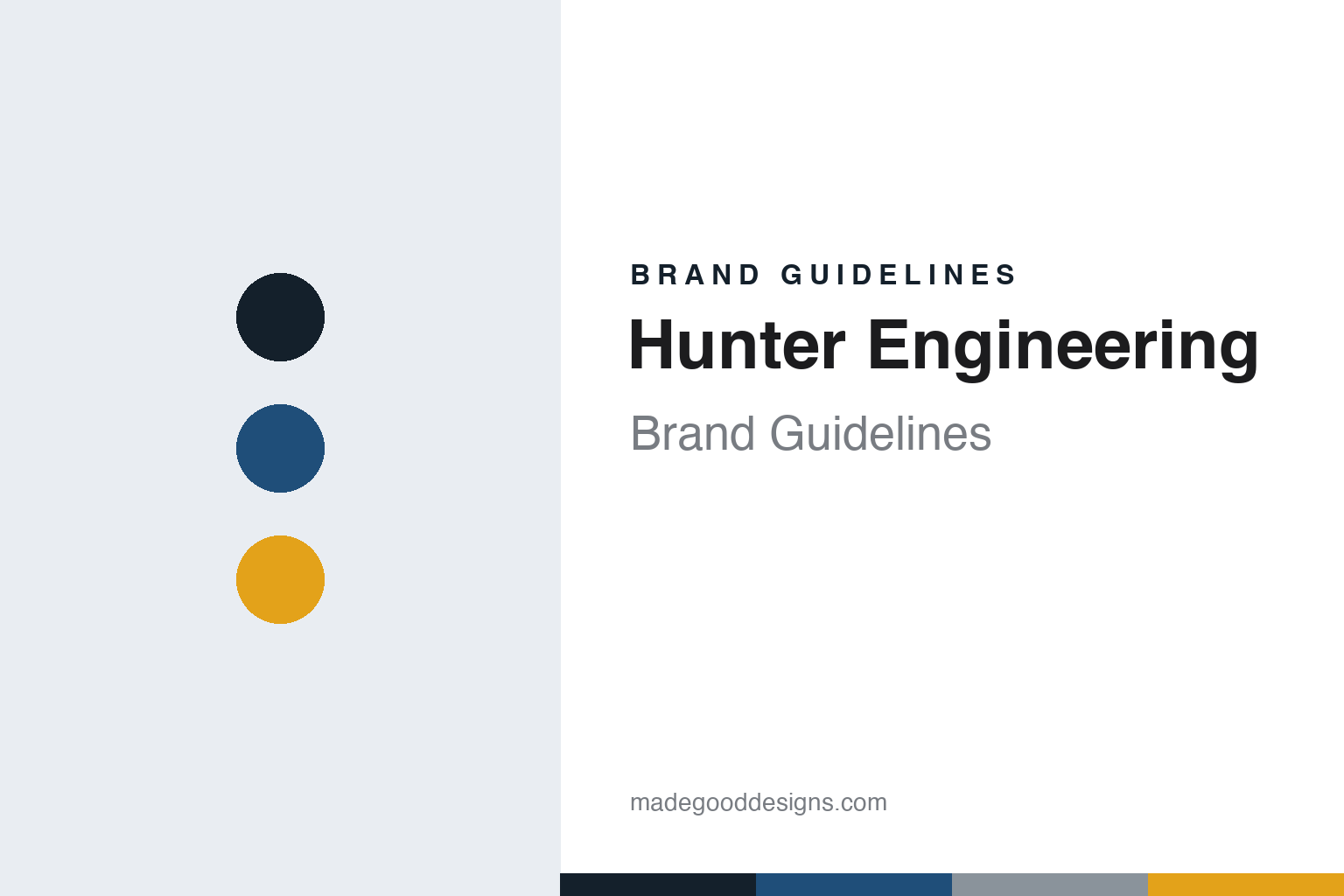
Hunter Engineering Brand Guidelines
A St. Louis battery charger, then seventy-odd years of wheel alignment.
Aa
Two constants: a navy, steel and amber palette and an engineering sans register. Abstract homage — not a Hunter Engineering product or mark; no machine, logo or nameplate is reproduced.
Kwikurent
An architecture student and a flat battery.
Hunter Engineering traces its start to a flat car battery. English Wikipedia and the company tell the same story: in 1936 Lee Hunter Jr., then a 23-year-old architecture student in St. Louis, kept running into battery failure in his Packard convertible, and set out to make a charger that worked in hours rather than days. With help from a former Washington University electrical engineering professor, Wikipedia says, he built the Kwikurent charger around a diverter-pole generator and sold it through the Lee Hunter Jr. Manufacturing Co. The company adds a more compact model, the Rocket Special, in 1938.
After serving in the US Army Corps of Engineers and the Ordnance Corps during the Second World War, Hunter returned to St. Louis and reopened the business in 1946 as Hunter Engineering Company. The company says it first stood on Hunter Avenue in Ladue, Missouri, and that its debut product was the Tune-In, a wheel balancer that worked with the wheel still on the car; Wikipedia credits Lee Hunter with a machine to balance wheels while they spin. A first product brochure followed in 1949.
Wheel alignment became the company’s core. Wikipedia says Hunter developed the Lite-A-Line alignment system in 1955 and that it became the industry standard, and that the 1962 Tune-Align was the first mechanical alignment system able to compensate for wheel run-out. In 1964, Wikipedia adds, the US Department of Commerce gave the company an E-Award for its export work. The company dates its move that same year to a 23-acre campus next to the St. Louis airport, in the suburb of Bridgeton, where it is still based.
Colour
Aligners, balancers, changers, racks.
Hunter’s catalogue grew out of alignment into a wider workshop range. The company sorts it into alignment systems, wheel balancers, tyre changers, alignment lifts, brake lathes and vehicle inspection. Its own timeline names the Compute-A-Line systems of 1969, the S7 Electron-A-Line of 1979 with its thrust-line principle, the A111 aligner of 1982 with a screen display, and WinAlign, the Windows-based alignment software it dates to 1992. Later names include the HawkEye camera aligners from 2007, the Road Force balancers, the Revolution automatic tyre changer of 2014 and the Quick Check drive-through inspection systems.
Training and field service are a large part of how the company presents itself. Hunter dates its Research & Training Center beside the headquarters to 1973, and it describes building a dedicated sales and service team from 1950 onward. Its timeline also records a 1953 installation at the General Motors plant in St. Louis that built the Corvette, and says Ford named it sole supplier of alignment and balancing equipment in 1964. In 2004, the company says, its imaging aligners were approved by BMW, DaimlerChrysler and the Volkswagen group. More recent lines cover the calibration of driver-assistance systems, under the ADASLink and Ultimate ADAS names.
Hunter makes much of where its products are built. The company says more than 1,000 people design and build its equipment at four manufacturing facilities in Missouri and Mississippi: headquarters and research in St. Louis, a metal fabrication and assembly plant in Durant, Mississippi, opened in 1976, and an electronics and fabrication plant in Raymond, Mississippi, opened in 1985. Modern Tire Dealer, whose editor toured one of the plants, described the company in September 2015 as a 69-year-old tyre equipment manufacturer with four domestic plants and training facilities at its Bridgeton headquarters. Outside the United States the company has offices in Canada and, since 2002, in Germany near Munich, and it says its products are sold in 130 countries.
Typography
How workshop equipment makers present themselves.
Garage equipment is sold to people who already know what a lift or a tyre changer should do, so the makers’ own material tends to show the machines at work. The usual picture is a two-post lift with a car raised to head height in a clean, well-lit workshop, the columns and arms set against pale floors and painted walls, with a technician underneath for scale.
Wheel-service equipment has its own look. Tyre changers and wheel balancers are typically shown as compact cabinets in strong body colours — reds, blues and greys recur across the trade — with a wheel mounted and the controls in view. Alignment systems are often shown through their targets or sensors clamped to the wheels and a screen nearby, and brake testers through rollers set into the workshop floor.
Much of the selling happens face to face. Makers present their ranges at trade fairs such as Automechanika in Frankfurt and at national shows, and most sell through dealer and installer networks rather than directly, so dealer locators, installer programmes and training centres feature prominently on their websites. Certification marks and named standards also appear often; Rotary Lift, for example, says many of its lifts carry the certification mark of the Automotive Lift Institute, a trade body formed in 1945.
The makers in this guide include family firms, private companies and brands held inside larger industrial groups. This guide sets out what can be checked about each — who founded it, who owns it and what it says about where its products are made — and marks clearly what rests only on the company’s own word.
Aa
An engineering sans for an alignment maker. (Specimen set in Archivo, a sans STAND-IN; NOT the Hunter Engineering logo.)
Hunter Engineering
Family and veteran owned, the company says.
Hunter Engineering is still based in St. Louis, and its leadership has changed hands rarely. The company says Stephen F. Brauer was appointed president in 1981, the first change since its founding, while English Wikipedia says Brauer joined in 1971, became chief operating officer in 1978 and chief executive in 1980. Wikipedia adds that he served as US Ambassador to Belgium from 2001 to 2003 before returning to the company, and that he is its chairman. In a December 2022 press release the company named Beau Brauer as president and Stephen F. Brauer as chairman.
The company calls itself a family and veteran-owned business. In that same release it said the National Veteran Business Development Council had certified it as a veteran-owned business in November 2022, and it described itself as veteran-owned for its entire history, from Lee Hunter to Stephen F. Brauer. Lee Hunter was inducted into the Automotive Hall of Fame in Dearborn, Michigan, which, Wikipedia says, cited his “dramatic impact on the development of the automobile and the automotive industry”; the company dates the induction to 1992. Hunter marked its 75th year in 2021.
The name needs care. Hunter Engineering’s website is hunter.com, and the old hunterengineering.com address redirects there; it is a different business from the Hunter boot brand and other companies that use the Hunter name.
For a design guide, Hunter Engineering shows how a family-owned equipment maker can build an identity on named systems, training and a home city. Compare Snap-on, another American workshop name sold through its own field team, and Rotary Lift. For this guide we use a deep navy, a steel grey and an amber with a sans, an unofficial interpretation; no product or logo is reproduced.
Explore & save
Keep Hunter Engineering’s identity on hand — save it to a board in the Made Good inspiration library.
Hunter Engineering identity set
Pin the navy, steel and amber palette and the engineering sans register to your own board.


