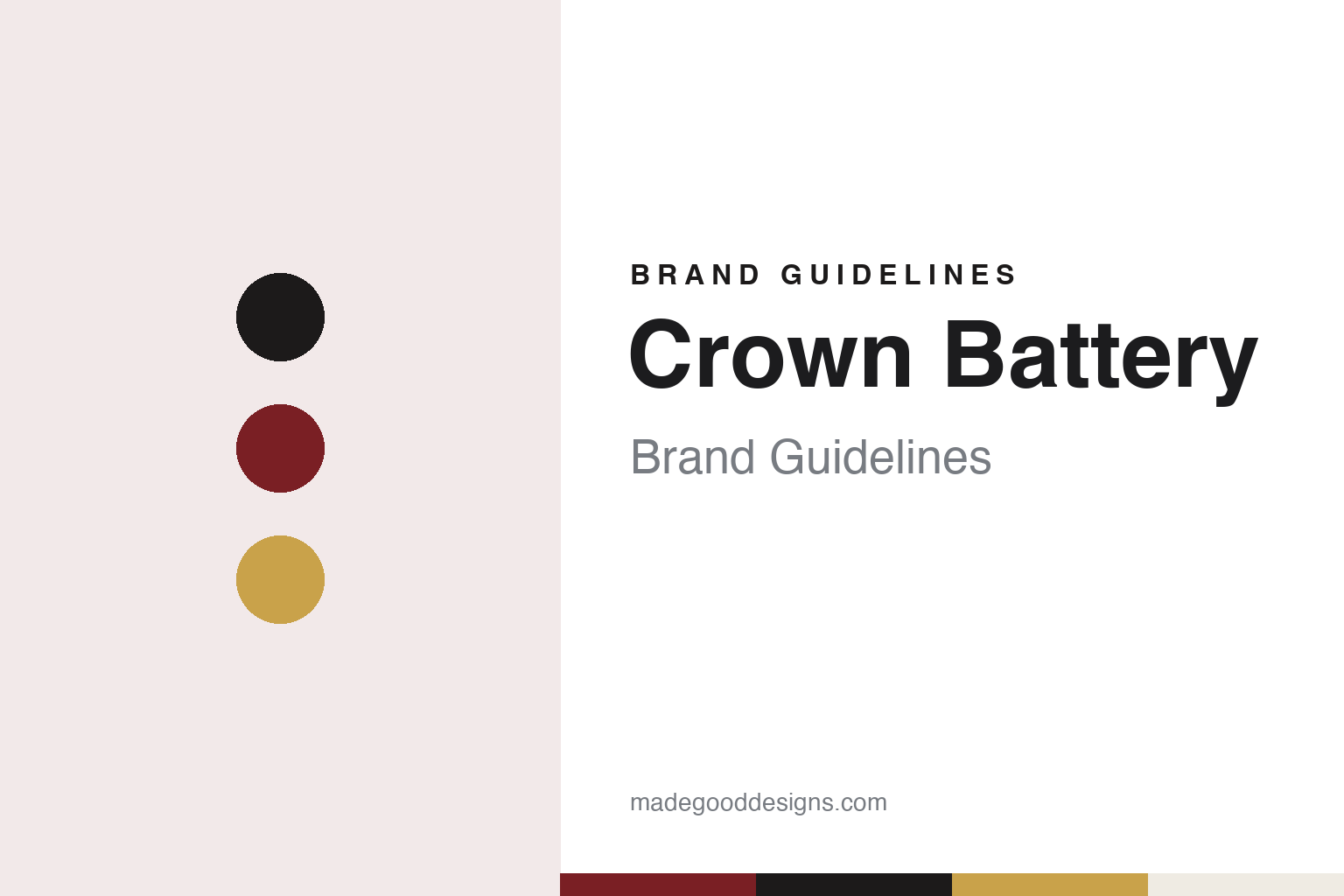
Crown Battery Brand Guidelines
The Fremont, Ohio battery maker named for “king.”
Aa
Two constants: a garnet, black and gold palette and an industrial sans register. Abstract homage — not a Crown Battery product or mark; no battery, logo or nameplate is reproduced.
Fremont Battery
A repair shop, a family name and a crown.
Crown Battery began in Fremont, Ohio, in 1926. Its founder was William J. Koenig, a German immigrant. The company’s own history describes a small battery repair shop; Batteries International, in a January 2024 profile of the family, says Koenig was a machinist who first opened a radiator repair shop, found that the batteries also needed repairing, and that same year renamed the business Fremont Battery.
The name that followed came from the family itself. Koenig means “king” in German, and the business became Crown Battery, both the company and Batteries International say. The timing was hard: the Great Depression began three years after the shop opened, and Batteries International describes a family firm in which Koenig’s wife and daughters worked on battery assembly and his son Lee started helping out as a boy, later trimming batteries on a pedal-operated press and placing wood separators between plates by hand.
The early 1950s were the low point. Lee Koenig later recalled that the firm “almost went out of business,” Batteries International reported, with staff falling from more than 20 to his father, himself and a part-time salesperson. He bought a panel truck, built up deliveries and sales, and in 1954 bought Crown from his father; the two kept working together until William retired. The company dates the start of its own automotive battery manufacturing to the 1950s.
Colour
From a regional plant to forklifts, mines and railroads.
Under Lee Koenig, Crown grew from a small regional maker with four employees into a firm of more than 270 people selling across the United States and in 16 other countries, according to Batteries International. The plant on North Fifth Street in Fremont was expanded seven times, distribution centres opened across the Midwest from Chicago to Buffalo in the 1960s, and the car and truck battery business widened into marine and industrial batteries. Koenig later put the change in his own numbers: Crown sold about 2,000 batteries in 1954, he recalled, and was making about half a million a year by 1998, when he stepped back, Batteries International reported. The company says it added industrial plates and batteries to its production lines in the 1970s.
Regulation shaped the next move. In 1958 Crown became affiliated with the Independent Battery Manufacturers Association, and Lee Koenig later served as its president and as president of Battery Council International, Batteries International reported. New rules introduced in 1976 put many battery makers under pressure, and in response Crown moved its manufacturing to its present site on Majestic Drive, still in Fremont.
Today Crown sorts its range into two families. Motive power covers batteries for electric forklifts and pallet jacks, electric mining machinery, automated guided vehicles, and railroad and stationary generator systems, along with industrial chargers. Transportation and energy storage covers starting and deep-cycle batteries for material handling, golf and utility vehicles, trucking and agriculture, floor-care machines, marine use and renewable energy storage. The company’s Power.Match. tool helps buyers pick a battery by application. In a 2017 look back at its first 90 years, Crown said it entered the railroad market in 2007, opened a research and development facility in 2009, had acquired seven businesses in three decades and had operations in Canada and Mexico.
Typography
How the category presents itself.
Industrial batteries are rarely seen by the people who depend on them. They sit under the seat of a forklift truck, in a locked room behind a telephone exchange or in the cabinets that keep a data centre running when the mains fail, so the makers in this guide have to show their products in places most readers will never visit.
Their pictures tend to come from a small set of scenes. There are rows of cells on a factory floor, forklift batteries packed into steel trays, standby racks lined up in data centres and telecom rooms, and cutaway diagrams that open a cell to show its plates, separators and chemistry. Newer lithium makers add architects’ renderings of large cell factories, and the oldest firms reach back to photographs of early lead and nickel works and to the railway, telephone and submarine customers they first supplied.
The trade is also a story of ownership. Many of these names have passed through electrical groups, private equity funds, stock markets and energy companies, and several survive mainly as brands inside larger groups. Regulators have looked at the trade too: in 2017 Germany’s competition authority fined two makers of industrial batteries over a shared lead surcharge, and a French heritage inventory has recorded one maker’s Bordeaux factory buildings as industrial architecture.
This guide sets out what can be checked about each brand — who founded it, who owns it, where it says its batteries are made and which product names it uses — and marks clearly what rests only on the company’s own word. The colours and typefaces shown are our own interpretation, not official brand assets.
Aa
An industrial sans — sturdy and plain. (Specimen set in Archivo, a sans STAND-IN; NOT the Crown Battery logo.)
Crown Battery
Three owners, one town.
Crown has had three owners, two of them from the same family, the company says. In 1998 Lee Koenig sold Crown to a group of employees, and Hal Hawk took over as head, Batteries International reported; the company says Hawk, who had joined as a route salesperson driving a delivery truck and worked up to vice-president of sales, led that acquisition. Hawk remains president. The company describes itself as privately owned, with corporate and manufacturing operations in Fremont, 14 sales and distribution offices in North America and about 615 employees, and sells through dealers and distributors in the Americas, Europe, Africa, the Asia-Pacific region, Australia and New Zealand.
Where the batteries are made is a point the company stresses. It says it keeps one location for engineering and manufacturing, in Fremont, and that its batteries are engineered and made in the USA at an ISO 9001:2015-certified plant there. In a 2017 post it said the facility had passed 250,000 square feet and that its headquarters had moved twice while staying in Fremont; a 2021 post marking 95 years described 3D modelling, robotic assembly and scanning electron microscopes in its work. In January 2025 Crown said it had received the Most Valuable Supplier award from MHEDA, the Material Handling Equipment Distributors Association, for the fifth year in a row.
The name is the brand’s clearest idea. A German surname became an English word, and the word became a company: Batteries International and Crown both tell the story the same way.
For a design guide, Crown Battery shows how a family name, translated, can carry a regional manufacturer for a century. Compare East Penn, another privately owned American battery maker, and Trojan Battery. For this guide we use garnet, black and gold with a sans, an unofficial interpretation; no product or logo is reproduced.
Explore & save
Keep Crown Battery’s identity on hand — save it to a board in the Made Good inspiration library.
Crown Battery identity set
Pin the Crown Battery garnet, black and gold palette and the industrial sans register to your own board.