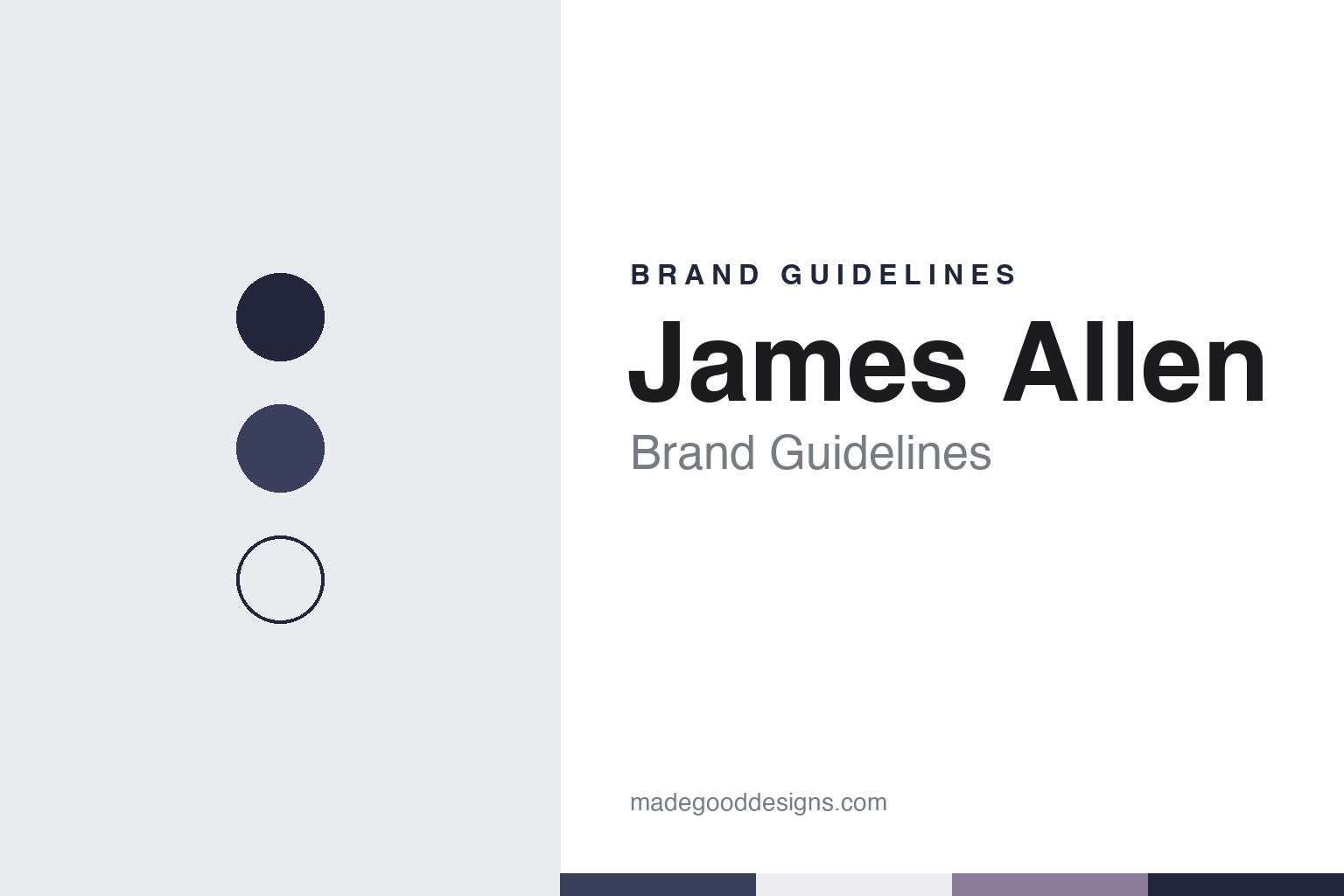
James Allen Brand Guidelines
The online diamond seller that became a collection on another site.
Aa
Two constants: a slate, pale grey and mauve palette of our own and a geometric sans register. Abstract homage — not a James Allen product or mark; no ring, logo or nameplate is reproduced.
R2Net
Four founders and an online shop.
James Allen was an American online seller of diamonds and engagement rings, and it no longer trades as a stand-alone retailer. Since 2026 the name has survived as a collection on the Blue Nile website.
The business was run by a company called R2Net, which Signet Jewelers said in August 2017 was founded in 2006 by Oded Edelman, James Schultz, Michele Sigler and Dean Lederman. Signet’s announcement described R2Net as headquartered in New York City, with technology centres in Israel and customer service in Frederick, Maryland. JCK had called James Allen “Frederick, Md.–based” in 2014, so the two descriptions differ. The Israeli Diamond Industry’s website said in 2018 that the four formed the company in New York.
JCK wrote in November 2014 that James Allen was “sometimes said to be Blue Nile’s closest rival in pure-play jewelry e-tail.” Edelman was its chief executive. That month it opened 16 boutiques in Sears jewellery departments in New York, Maryland and Puerto Rico. Each held 120 rings to try on, and the sales stations pointed shoppers to the website rather than selling anything themselves.
In June 2017 JCK reported that the company had signed a deal with Dominion Diamond giving it online exclusivity for CanadaMark, a programme that certifies Canadian origin through audited tracking and individual serial numbers.
Signet Jewelers, the owner of Kay, Zales and Jared, announced in August 2017 that it would buy R2Net, and its later filing dates the completed purchase to 12 September 2017. The deal also brought in R2Net’s imaging company, Segoma Imaging Technologies. National Jeweler reported that Signet planned to run JamesAllen.com as an independent division, with co-founder and chief executive Edelman also becoming Signet’s chief digital innovation adviser. JCK later described him as president of the site.
Colour
Technology at the core.
Signet’s annual report filed in 2026 called James Allen an online “pure-play” brand, focused “primarily” on “diamonds, engagement rings and fine jewelry, with technology at the core of the James Allen model.” Imaging was the first of those technologies to be reported. Edelman told JCK in 2014 that its proprietary 360-degree display let customers “see the diamonds from every angle, better than you can at the store.” By the time of the Signet deal, National Jeweler described a diamond imaging camera producing 360-degree HD images with a 40x zoom on any device, 3-D imaging that paired loose diamonds with rings, and a ring try-on app. Signet’s announcement also listed a virtual ring sizer, and Segoma supplied the machines behind the system.
Signet’s chief executive at the time, Gina Drosos, described this to National Jeweler as a “new-generation digital shopping strategy for jewelry.” JCK reported in 2026 that Signet’s other brands would use James Allen’s “custom capabilities and technology” after the site closed.
The site kept adding tools and stock under Signet. On 1 May 2019 it began offering laboratory-created diamonds, the first Signet-owned business to do so, JCK reported, with Edelman calling the move “a test” for the wider group and saying the stones would not be branded. National Jeweler reviewed its online engagement ring customiser, The Ring Studio, in March 2022, and its reporter received a cubic zirconia reproduction of the ring she designed. In July 2023 the brand introduced octagonal diamonds with 65 facets, which it announced as an “industry first,” JCK reported.
Typography
How jewellery retailers present themselves.
A jewellery retailer sells something most customers cannot judge by eye. Much of its visual identity works on that gap, using bright counters, close-up photography and printed assurances to make purity, weight and origin feel visible. The store counter is the oldest of these devices: pieces sit under strong light, on neutral trays, with a member of staff between the customer and the case.
Festive selling changes the display. Gold sets shown for weddings and holidays tend to be arranged as full ensembles, with necklace, earrings and bangles together, and campaigns are often planned around the calendar. The store itself can carry the message. JCK reported in 2023 that Tanishq’s New Jersey store used Dhokra metal-casting in its signage, and Khaleej Times reported in 2013 that Kalyan Jewellers’ UAE showrooms each had a dedicated diamond floor.
Online sellers have had to replace the counter with a screen. Their pages lean on magnified diamond viewers, grading details and rotating product images, so the shopper can inspect a stone without holding it. The certificate, the cut chart and the zoomed photograph do the work a salesperson once did, and they tend to be set in plain, spec-sheet type.
Younger demi-fine brands use a looser language. Their pictures favour stacked rings and layered chains shown on hands and necks rather than on trays, and the gift box often becomes part of the identity, since many pieces are sold as presents. Charm bars, where a customer builds a piece in the shop, turn the counter into something closer to a workshop. Each of these settings asks something different of a logo, a typeface and a palette, which is why this guide looks at what can be documented about each brand.
Aa
A clean geometric sans for a brand led by its imaging. (Specimen set in Jost, a sans STAND-IN; NOT the James Allen logo.)
James Allen
A store that did not look like a jeweller.
In December 2018 JCK reported on a James Allen store on M Street in Georgetown, Washington, D.C., which Edelman called a “laboratory” for ideas that other Signet nameplates might adopt. “It’s not a store,” he said. “It’s more of a place you can hang out.” He told JCK it did not look like a jeweller from the outside, and that the shop was deliberately not packed with product.
The article described couches and a cappuccino bar, a long communal table where visitors could try on cubic zirconia and silver rings without a salesperson, an aquarium-like case of best sellers, a virtual reality area giving a three-minute lesson in the Four Cs, and appointment rooms divided by walls of plants. Sounds such as birdsong played to visitors who stepped on certain spots. National Jeweler described James Allen in 2026 as having operated primarily online.
The end came through a restructuring at the parent company. On 19 March 2026, alongside its annual results, Signet announced that it would wind down the James Allen website and keep the name as a proprietary collection within Blue Nile, JCK, National Jeweler and INSTORE reported. Signet told analysts it was narrowing its focus from eight businesses to four core brands: Kay, Zales, Jared and Blue Nile. Rocksbox went the same way, into Kay. Signet’s annual report said the aim was to support Blue Nile’s move “into a more elevated luxury position,” and that it would be “sunsetting the jamesallen.com website” in the first half of the year.
That has now happened. Joan Hilson, Signet’s chief operating and financial officer, told National Jeweler in September 2026, “We did transition the James Allen brand and the James Allen customers to the Blue Nile site.” In November 2026 pages on jamesallen.com were forwarding to Blue Nile, whose menus list “Engagement Rings By James Allen” and a James Allen collection.
For a design guide, James Allen shows how a brand can be built on a way of seeing a product, and how a name can outlast the shop that carried it. Compare Blue Nile, its one-time rival and now its home, and Brilliant Earth, an online diamond seller of the same period. For this guide we use slate, pale grey and a muted mauve with a sans, an unofficial interpretation; no product or logo is reproduced.
Explore & save
Keep James Allen’s identity on hand — save it to a board in the Made Good inspiration library.
James Allen identity set
Pin the slate, pale grey and mauve palette and the geometric sans register to your own board.