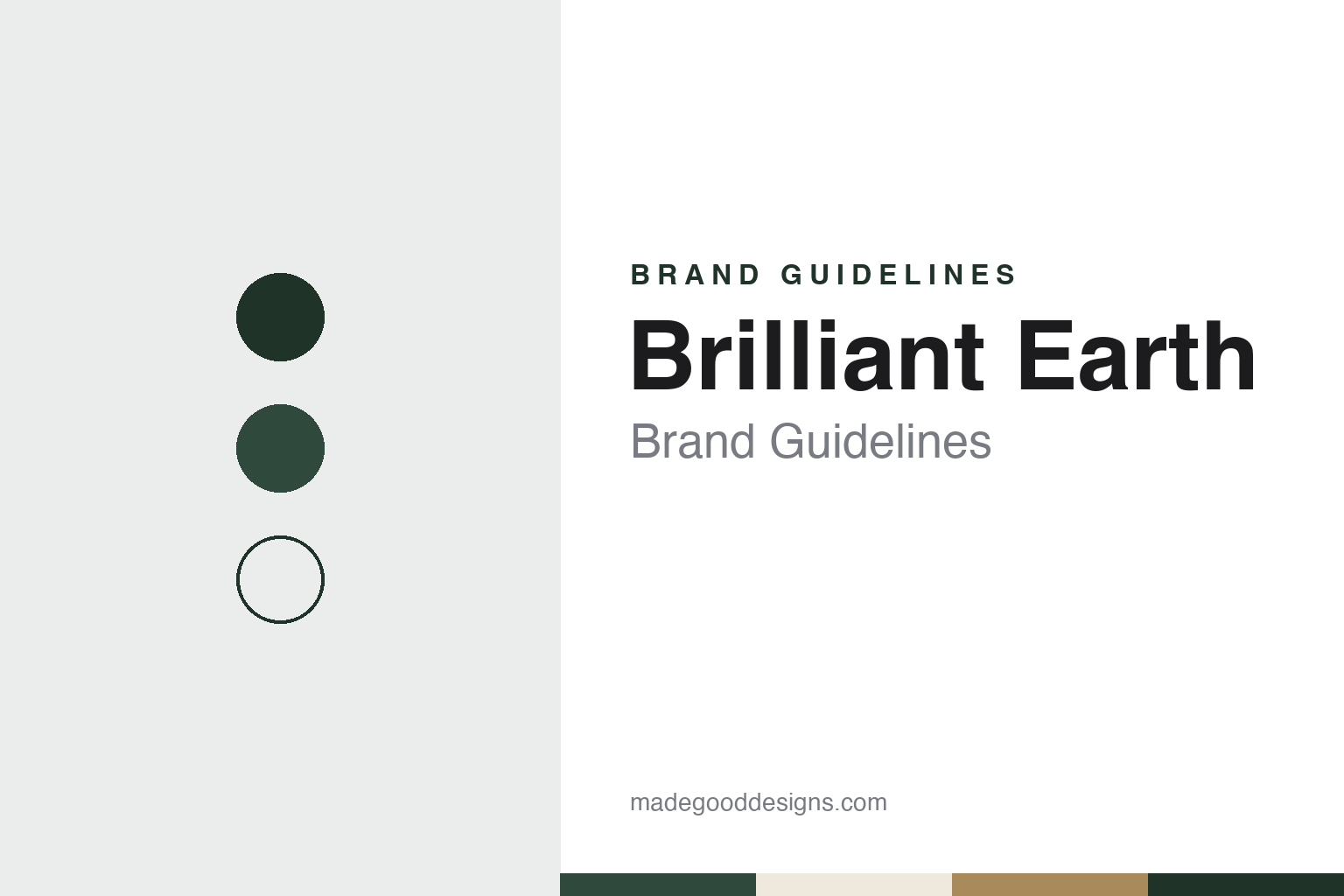
Brilliant Earth Brand Guidelines
The San Francisco website that grew into a chain of jewellery showrooms.
Aa
Two constants: a deep green, oat and brass palette of our own and a fine-line serif register. Abstract homage — not a Brilliant Earth product or mark; no ring, logo or nameplate is reproduced.
From a website to a listing
Two Stanford graduates and an online shop.
Brilliant Earth was conceived in 2004 by two Stanford alumni, Beth Gerstein and Eric Grossberg, English Wikipedia says, citing BusinessWeek. The company was established in San Francisco in August 2005 and its e-commerce site launched in July 2006. JCK reported in 2021, citing Insider, that the pair started it after graduating from Stanford Business School. The annual report the company filed in March 2026 gives the same founding year, describing an e-commerce business with “a single showroom in San Francisco.”
In February 2007 the Los Angeles Times reported that Gerstein had been “shocked” by a PBS Frontline episode on the diamond industry and had then struggled to find a diamond she could be sure was ethically mined. The paper dates that search to 2001; English Wikipedia, citing the San Francisco Chronicle, gives 2003. The same article placed the company in a wider movement of jewellers answering questions about gold and diamonds, after the film Blood Diamond, released the previous December, had raised questions about diamonds and war. “There’s definitely a trend towards ethical consumerism,” Gerstein told the paper.
The company went public in 2021. JCK reported that the offering opened on 22 September and closed on 27 September, with the shares trading on the Nasdaq Global Market under the symbol BRLT. Ahead of the listing, JCK reported that the filing named the private equity fund Mainsail Partners III and the two founders as owners, that those holders would keep more than half of the voting power, and that this made Brilliant Earth a “controlled company” under Nasdaq rules. The same report said Grossberg had served as co-CEO until March 2021. The 2026 annual report describes Gerstein as co-founder and chief executive and Grossberg as co-founder and executive chairman.
Colour
A mission stated in the company’s own words.
Sourcing is the centre of the brand, and most of what is said about it comes from the company. Its annual report gives its mission as “to create a more transparent, sustainable, compassionate, and inclusive jewelry industry.” It uses the trademarked phrase Beyond Conflict Free Diamonds for stones it says are “selected for their ethical and environmentally responsible origins,” and in February 2025 it added a second label, Pathway to Beyond Conflict Free Diamonds, for stones from suppliers it says it has vetted. It says its jewellery is “crafted from primarily repurchased precious metals,” and describes lab-grown diamonds as “a mining-free alternative to natural diamonds.” These are the company’s statements.
Press reports have named the origins over time. English Wikipedia, citing a 2006 New York Post article and a 2011 Mother Jones article, lists the Diavik and Ekati mines in Canada, and Namibia and Botswana. In March 2022 JCK reported Gerstein telling analysts that the company had removed Russian-origin stones from its website.
The company also describes tracing technology that “tracks a diamond from its origins at the mining operator, through cutting and polishing, to the customer.” In March 2021 National Jeweler reported that it had begun offering coloured stones from Moyo Gems, a mine-to-market initiative working with women miners in Tanzania, with the blockchain platform Everledger among its partners. In October 2024 the same magazine reported a collection created with the conservationist Jane Goodall, with a percentage of proceeds going to the Jane Goodall Institute, as part of a campaign called “Rethink Everything You Know About Diamonds.” The company’s annual report lists a second Goodall collection in 2025, and the Capture and Renewable collections of 2023.
On manufacture, the company says it works with long-term manufacturing partners, and that “because we own the designs created by our in-house studio, we have flexibility to determine where the jewelry is manufactured.” Many pieces are made to order. JCK described this in 2021 as an “asset-light” model with very little inventory.
Typography
How jewellery retailers present themselves.
A jewellery retailer sells something most customers cannot judge by eye. Much of its visual identity works on that gap, using bright counters, close-up photography and printed assurances to make purity, weight and origin feel visible. The store counter is the oldest of these devices: pieces sit under strong light, on neutral trays, with a member of staff between the customer and the case.
Festive selling changes the display. Gold sets shown for weddings and holidays tend to be arranged as full ensembles, with necklace, earrings and bangles together, and campaigns are often planned around the calendar. The store itself can carry the message. JCK reported in 2023 that Tanishq’s New Jersey store used Dhokra metal-casting in its signage, and Khaleej Times reported in 2013 that Kalyan Jewellers’ UAE showrooms each had a dedicated diamond floor.
Online sellers have had to replace the counter with a screen. Their pages lean on magnified diamond viewers, grading details and rotating product images, so the shopper can inspect a stone without holding it. The certificate, the cut chart and the zoomed photograph do the work a salesperson once did, and they tend to be set in plain, spec-sheet type.
Younger demi-fine brands use a looser language. Their pictures favour stacked rings and layered chains shown on hands and necks rather than on trays, and the gift box often becomes part of the identity, since many pieces are sold as presents. Charm bars, where a customer builds a piece in the shop, turn the counter into something closer to a workshop. Each of these settings asks something different of a logo, a typeface and a palette, which is why this guide looks at what can be documented about each brand.
Aa
A fine-line serif for a brand built around detail. (Specimen set in Cormorant Garamond, a serif STAND-IN; NOT the Brilliant Earth logo.)
Brilliant Earth
Delight in the details.
The brand’s claims have been challenged in public. In June 2017 The Next Web published an investigation of online “conflict-free” diamond selling that centred on Brilliant Earth, reporting that it had traced listed stones to suppliers and concluding that there was no certainty in buying such a diamond online. The company replied in the article that all its suppliers must provide the origin of their diamonds. A New York jewellery resale owner also posted videos questioning its sourcing, and in July 2017 the company sued him for defamation. JCK reported that the complaint called the central statement false, and that the company had hired SGS Global Services the previous year to audit its tracking system. In October 2017 JCK reported that the suit had been discontinued with prejudice and without costs, that it was not clear whether any settlement had been struck, and that the videos appeared to have been taken down. “The matter has been resolved,” Gerstein said.
The visual side of the brand is easiest to read in its shops. Showrooms grew from one to 15 by March 2022, JCK reported, and to 42 across the United States by the end of 2025. Chief brand officer Pam Catlett told JCK in February 2026 that the formats had moved from upper-floor, appointment-only rooms to malls and street-facing shops. The newest is the Beverly Hills flagship, which opened on 28 January 2026 at nearly 3,500 square feet, replacing the West Hollywood showroom, and which the company calls its “showroom of the future.”
JCK described a warm space with minimal decor. The words “Delight in the details” are written in gold-toned script on the threshold, and a white wall motif in wood and plaster shows camellias, olive branches and lotus flowers, evoking bridal collections such as Camellia and Olivetta. Catlett said the lighting, the showcases and a curved “eternity bar” were inspired by eternity rings, and that enlarged photographs treat the company’s own jewellery as art. Gerstein told National Jeweler in March 2026 that “delight in the details” is the brand’s north star. Four “coves” hold private appointments, and bridal and fine jewellery each get their own space.
For a design guide, Brilliant Earth shows how one line of copy can run from a website to a store threshold, and how a sourcing argument rests on what a company can document. Compare Blue Nile, another online diamond seller, and Mejuri, a fine jewellery brand built on buying for yourself. For this guide we use deep green, oat and brass with a serif, an unofficial interpretation; no product or logo is reproduced.
Explore & save
Keep Brilliant Earth’s identity on hand — save it to a board in the Made Good inspiration library.
Brilliant Earth identity set
Pin the deep green, oat and brass palette and the fine-line serif register to your own board.