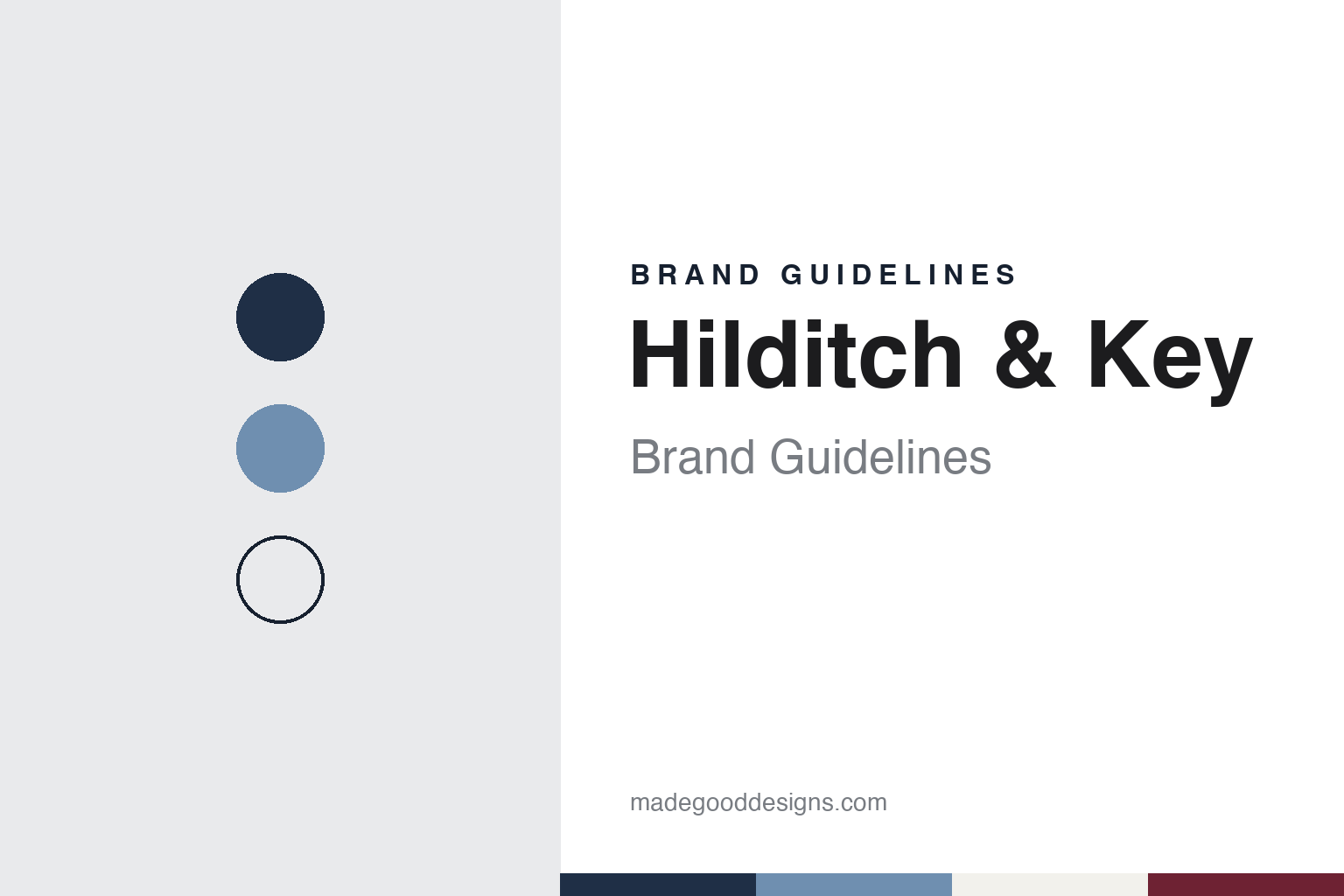
Hilditch & Key Brand Guidelines
The 1899 shirtmaker that made Karl Lagerfeld’s white shirts.
Aa
Two constants: a Hilditch & Key navy, shirting blue and burgundy palette and a Caslon serif register. Abstract homage — not a Hilditch & Key product or mark; no shirt, logo or shop front is reproduced.
Two Shirtmakers
From Tottenham Court Road to St James’s.
Hilditch & Key is a London shirtmaker founded in 1899 by Charles F. Hilditch and W. Graham Key. English Wikipedia, citing Jonathan Sothcott’s 2021 book The Jermyn Street Shirt, says the two had trained at Harman’s on Duke Street; The Gentleman’s Journal also says they left Harman’s to go into business together. The company calls itself a “shirtmaker since 1899,” and Vogue France gave the same year in 2023. Spear’s gave 1901 in 2020.
The first shop was on Tottenham Court Road, according to Wikipedia, The Gentleman’s Journal and Gentleman’s Gazette, while the company’s website speaks of its “Jermyn Street home since 1899.” Wikipedia says the shop aimed at university undergraduates, and Gentleman’s Gazette says in 2018 that the partners made their name by travelling to the universities to measure them. The move to St James’s followed within a few years; The Gentleman’s Journal places the larger premises on the corner of Duke Street and Jermyn Street.
In 1907 the firm opened in Paris, on the Rue de Rivoli, Wikipedia says. Gentleman’s Gazette wrote in 2018 that a Paris store remained the company’s only other shop; the company’s own website today speaks of selling online and at 73 Jermyn Street.
The war cost the firm its home. During the Blitz, The Gentleman’s Journal says, the St James’s shop and a large workroom in Store Street were both destroyed on the same night. Temporary premises were taken at 65 Jermyn Street before a move to number 39, and in 1978 a second shop was added at number 37. The flagship today is at 73 Jermyn Street, the address given by both the company and the St James’s neighbourhood directory, and Gentleman’s Gazette listed it there in 2018, next door to Turnbull & Asser.
Colour
A customer becomes the owner.
During the 1970s the company was acquired by Michael Booth, a long-time customer, Wikipedia says, citing Sothcott. Gentleman’s Gazette called him the owner in 2018, and the public register agrees. Companies House shows Hilditch & Key Limited as an active private company, incorporated in December 1967, controlled by Hilditch & Key (Holdings) Limited, incorporated in April 1960, with Booth listed as the person with significant control of the holding company. He is also listed as a director, alongside Steven Miller, who was appointed in February 2024. The registered office is in Sidcup, Kent.
Booth also bought a neighbour. Bates, a hatter on Jermyn Street since 1898, faced closure in 2009 when its block was to be redeveloped, Gentleman’s Gazette reported, and he bought the business rather than see it go under. The company says Bates now sits inside its Jermyn Street store, and its website sells hats and caps alongside the shirts.
Where the shirts are made has changed. An issue of Savile Row Style magazine said all the firm’s ready-to-wear and made-to-measure shirts were made at its Scottish plant by a team of skilled workers. Wikipedia, citing Sothcott, says that after Miller, formerly managing director of Turnbull & Asser, became chief executive, the Scottish factory was closed, and that bespoke shirts are made in Milan.
The made-to-measure routine is well documented. Savile Row Style described measurements being taken, a sample shirt being made, and the customer being asked to wear and launder it two or three times before the full order, with a minimum of six shirts. It also explained that in shirtmaking, made-to-measure means bespoke, unlike in tailoring. In 2020 Spear’s reported that the firm still constructed a paper pattern by hand, with 19 basic measurements and more than 1,150 fabrics. A 2025 company journal entry describes an in-store service offering changes to collar, body and sleeve, with collar and cuff styles and fabrics not found in the ready-to-wear range.
The company calls Karl Lagerfeld perhaps its best-known customer. Vogue France reported in April 2023 that, according to Miller, his uncle introduced him to the firm at 16 and he became a loyal customer, sending detailed sketches of what he wanted. Miller estimated that he probably owned more than 1,000 of its shirts. The company goes further, saying that Lagerfeld used its know-how to make prototype shirts for his catwalk presentations for Chanel, Chloé and his own label.
Typography
How shirtmakers present themselves.
Shirtmakers show their work through cloth. A bolt of poplin, a stack of stripes or a swatch book does what a logo does elsewhere: it tells a customer what kind of house this is. Charvet presents its shirtings in full bolts rather than on swatch cards, according to English Wikipedia, which describes a wall of four hundred white fabrics on its bespoke floor. Turnbull & Asser says its pattern books from the 1920s and 1930s survive, and it sells bespoke and made-to-measure shirts from its London shops.
Collars are the category’s other recurring image. They are small, repeatable shapes, easy to set out in rows and easy to tell apart. A Highsnobiety visit to Charvet found collar samples pinned to velvet and framed on the wall, and Turnbull & Asser names a collar of its own, the Classic T&A, as its signature style, English Wikipedia says. Paper patterns and fitting shirts belong to the same picture of a trade built on measurement.
Place matters as much as product. London’s Jermyn Street, in St James’s, is home to shirtmakers whose shop fronts appear in their own storytelling, and Turnbull & Asser dates its address there to 1903. In Paris, Charvet’s full name includes Place Vendôme.
Neckwear shares the same visual stock: silk ties folded and laid out by colour, and woven or printed patterns shown in ranges rather than one at a time. This guide sets out what can be checked about each house, including who founded it, who owns it now and where it says its products are made. Where a story rests on a company’s own account, the text says so. The tones and typefaces shown are our own interpretation.
Aa
A Caslon serif — for a house that says luxury “is not about noise.” (Specimen set in Libre Caslon Text, a serif STAND-IN; NOT the Hilditch & Key logo.)
Hilditch & Key
A shirt that whispers.
The brand’s voice is restraint. Gentleman’s Gazette quoted the website in 2018 as saying that “a shirt shouldn’t shout . . . it should whisper,” and described discretion and understatement as trademarks, with staff who refrained from naming celebrity customers. The current site has changed its emphasis but not its tone: “We believe luxury is not about noise,” it says, while also giving Lagerfeld a full section on its about page. The home page opens on the words “Shirtmakers since 1899.”
The shirt itself is set out in specific terms on the company’s website. It says its classic cotton poplin is two-fold 120, with poplin, oxford, twill and herringbone weaves; that all its shirts are pattern matched across the yoke and shoulder; and that they carry mother-of-pearl buttons and a raised placket. Button cuffs are rounded and double cuffs square. There are two cuts: the Classic Fit, which it calls the original Hilditch & Key cut, and the more tailored Contemporary Fit. Sleeves can be shortened by up to five inches.
The shop has been part of the display. Gentleman’s Gazette described the shirtmaker David Gale, newly arrived from Turnbull & Asser, measuring and cutting on a large glass table visible from the window, framed by displays of named collar and cuff styles. Pattern has its place as well: Savile Row Style recalled John Taylor, editor of Tailor & Cutter, specifying a bold black stripe to run horizontally on an evening shirt, to the surprise of the shirtmakers, who approved the result.
The brand has grown from shirts into a wider menswear shop. Its website now sells ties, knitwear, tailoring, sleepwear and leather goods as well as Bates hats, and lists Ettinger leather goods, Longmire cufflinks and Sanders shoes as partner brands.
For a design guide, Hilditch & Key shows how a single date and a quiet tone of voice can carry a house through bombing, new owners and changes in where its shirts are made. Compare Turnbull & Asser, its neighbour on Jermyn Street, and Ettinger, a partner brand on its website. For this guide we use navy, shirting blue, poplin white and burgundy with a serif, an unofficial interpretation; no product or logo is reproduced.
Explore & save
Keep Hilditch & Key’s identity on hand — save it to a board in the Made Good inspiration library.
Hilditch & Key identity set
Pin the Hilditch & Key navy, shirting blue and burgundy palette and the Caslon serif register to your own board.