HANRO Brand Guidelines
A Swiss knitting mill of 1884, now an Austrian-based underwear house.
Aa
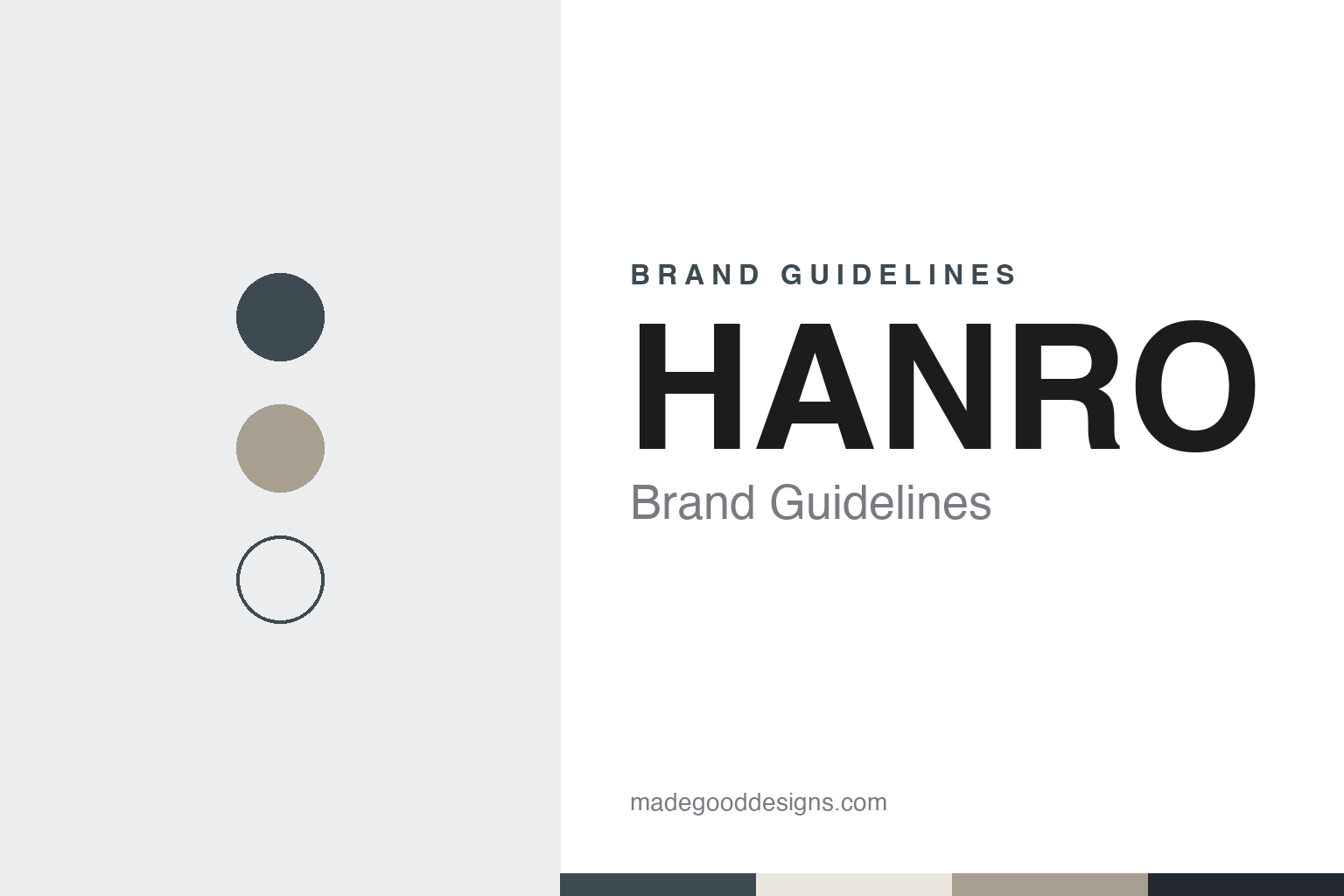
Two constants: a HANRO slate, raw cotton and stone palette and a Quiet serif register. Abstract homage — not a HANRO product or mark; no garment, logo or label is reproduced.
Handschin and Ronus
A knitting business in a house in Liestal.
HANRO began in Liestal, the capital of the Swiss canton of Basel-Landschaft, in 1884. The Historical Dictionary of Switzerland says Carl Albert Handschin, who had been a savings-bank manager and then a partner in a knitting works at Aarburg, set up his own knitting business in Liestal that year. The company calls him Albert Handschin. German Wikipedia says the business started in his home, with six women working at six machines.
The name came later. The brand’s US site says Handschin and Carl Ronus founded the factory together in 1884; Wikipedia dates Ronus’s arrival to 1895, when the two formed the partnership Handschin & Ronus, which then had 60 employees. The Historical Dictionary also describes Ronus as a later partner. The word Hanro, joining the first letters of the two surnames, was registered as a trademark in 1913.
The firm bought a factory property in Liestal in 1898 and opened a second works at Büren in Solothurn in 1911, Wikipedia says. English Wikipedia records a silver medal for Handschin at the Paris Exposition Universelle of 1889. Before the First World War the company exported women’s underwear to Britain, the United States and France. During that war it switched to military underwear and knitted jackets for soldiers. It became a family-held company limited by shares, Hanro AG, at the end of 1919 according to Wikipedia and in 1920 according to the Historical Dictionary.
In 1926 HANRO opened a subsidiary in Bendigo, Australia, where 17 employees settled and started production on machines brought from Switzerland. German Wikipedia says that subsidiary was sold in 1964.
Colour
From underwear to swimwear to a Swiss archive.
From the mid-1930s the company moved beyond underwear. German Wikipedia says that, working with the knitting-machine maker Dubied, HANRO developed circular knitting machines for outerwear, and from 1936 used them to make fabric for swimsuits, dresses and costumes. During the Second World War, English Wikipedia says, production and sales were hard going because materials were scarce, textiles were rationed and fabrics were substituted.
After 1945 production rose again. In 1947 HANRO began recruiting young women from Italy, and its workforce grew from 350 in 1946 to 689 in 1958, according to German Wikipedia. By the 1950s it was selling in 45 countries. It took over HIS & Co. at Murgenthal in 1963, a business it closed in 1976; founded Hanro Nova at Novazzano, on the Italian border, in 1970; and set up a subsidiary near Dublin in 1980. In 1973 an investment company close to Dubied took a minority stake, but more than four-fifths of the shares stayed with descendants of the two founding families. Wikipedia says the 1970s were difficult, with the strong franc, high wages and export duties all weighing on the firm.
The company’s own timeline adds product milestones. It credits Madeleine Handschin with what it calls the world’s first seamless bra camisoles, placed at 1930; it lists Raschel lace designs at 1960; and it dates the Cotton Seamless spaghetti top to 1980. These are HANRO’s own datings.
The best record of that century now sits outside the company. The firm’s historical collection has belonged to the Canton of Basel-Landschaft since 2015, as a gift from the company, according to a May 2024 release from the publisher Hier und Jetzt. The release describes company files, advertising material and about 20,000 sample pieces. SRF, the Swiss broadcaster, reported that staff set aside one specimen of each piece as a record. In 2024 Archäologie und Museum Baselland published the book Hanro – Mode aus Liestal 1884–1991, by Leonie Häsler, Madeleine Girard and Saskia Klaassen Nägeli. The release says the collection remains accessible locally.
Typography
Lace, cards and boxes.
Many lingerie houses present themselves through material first. Close-up photographs of lace, ribbon and stitching run across the category, and the trade sorts itself in the same terms: Interfilière Paris, the show for suppliers, listed fabrics, lace, embroidery, accessories and textile designers among its sectors in a press release of November 2023, with nearly 170 exhibiting suppliers expected.
Behind the photographs sits the workroom: pattern cards, cutting tables and sample rails. Wacoal says its first bra began with a paper pattern, and The Underpinnings Museum, an online collection of dated garments, publishes a pattern library beside its catalogue entries, which record fabric, origin and construction piece by piece.
The shop counts for as much as the cloth. Wacoal says it opened its first department-store underwear counter at the Kyoto branch of Takashimaya in 1950, while Agent Provocateur’s first shop, opened in 1994 on Broadwick Street in London’s Soho, still carried its seasonal windows in February 2026, FashionUnited reported. Boxes and ribbon finish the sale in many houses, and ribbon can be part of the product too: the museum names satin ribbon-slot lace trim and bows as signature details of many early Agent Provocateur designs.
The trade meets in France. The Salon International de la Lingerie and Interfilière Paris, organised by Eurovet, marked sixty years since the Salon’s first edition at Paris Porte de Versailles in January 2024, with nearly 250 brands expected at the Salon, according to the press release.
Aa
A quiet serif for a house that says “less, but better.” (Specimen set in Cormorant Garamond, a serif STAND-IN; NOT the HANRO logo.)
HANRO
Swiss by origin, Austrian by address.
The family era ended in 1991, when the Austrian underwear maker Huber Tricot of Götzis took 75 percent of the shares; it bought the remaining 25 percent two years later, Wikipedia says. At that point about 500 people worked for HANRO in Liestal, Novazzano and Dublin. Production in Liestal was wound down from 1997 to 1999, the Dublin plant was sold in 1998, and production at Novazzano ended in 2002. Since 2004 HANRO’s headquarters have been in Götzis, in Vorarlberg. The 2024 book release puts it simply: HANRO has not worked in Liestal for a good 20 years.
Huber’s own ownership has also changed. German Wikipedia says Benger Brands took 24 percent in October 2005 and a further 26 percent in 2009, and the Austrian news agency APA reported in June 2016 that Huber was wholly owned by China’s Benger Brands. In May 2020 the group filed for self-administered restructuring at the Feldkirch regional court, citing the Covid-19 revenue gap, FashionUnited reported. The filing covered Huber Holding, Arula, Huber Shop and Huber Trikot, and the group said no other companies were affected. Creditors accepted the plans that August. HANRO’s website today says the brand is part of the Huber Holding group, alongside Huber, Skiny and HOM, the French men’s brand Huber bought from Triumph in January 2015, Vindobona reported.
On manufacturing, the company’s wording is precise. It says the range is “manufactured predominantly in Europe,” that a significant proportion of its fabrics are knitted and finished at its own Arula plant in Vorarlberg, and that garments have been made at its own facility in Portugal since 1992, with further production in Hungary, Bulgaria, Croatia and Romania and a small share in China. It describes soft mercerisation on a 28-metre machine and names OEKO-TEX STANDARD 100. German Wikipedia, giving the position in 2020, says 80 percent of textiles came from Arula.
Its stated philosophy is “less, but better,” and HANRO says it was named Designer of the Year at the Salon International de la Lingerie in 2016. It has also run Atelier collaborations, including one with the designer Arthur Arbesser. It lists its own shops in cities from Zurich and Gstaad to London and New York.
For a design guide, HANRO shows how a Swiss founding date can outlast Swiss production, with the archive holding the history and the brand keeping the name. Compare Calida, another Swiss underwear name that moved its sewing abroad, and Jockey, whose licence Huber held from 1954, German Wikipedia says. For this guide we use a slate, a raw cotton and a warm stone with a serif, an unofficial interpretation; no product or logo is reproduced.
Explore & save
Keep HANRO’s identity on hand — save it to a board in the Made Good inspiration library.
HANRO identity set
Pin the HANRO slate, raw cotton and stone palette and the Quiet serif register to your own board.