Warrior Met Coal Brand Guidelines
Alabama steelmaking coal, from a bankruptcy sale to the Blue Creek mine.
Aa
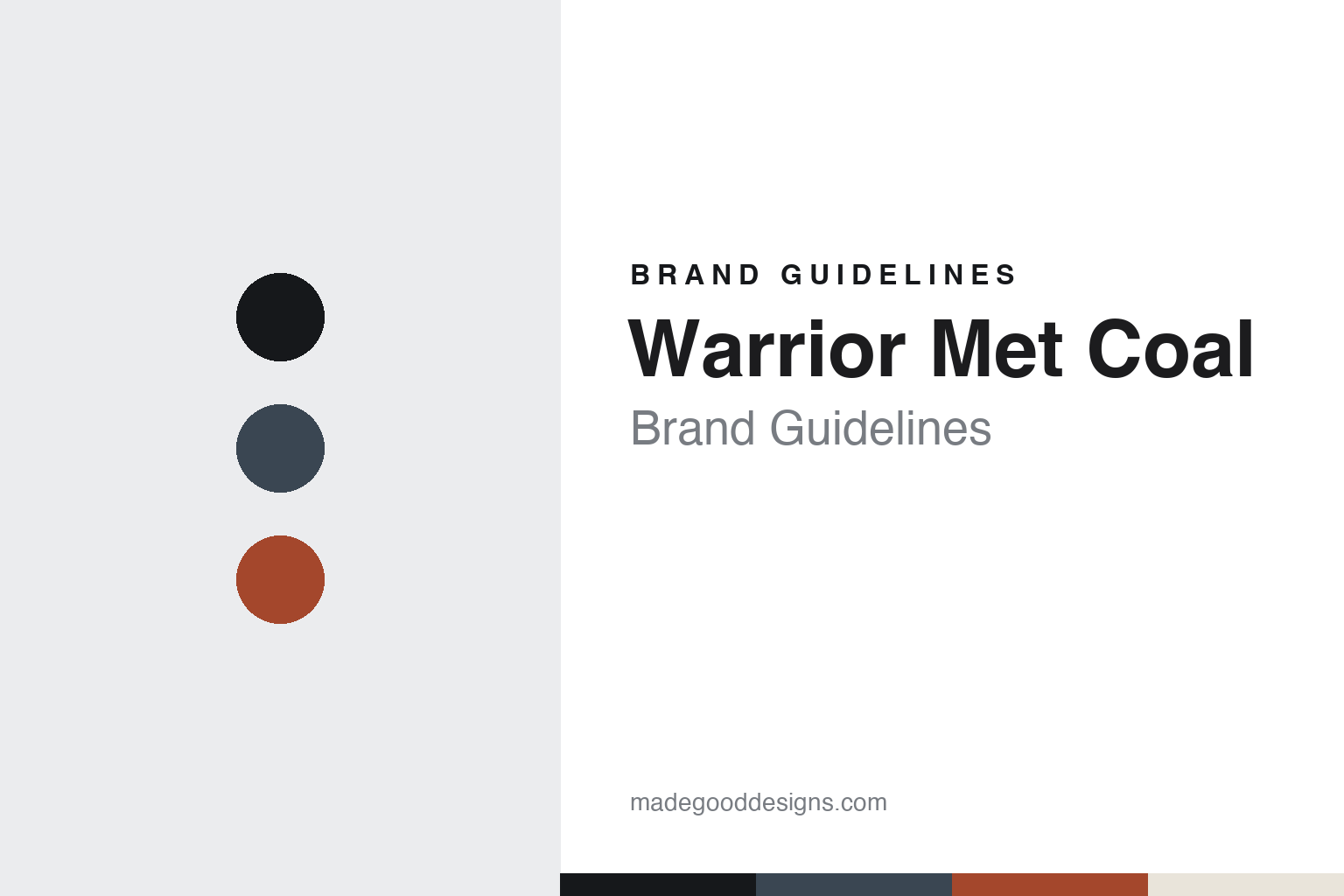
Two constants: a seam black, steel blue-grey and red clay palette and a condensed industrial sans register. Abstract homage — not a Warrior Met Coal product or mark; no logo, photograph or nameplate is reproduced.
Coal Acquisition
A company born in an Alabama bankruptcy court.
Warrior Met Coal was created to take over a mining business rather than to start one. On 1 April 2016 Walter Energy announced, in a release distributed by PR Newswire, that it had closed the sale of “substantially all” of its core assets, its Alabama coal operations, to Warrior Met Coal, LLC, formerly known as Coal Acquisition LLC, an entity owned by Walter Energy’s first-lien creditors. The sale took effect at the end of 31 March 2016. The Bankruptcy Court for the Northern District of Alabama had approved it on 8 January 2016, after a court-supervised auction, under section 363 of the US Bankruptcy Code. Walter Energy said that with the sale it had transferred virtually all of its US operating assets to third parties; earlier in 2016 it had sold its non-core US assets to affiliates of ERP Compliant Fuels.
The new company kept the mines and the place. It is based in Brookwood, Alabama, in Tuscaloosa County, and says it has been in operation since 2016 and employs more than 1,400 people. Its two longer-running underground mines, Mine 4 and Mine 7, are longwall operations; the company says Mine 7 runs two longwalls and Mine 4 one, and that its coal is cleaned at three preparation plants, one of them at the closed Mine 5, which is linked to Mine 7 by an overland conveyor. The company estimates that Mine 4 and Mine 7 hold about 91.4 million metric tons of recoverable reserves, roughly 40 years of life under the current mine plan.
A year after the purchase the company went public. Its own release of 19 April 2017 says its shares began trading on the New York Stock Exchange on 13 April 2017 under the symbol HCC; the shares in the offering were sold by existing stockholders, so the company itself received none of the proceeds. Warrior Met Coal, Inc. still trades under that symbol.
Colour
Steelmaking coal and the Blue Creek seam.
Warrior sells one kind of product. The company says it is “dedicated entirely” to mining non-thermal steelmaking coal, also called metallurgical or coking coal, and describes itself as the sole US producer of exclusively steelmaking coal. Its coal comes from the Blue Creek coal seam, which the company says is very low in sulphur, has strong coking properties and is similar in quality to the premium steelmaking coal produced in Australia. The company says its coal is mined from 1,800 feet below the surface.
Geography shapes the business. Coal travels from central Alabama to the McDuffie Coal Terminal at the Port of Mobile, and the company says it sells to steelmakers in Europe, South America and Asia and that its coal makes up half of all exports through the port. Its website leans on that route, promising short transit times to customers around the Atlantic.
The newest mine carries the seam’s name. On 8 January 2026 Warrior held a ribbon-cutting to mark the completion of the Blue Creek Mine in Tuscaloosa County, a single-longwall mine that the company expects to produce an average of about six million short tons of metallurgical coal a year over its first ten years, raising its nameplate capacity by about three-quarters. The project includes a rail load-out in Fayette County, a barge load-out in Walker County and a curved overland belt carrying clean coal to the rail facility. Partners named in the company’s release include Norfolk Southern, which is investing in its rail corridor to the Port of Mobile, and the Alabama Port Authority, which is modernising the McDuffie terminal. On 13 January 2026 the company said two of its subsidiaries had been awarded federal coal leases by the Bureau of Land Management through its Lease By Application process.
Typography
How coal companies present themselves.
Coal companies rarely sell to the public, so their identity work is aimed at investors, governments, customers in power and steel, and the communities around their mines. The visual language that follows is one of scale: draglines working an open pit, haul trucks on benched slopes, trains on loading loops and ships at export terminals. Peabody’s own description of itself as a supplier of “essential products for the production of affordable, reliable energy and steel” names both of the markets those pictures serve.
Alongside the pit photography sits a second register: the land after mining. Producers publish reclamation and rehabilitation pages, biodiversity and water sections, and reports on safety and community relations. Peabody, for example, groups climate, land, water, safety, human rights and cultural heritage under one sustainability menu on its website, and says it plans progressive restoration of land disturbed by mining.
A third theme is the future of the product itself. Thermal coal for power and metallurgical coal for steelmaking are often reported as separate businesses; Peabody, for instance, lists its mines under “Seaborne Metallurgical,” “Seaborne Thermal,” “Powder River Basin” and “Other U.S.” headings. Some producers point to other energy projects; Coal India, for one, describes a solar project in Gujarat on its own website. How much weight a company gives each story varies, and the guides in this round report what each one says rather than judging it.
The most consistent document in the category is the annual report, with its maps of mines, its tables of operations and its photographs of crews and equipment. For a designer, that report is often the clearest record of how a coal company wants to be seen: the identity is less a logo than a set of repeated scenes, from the open cut to the rail line to the restored hillside.
Aa
A condensed industrial sans for a single-product miner. (Specimen set in Archivo Narrow, a sans STAND-IN; NOT the Warrior Met Coal logo.)
Warrior Met Coal
A strike, a new mine and a single product.
The company’s history also includes a long strike. Its contract with the United Mine Workers of America was due to expire on 1 April 2021, the company said in a statement the day before, adding that the union had declared a strike while talks continued and that it had plans in place to keep supplying key customers. About a thousand miners stayed out for close to two years. On 28 February 2023 NPR reported that the union had asked Warrior Met Coal to take the strikers back unconditionally, without the better pay and benefits they had sought, and described the outcome as a loss for the union.
Warrior’s public face is plain and industrial. Its website pairs mine and plant imagery with short headline phrases such as “Mined for Manufacturing” and “Empowering Industry Every Day”, a running share-price ticker and quick-fact panels on capacity, export markets and reserve life. It publishes an annual corporate responsibility report; the 2025 edition was released in February 2026.
For a design guide, Warrior Met Coal shows how a company built from another firm’s assets can present itself through one product and one route to the sea. Compare Core Natural Resources and Peabody, two other US coal producers. For this guide we use seam black, a steel blue-grey and a red-clay accent with a condensed sans, an unofficial interpretation; no product or logo is reproduced.
Explore & save
Keep Warrior Met Coal’s identity on hand — save it to a board in the Made Good inspiration library.
Warrior Met Coal identity set
Pin the Warrior Met Coal seam black, steel blue-grey and red clay palette and the condensed sans register to your own board.