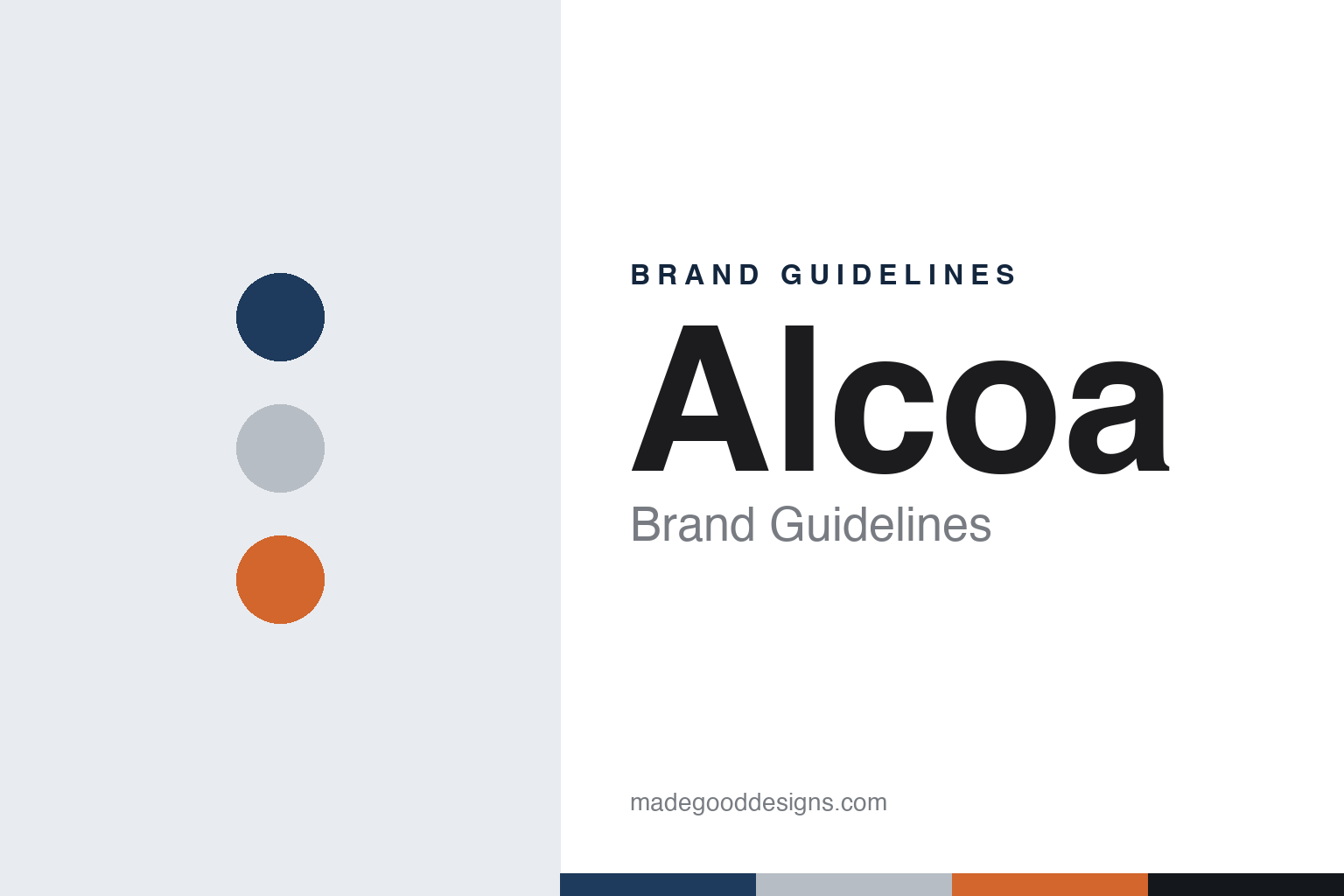
Alcoa Brand Guidelines
The 1888 Pittsburgh Reduction Company and its 2016 split.
Aa
Two constants: a navy, silver and orange palette and an industrial sans register. Abstract homage — not an Alcoa product or mark; no logo, ingot stamp or product is reproduced.
The Pittsburgh Reduction Company
A chemist’s process and Pittsburgh backers.
Alcoa’s story starts with a process. In 1886 the young chemist Charles Martin Hall found a way to make aluminium by electrolysis, working in a woodshed at his family’s house in Oberlin, Ohio, the International Directory of Company Histories says; the company’s own timeline adds that he worked with his sister Julia. Around the same time the French chemist Paul Héroult arrived at the same method, which is why the industry calls it the Hall–Héroult process. Before it, aluminium was difficult and costly to refine, Wikipedia says; Hall’s discovery promised to make production economical for the first time, the Directory says.
The company was founded in Pittsburgh in 1888 as The Pittsburgh Reduction Company. English Wikipedia names Hall as founder, with the financial backing of Alfred E. Hunt and Arthur Vining Davis; the International Directory of Company Histories describes a group of backers headed by Hunt, a metallurgist from the steel industry. Alcoa says the first pilot plant stood on Smallman Street and that operations moved to nearby New Kensington in 1891. To build demand for a metal few people used, the firm went into cookware: it formed the Aluminum Cooking Utensil Company in 1901, which sold under the Wear-Ever name, the Directory says. By about 1903, while its patents were in force, it was the only legal supplier of aluminium in the United States, according to Wikipedia.
The name followed the business. On 1 January 1907 the firm became The Aluminum Company of America, and the short form “Alcoa” was coined around 1910, Wikipedia says; the company says the word was first used for a company town in Tennessee, where a plant opened in 1911. It took “Alcoa” as its official corporate name only at the end of the century: Wikipedia and the Directory give 1999, when it became Alcoa Inc., while the company’s timeline places the decision in 1998. In 1928 it spun off almost all its foreign operations as Aluminum Limited of Montreal, the business later known as Alcan.
Colour
War work, an antitrust ruling and new rivals.
Both world wars shaped the company. Production rose by about 40% during the First World War, and in both wars about nine-tenths of American aluminium went to military uses, Wikipedia says. During the Second World War the government financed new plants that Alcoa built and ran, the International Directory of Company Histories reports, while also encouraging other producers.
Those plants became part of the answer to a long antitrust case. The Justice Department filed suit in 1937 charging monopolisation, the Directory says; the trial ran from 1938 to 1940 and a district court found for Alcoa in 1942. On 12 March 1945 the Court of Appeals for the Second Circuit, in an opinion by Judge Learned Hand, ruled in United States v. Aluminum Co. of America that the company held an illegal monopoly of the domestic aluminium ingot market, an EBSCO Research Starters article (2021) records. The wartime government plants were then sold to two new rivals, Reynolds Metals and Henry Kaiser’s Permanente Metals, which became Kaiser Aluminum & Chemical, and a court decree in 1950 settled the shape of the industry, the Directory says.
Alcoa’s own history page dwells on applications rather than courtrooms. It says aluminium supplied by the Pittsburgh Reduction Company was cast into the engine block and crankcase of the Wright brothers’ 1903 Flyer, that it introduced aluminium foil to America in 1910, and that it worked with Pittsburgh Brewing on pull-tab cans of Iron City beer in 1962. It also points to the Alcoa Building in downtown Pittsburgh, completed in 1952 with an aluminium exterior and used as headquarters for more than 40 years, and to the aluminium space frame of the 1994 Audi A8, built with techniques the company says it developed.
Typography
Metal, light and labels.
Aluminium companies sell a grey metal that most people never see in its raw form, so their imagery leans on the moments when it glows. The potline, a long hall of electrolytic cells, and the casthouse, where molten metal is poured into ingots, slabs and billets, are the scenes that recur in annual reports and recruitment pages: orange light, heat-resistant suits and stacked bars of silver metal.
Further down the chain, the pictures change to finished forms. Rolling mills show coils of sheet and foil; marketing pages turn to beverage cans, window frames, aircraft panels and car bodies, the places where buyers meet the metal. Producers also photograph the smelter itself from a distance, sometimes beside the dam, hydro station or power plant that feeds it, since smelting is done by electrolysis and runs on a steady supply of electricity.
Over the past decade, low-carbon metal has become a brand category of its own. Producers give named labels to aluminium made with hydropower or other low-emission electricity and publish carbon figures alongside them; Rusal markets metal under the ALLOW name and Alcoa uses its Sustana family, the companies say. Recycling programmes, scrap collection and remelting are presented in the same frame, and sustainability reports, with their landscapes, maps and charts, have become one of the main design documents these companies publish.
For a designer, the category is a study in contrast: heavy industry, huge sites and molten metal on one side, and on the other a clean, technical language of labels, figures and finished products used to present it to buyers and the public.
Aa
An industrial sans for a Pittsburgh metal maker. (Specimen set in Archivo, a sans STAND-IN; NOT the Alcoa logo.)
Alcoa
Upstream again since 2016.
The modern company is the result of a split. Alcoa bought competitors in the 2000s, among them Reynolds Metals in 2000, the International Directory of Company Histories says. In June 2016 Alcoa Inc. announced it would divide itself, and on 1 November 2016 the split was completed: the old Alcoa Inc. was renamed Arconic and took the business of designing and making processed metal parts, mainly for cars and aircraft, while a newly created Alcoa Corporation took the bauxite mining, alumina refining and aluminium smelting and kept the name, Wikipedia says. Its top executives had moved to New York in 2006; headquarters returned to Pittsburgh effective 1 September 2017, according to Wikipedia.
For decades Alcoa ran its mines and refineries through Alcoa World Alumina and Chemicals (AWAC), a joint venture with the Australian company Alumina Limited. Alcoa announced in February 2024 that it would acquire Alumina Limited in an all-stock deal, and the purchase was completed in August 2024, giving it full ownership of AWAC, Wikipedia says. Its Western Australian operations include the Huntly and Willowdale bauxite mines. On the product side, Alcoa says it formed the ELYSIS joint venture in 2018 to commercialise a new smelting technology it invented, joined the International Council on Mining and Metals in 2019, and added EcoSource, which it calls a low-carbon alumina brand, to its Sustana line in 2020.
For a design guide, Alcoa shows how a company named after a material can keep that name through a century of renaming and restructuring, from a Pittsburgh process patent to a pure upstream producer. Compare Norsk Hydro, the Norwegian aluminium producer, and Kaiser Aluminum, whose forerunner Permanente Metals bought wartime plants that Alcoa had run. For this guide we use a deep navy, a cool silver and a warm orange with a sans, an unofficial interpretation; no product or logo is reproduced.
Explore & save
Keep Alcoa’s identity on hand — save it to a board in the Made Good inspiration library.
Alcoa identity set
Pin the Alcoa navy, silver and orange palette and the industrial sans register to your own board.